
More recently, based on various case-studies, we highlighted why these economists understood that Public Money Creation does not need to be hyperinflationary. Accordingly, we are trying to keep a record of the various people who share Keynes’s and Friedman’s understanding of Public Money Creation. Most recently, Janet Yellen, Chairwoman of the US Federal Reserve announced that the FED would ‘legitimately consider‘ using a form of Public Money Creation in exigent circumstances.
Did you know that there are a number of other economists in influential circles that also endorse Public Money Creation?
Prominent Policy Makers thinking about different types of QE
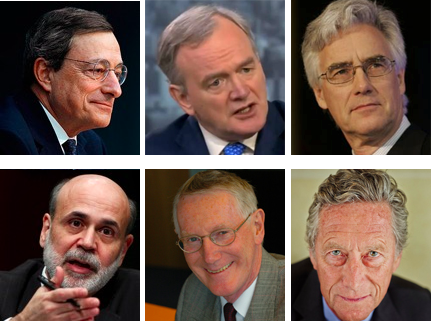 “’Helicopter
money’ – by which we mean overt money finance of increased fiscal
deficits – may in some circumstances be the only certain way to
stimulate nominal demand, and may carry with it less risk to future
financial stability than the unconventional monetary policies currently
being deployed.”
“’Helicopter
money’ – by which we mean overt money finance of increased fiscal
deficits – may in some circumstances be the only certain way to
stimulate nominal demand, and may carry with it less risk to future
financial stability than the unconventional monetary policies currently
being deployed.”Lord Adair Turner- Member of UK Financial Policy Committee, former Chairman of Financial Services Authority
Read more
Prominent Academics who advocate a different type of QE
 “I
would have used the capacity of central banks to create money by making
a direct injection into individuals bank accounts on a pro rata basis,
complicated to work out how, but basically injecting money into peoples
bank accounts, on the condition that those people who are in debt pay
there debts down so that way you have private debt cancellation coming
out of it, not therefore not only benefiting debtors but also benefiting savers who would also get it, and rather than paying down
their debts down they would get an increase in cash levels…Its a very
indirect and expensive way of getting very little bang for your buck…”
“I
would have used the capacity of central banks to create money by making
a direct injection into individuals bank accounts on a pro rata basis,
complicated to work out how, but basically injecting money into peoples
bank accounts, on the condition that those people who are in debt pay
there debts down so that way you have private debt cancellation coming
out of it, not therefore not only benefiting debtors but also benefiting savers who would also get it, and rather than paying down
their debts down they would get an increase in cash levels…Its a very
indirect and expensive way of getting very little bang for your buck…”Professor Steve Keen, Kingston University, UK
Read more
Prominent Politicians who advocate a different type of QE
 “If the majority view is that quantitative easing is necessary, we need to ask this question: why not inject those funds into the real economy—into
housing and energy projects of the kind that Opposition Members have
spoken about—rather than using the mechanism in a way that clearly
benefits only very few people within the world of financial and banking
wizardry that we are discussing?”
“If the majority view is that quantitative easing is necessary, we need to ask this question: why not inject those funds into the real economy—into
housing and energy projects of the kind that Opposition Members have
spoken about—rather than using the mechanism in a way that clearly
benefits only very few people within the world of financial and banking
wizardry that we are discussing?”Zac Goldsmith, Conservative MP
Read more
Prominent Economists working in the financial sector that advocate a different type of QE
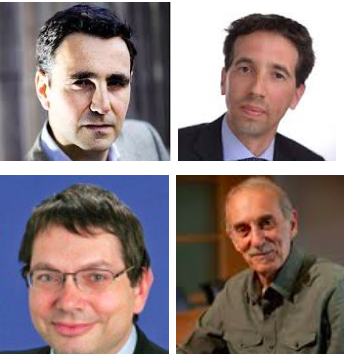 “Rather
than trying to spur private-sector spending through asset purchases or
interest-rate changes, central banks, such as the Fed, should hand
consumers cash directly. In practice, this policy could take the form of
giving central banks the ability to hand their countries’ tax-paying
households a certain amount of money. The government could distribute
cash equally to all households or, even better, aim for the bottom 80
percent of households in terms of income. Targeting those who earn the
least would have two primary benefits. For one thing, lower-income
households are more prone to consume, so they would provide a greater
boost to spending. For another, the policy would offset rising income
inequality.”
“Rather
than trying to spur private-sector spending through asset purchases or
interest-rate changes, central banks, such as the Fed, should hand
consumers cash directly. In practice, this policy could take the form of
giving central banks the ability to hand their countries’ tax-paying
households a certain amount of money. The government could distribute
cash equally to all households or, even better, aim for the bottom 80
percent of households in terms of income. Targeting those who earn the
least would have two primary benefits. For one thing, lower-income
households are more prone to consume, so they would provide a greater
boost to spending. For another, the policy would offset rising income
inequality.”Eric Lonergan, Fund Manager and Author of ‘Money: The Art of Living’
Read more
Prominent Journalists who advocate a different type of QE
 “The
Case for Helicopter Money…What makes this policy so powerful is the
combination of fiscal spending with monetary expansion: Keynesians can
enjoy the former; monetarists the latter. Provided the decision on the
scale of financing rests in the hands of the central bank and it, in
turn, looks at the impact of the policy on the economy, this need not
even generate high inflation, let alone hyperinflation.”
“The
Case for Helicopter Money…What makes this policy so powerful is the
combination of fiscal spending with monetary expansion: Keynesians can
enjoy the former; monetarists the latter. Provided the decision on the
scale of financing rests in the hands of the central bank and it, in
turn, looks at the impact of the policy on the economy, this need not
even generate high inflation, let alone hyperinflation.”Martin Wolf, Chief Economics Commentator at the Financial Times
Read more
Prominent Activists and Special Advisors who advocate a different type of QE
 “Would
direct reflation of the economy through a modern Debt Jubilee,
“helicopter money” and/or a money-financed investment programme have
worked better? I am one of many who think it would. We need investment,
yes, but while interest rates remain low we can have this through
conventional bond financing at little cost. To my mind the attention of
the new Labour party leadership should be elsewhere.”
“Would
direct reflation of the economy through a modern Debt Jubilee,
“helicopter money” and/or a money-financed investment programme have
worked better? I am one of many who think it would. We need investment,
yes, but while interest rates remain low we can have this through
conventional bond financing at little cost. To my mind the attention of
the new Labour party leadership should be elsewhere.”Frances Coppola
Read more




Nessun commento:
Posta un commento