lunedì 29 luglio 2019

The Coming Savings Writedowns

The Coming Savings Writedowns


Photograph Source: Michielverbeek – CC BY-SA 4.0</>

Debts that can’t be paid, won’t be. That point inevitably arrives on the liabilities side of the economy’s balance sheet.

But what of the asset side? One person’s debt is a creditor’s claim for payment. This is defined as “savings,” even though banks simply create credit endogenously on their own computers without needing any prior savings. When debts can’t be paid and debtors default, what happens to these creditors?
As President Obama showed, banks and bondholders can be bailed out by new Federal Reserve money creation. That is what the $4.6 trillion in Quantitative Easing since 2008 was all about. The Fed has spent the last few years supporting stock market prices (and holding down gold prices) by manipulating the forward option markets.

But this artificial life support to keep the debt overhead afloat is nearing the reality of the debt wall. The European Central Bank has almost run out of available euro-bonds to buy. The new fallback position to keep the increasingly zombified U.S. and Eurozone financial markets afloat is to experiment with negative interest rates.

Writing down savings by a few percentage points helps bring the glut of creditor claims marginally back towards balancing bank deposits with the ability of debtors to pay. But such marginal moves are rarely sufficient. A quantum leap is needed.

Governments have long followed a basic guideline when faced with a need to devalue their currencies (for instance, as the dollar was devalued against gold in 1933). Nothing is worse for a politician or central banker than to be overly shy when it comes to devaluation. The motto is, “Always depreciate to access.” That means at lest 25 percent, often a third when a basic structural adjustment is needed.

The recent experiment in negative interest rates writing down savings as a necessary compliment to the inevitable debt writedowns means that financial policy makes are beginning to fact the hitherto unthinkable fact that many zombie companies and debtors have no foreseeable means of paying the amounts that they owe on paper.

The tendency of debts to grow exponentially at rates in excess of the economy’s ability to create an economic surplus to pay creditors has been known for nearly 5,000 years. My book “… and forgive them their debts” describes how ancient Near Eastern rulers recognized the inherent tendency of financial dynamics to cause instability, leading to debt bondage and forfeiture of land to creditors.
To prevent this rising indebtedness from tearing their realms apart, rulers started their first full year on the throne by clearing away the overhang of arrears that had been accruing on personal and agrarian debts. The aim was to restore an idealized “mother condition” in which bondservants were liberated, able to start with a Clean Slate with their self-support land returned to them, in balance with regard to their income and outgo.

An analogy would be the idyllic condition that the U.S. economy would achieve if we could restore the financial situation that existed in 1945. The end of World War II left an economy in which most families were almost debt-free. Families and businesses and were rife with cash, as there had not been much opportunity to spend during the wartime years, and the Great Depression had wiped out substantial debts. Returning soldiers were able to start families and buy homes by committing to pay only 25 percent of their income for 30 years. This era was as close as the United States came to a Clean Slate. Today it seems an unrecoverable golden age – as the ancient Near East seemed to be to debt-wracked imperial Rome.

Germany’s Economic Miracle consisted of its Allied Monetary Reform of 1948 – a Clean Slate erasing most personal and business. That debt cancellation was fairly easy because most debts were owed to Nazis, and the Allies were glad to see their savings claims for payment wiped out.

Fast forward to today: Indebted students graduate with an obligation to pay so much education debt that they cannot qualify for mortgages to buy homes of their own. Marriage rates are down, U.S. home ownership is plunging, and rents are rising. Automobile debt also has soared, leading to rising default rates second only to student debt defaults. The overhang of junk-mortgage debts that crashed the economy in 2008 remains on the books of families who managed to survive the ten million foreclosures under the Obama bailout of Wall Street. (His constituency turned out to be his Donor Class, not the junk-mortgage victims among his voters. He characterized them as “the mob with pitchforks” to the banksters he invited to the White House to celebrate his bailout.)

By driving down interest rates, the Fed’s policy of Quantitative Easing has subsidized an enormous debt buildup without increasing the interest burden proportionally. This has enabled corporations to carry much higher debt and even indulge in leveraged buyouts and stock buyback programs.

This QE policy has made financial engineering much more enriching than industrial engineering. But it has painted the U.S. and European economies into a corner. At some points interest rates will inevitably begin to rise back up. Some countries will have to increase rates in order to borrow to stabilize their exchange rates when their balance of trade and payments falls into deficit. Other countries will simply see that the game is over and will give up the pretense that the personal, corporate and public-sector debt overhead can be paid.

It is to prepare for this inevitable eventuality that Europe is experimenting with its trial run of negative interest rates. Once the technique is established, it will prepare the way for the inevitable step of writing down national savings in line with the economy’s ability to pay.

That ability is shrinking much more than at any time since the 1920’s, which gave way to the Great Depression despite the many debt writedowns of 1931-32. The exponential mathematics of compound interest have created more and more claims on personal income and corporate cash flow, leaving less and less to be spent on goods and services.

Until a debt writedown occurs, storefronts will continue to close, arrears will mount, students will continue to postpone marriage and family formation, high-risk bonds will begin to give way and default.

That should be what economic theory is all about. But for the past generation, economic models have pretended that banks and creditors act responsibly enough not to make bad loans. Pension fund managers pretend that they can provide for future retirement by corporate or public employees by earning 8 percent annually ad infinitum, doubling every 7 years, as if this is really possible in an economy not really growing outside of the Finance, Insurance and Real Estate (FIRE) sector (and even so, growing at only 1 or 2 percent). How then can the economy pay its debts without imposing financial austerity much like Third World countries subjected to IMF austerity programs?

Today’s economic orthodoxy denies that this debt problem can exist. Debt dynamics and the exponential growth curve of compound interest does not exist in the parallel academic universe that somehow has been situated in the social science department instead of the literature department as science fiction.
Perhaps someday a revamped economics curriculum will include the study of history to see how earlier societies have coped with the inherent tendency of debts to increase faster than the ability to be paid. It is a long history with many examples. Western civilization has failed to solve the financial problem that Near Eastern societies were able to cope with by intervening from “outside” the economy.

But these formative debt experiences are as repressed today as sexual drives repressed academically before the work of Freud. Academic economists are financial prudes. Debt cancellation is historically the solution. Quantitative Easing and bailouts of the One Percent can only be a temporary substitute. We should think of them as “abstinence” from recognizing the need to write down bad loans (“savings”) along with the bad debts.

More articles by:
Michael Hudson is the author of Killing the Host (published in e-format by CounterPunch Books and in print by Islet). His new book is J is For Junk Economics.  He can be reached at mh@michael-hudson.com

mercoledì 3 luglio 2019

Clandestine Finance

Clandestine Finance
Extracted from: "Athenian Economy and Society - A Banking Perspective" by Edward E. Cohen, Princeton University Press, 1997
https://press.princeton.edu/titles/5125.html


The tale of Theophemos's violent efforts to execute on a judgment illustrates the complex interplay of tax burdens, creditor avoidance, bank deposits, and the invisible economy. Seeking to collect over 1,200 dr., Theophemos attacked a judgment-debtor's home. But instead of the ample personal property that he had anticipated, he was able to carry off only a small amount of furniture. The debtor explains that "through liturgies and capital-tax payments (eisphorai) and my liberality to the state, part of my property had been pledged as security for loans, and the rest had been sold." 76 (In other words, his wealth had been transferred from the visible to the invisible sphere, for protection from such onslaughts by creditors). In their frustration, the raiding party allegedly even maltreated the women of the house. But the debtor, protected by his bankers from taxation and creditors, was able to plead self-righteously: "Theophemos should have followed me to the bank to recover his judgment, instead of seizing property"; "my wife told them that the money was waiting for them at the bank." 77

But these assertions are made only much later: by this time, the assets might have been further transferred or transformed. Perhaps the statements actually reflect some aspect of the truth—since they are made in court in a suit charging Theophemos's associates with perjury! In any event, they reflect a story intended to be credible to the jurors: a claim that a person believed to be wealthy, overwhelmed by taxes and assailed by creditors, kept little tangible property but held large deposits "at the bank" (epi tëi trapezei). As a practical matter, invisible banking assets were not as accessible to third parties as this pleader suggests. Even the prominent Kallippos, proxenos of the Hèrakleotes, inquiring at a bank as to possible deposits belonging to a deceased Hërakleöte, was dismissed by a slave functionary with the derisive, "And what business is it of yours?" 78

Bankers also made loans in secrecy. A prominent example is the loan transaction in which the banker Hërakleidës supplied the bulk of the monies but did not appear as a named creditor (see above, pp. 155—57). Through the process of bank intermediation (dia tës trapezës), trapezai shielded the identity of depositors whose "invisible" assets funded maritime loans (see above, pp. 151—60).

In a lawsuit indirectly relating to bank assets, the bank owner Apollodoros alludes to the role of the Athenian trapeza as an intermediary in providing profitable investment opportunities for monies otherwise concealed by their owners (Dem. 45.64—66; see above, pp. 115—18). Through a number of banks, Demosthenes' ubiquitous father was able to invest in maritime loans and to obtain preferential returns without public disclosure (see above, pp. 121—29).

When silent payments were required to settle political disputes or to forestall prosecutions, bankers frequently provided the funds, anonymously. When a trapezitès merely approached a prominent leader who was planning a politically explosive prosecution, it was widely assumed— "Here we go again!" 79 —that money was being delivered to settle a claim in which the banker himself had no involvement. Hence the ridiculous position forced on Demosthenes, who had been insulted by Meidias during the festival of Dionysos, and was approached shortly thereafter by the banker Blepaios. In order to defuse expectations that Meidias was buying freedom from prosecution for his gross violation of Athenian propriety and law, Demosthenes felt it necessary, even amidst a crowd of spectators, to "let my cloak drop so that I was left almost nude in my tunic," thus showing by his half-nakedness that he was not accept-ing secret payments from the trapezites, 80 a testimonial to the general populace's association of bankers and clandestine arrangements.

Only occasionally, in exceptional circumstances, did the actual arrangements underlying this public perception became publicly known. In the most spectacular example, the sacred Opisthodomos, part of the Acropolis complex, was actually burned down by the Treasurers of Athena in a desperate effort to avoid disclosure of their secret bank deposits of public monies supposed to be lying in their trust untouched on the sacred hill. When the trapezai were unable to repay the deposits, the Treasurers resorted to arson in a vain attempt to keep their bank activity secret. The ensuing investigation revealed their wrongdoing, resulting in their imprisonment—and confirming the popular association of banking with the unseen economy. 81

Athens was threatened with serious diplomatic contretemps when Satyros, the king of Pontos, sought the return of funds which had been brought to Athens by the son of an important royal associate who had later fallen into disfavor (Isok. 17.3ff.). Because the enormous sums were all that had been salvaged from the family's wealth, the son was reluctant to hand over the funds. 82 But since Athens was highly dependent for food on imports from the Pontic kingdom, 83 the son's outright refusal to return the monies would have resulted in the Athenians' returning him to Pontos 84—as required by traditional notions of xenia and practical political considerations. 85 In the world of disclosed assets, no satisfactory resolution was available. But in the parallel economy of invisible assets, a Solomonic solution was provided by the son's banker: "Agree to do everything that the king has ordered; hand over the monies that are visible (phanera); but as to the funds on deposit at the bank, not only deny their existence, but even reveal (phainesthai) that you are in debt on yield-bearing obligations to the bank and others." 86 The son claims that he did so. After a reconciliation between his father and the king, the Pontian was now free to withdraw his deposits from the bank and return them to the "visible" world. 87 But when he seeks to recover these funds, the banker claims that the son's earlier assertions had been true: there were no net funds on deposit at the bank, only loans. 88

Although the actual facts underlying the parties' dispute cannot be determined - indeed, we can only speculate as to who prevailed in the litigation 89 - the case provides unique information about otherwise hidden business and trapezitic practices, and insight into the scale and functioning of banking in the unseen economy. Unlike similar situations where the parties' mutual interests and fears might have kept the dispute out of court and the transactions secret, this litigation could be safely and openly pursued through an Athenian tribunal, even though it exposes the "unseen" economy of Athens: the Bosporan plaintiff had sought to evade not Athenian taxes, but Bosporan claims, and his family's reconciliation with the ruler of the Pontic kingdom left him free to claim the funds without fear of the Bosporan authorities.

Thus we glimpse bank activity that would otherwise have remained unseen and undisclosed. The Bosporan's deposits were significant enough to secure loans of no less than seven talents (42,000 dr.; §44); he had exchanged gold bullion for currency having a value of about four talents (24,000 dr.). 90 These sums represented enormous purchasing power, many thousands of days of skilled labor. 91 Yet in argumentation based on proofs from "probability" and "plausibility," 92 as was usual in Athenian courts, there is no suggestion that these huge amounts were incredibly beyond the normal scope of trapezitic operations (although this argument would have significantly aided the banker's defense). To the contrary, we are told explicitly that Athenian bankers, because of their reputation for integrity, were able, in secrecy, to obtain and work with large amounts of currency. 93

This link at Athens between banking and the hidden economy was fostered by business procedures: the unique lack of witnesses for banking obligations, 94 and the special legal recognition accorded to banking records. 95 All other Athenian commercial transactions required witnesses, even for written obligations; 96 the simple written receipt was unknown. 97

These considerations evoked, in nonbanking transactions, strong dependence on third-party witnesses, and a correspondent lack of confidentiality. In contrast, funds delivered to a trapezitës were known only to the banker, or at most to the group of family members who helped in the operation of the trapeza (see above, pp. 70—82).

Indeed, the widespread use of bankers to effectuate and monitor business transactions seems an effort to obtain the advantages of bankers' commitment to secrecy. 98 Although bankers normally did maintain written records of their transactions, the verb aphanizein ("to erase") came to refer to banking transactions that were omitted even from the banks' internal records. 99

In foregoing written references to the deposit of funds, the trapezitai themselves ran no financial risk. To the contrary, in the event of dispute the banker could rely on his records—with their high evidentiary significance—to establish the absence of deposits, and thus to avoid a claim for return of funds. (The banker's defense in Isokrates 17 is based on this contention.) But loans engendered more complex considerations. To forestall later denials by debtors, lenders needed witnesses who could confirm that the requisite monies had actually been advanced to the borrowers. 100 This public procedure necessarily rendered visible (phaneron) funds that had been held as "invisible" assets. 101

Since borrowers would seek similar public knowledge of repayment, return of monies generally occurred before an assemblage of onlookers: the bank loan of 3,000 dr. in Demosthenes 33, for example, was repaid before a large crowd, which also witnessed the destruction of the relevant loan documentation. 102 This publicity provided prime motivation for the making of maritime loans "through the bank." For persons seeking to keep their assets unseen, direct loans were not feasible. But bankers used as intermediaries would keep assets "invisible."

Identification of a banker as "the lender" revealed nothing as to the true source of funds. Because of the bankers' intermingling of trapezitic funds with depositors' money, even the limited use of depositors' money could not be assumed by spectators observing the disbursement or repayment of bankers' loans.

Where trapezitai held documents, the public would know nothing about the actual source of funds—especially since the loan documents were destroyed at the time of the repayment. Where individuals did make loans with their own funds and in their own names, 103 the public acknowledgment inherent in such financings could be followed by the return of the repaid funds to the invisible (aphanes) sphere — by deposit with a banker ! 104


lunedì 1 luglio 2019

Seigniorage Fraud Hazard Awareness

 "It is not clear how much seigniorage commercial banks appropriate."
- Martin Wolf, Chief Economics Commentator, Financial Times

The current narrative completely omits the problem of clandestine seigniorage which is appropriated by both central banks and commercial banks. Once the critical mass of the public realizes it, it will no longer have any confidence in a system that has deceived it for centuries. A future currency will base its value on the trust that the public will grant it for the honest management of seigniorage. Nobody talks about it. It's too sad for them. See: Accounting Meets Economics: Towards an 'Accounting View' of Money https://papers.ssrn.com/sol3/papers.cfm?abstract_id=3270860 A pilot program in seigniorage redistribution is carried on by the Universal Blockchain Income Project, here: https://universalincome.cash
More on the subject:
COMMERCIAL BANK MONEY, SEIGNIORAGE, AND THE MACROECONOMY

The “accounting view” of money: money as equity (Part I)
http://blogs.worldbank.org/allaboutfinance/accounting-view-money-money-equity-part-i
The “accounting view” of money: money as equity (Part II)
http://blogs.worldbank.org/allaboutfinance/accounting-view-money-money-equity-part-ii
The “accounting view” of money: money as equity (Part III)
http://blogs.worldbank.org/allaboutfinance/accounting-view-money-money-equity-part-iii

domenica 9 giugno 2019

ECB: Draghi Is No Longer Taken Seriously

Draghi Is No Longer Taken Seriously by Markets

Dovish comments by the ECB president sent the euro soaring, exactly the opposite of what should happen. Also, book club notes.
The President of the European Central Bank Mario Draghi is on his way out. 
The President of the European Central Bank Mario Draghi is on his way out.  Photographer: Stringer/AFP/Getty Images
To get John Authers' newsletter delivered directly to your inbox, sign up here.

Max Headroom to do whatever it takes.

When European Central Bank President  Mario Draghi speaks, markets usually take notice. Back in 2012, he effectively ended the euro zone’s sovereign debt crisis by promising to do “whatever it takes” to protect the euro. His words were so effective that the market never tested his resolve. The crisis abated, even as the economy went into a long and slow malaise.

On the face of it, his comments after the ECB monetary policy meeting Thursday, held this month in Lithuania, were almost as aggressive as those he spoke in 2012. He was obviously determined to convince all that he was prepared to be far more dovish if necessary. He even suggested that he had “headroom” to resort to more quantitative easing, or bond purchases, if necessary. And yet the market did not take him all that seriously. The euro somehow strengthened against the dollar, exactly the opposite of what should happen when a central banker hints at interest rate cuts.

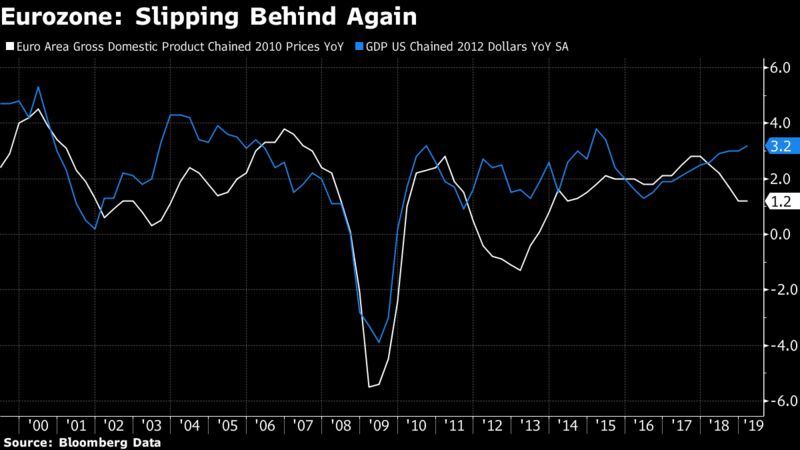
This is partly because Draghi is half way out the door, as Bloomberg Opinion columnist Ferdinando Giugliano put it. It is also because the ECB is running out of ammunition. Rates are already low, and its balance sheet is loaded. It does not have anything like as much freedom of movement as the Federal Reserve. The need to do something is clear enough. The euro zone’s economy has not lagged behind the U.S. as badly as many believe since the single currency came into being in 1999, but the latest dip, while the U.S. is gaining strength, is concerning.
Eurozone: Slipping Behind Again
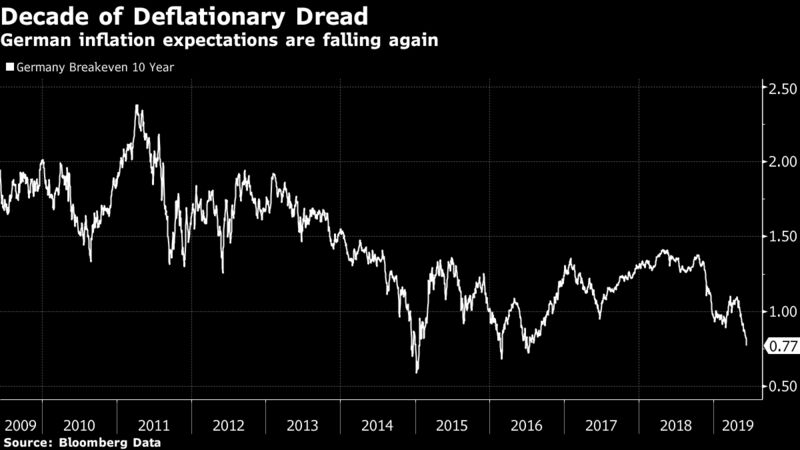
Another problem is that inflationary expectations appear to have become untethered.  The German bund market is signaling inflation of less than 0.8% per year over the next 10 years. This is lower than at any point when the sovereign debt crisis was at its height, from 2010 to 2012, and approaching its lowest since the euro’s inception. The ECB has another deflation scare on its hands:
German inflation expectations are falling again
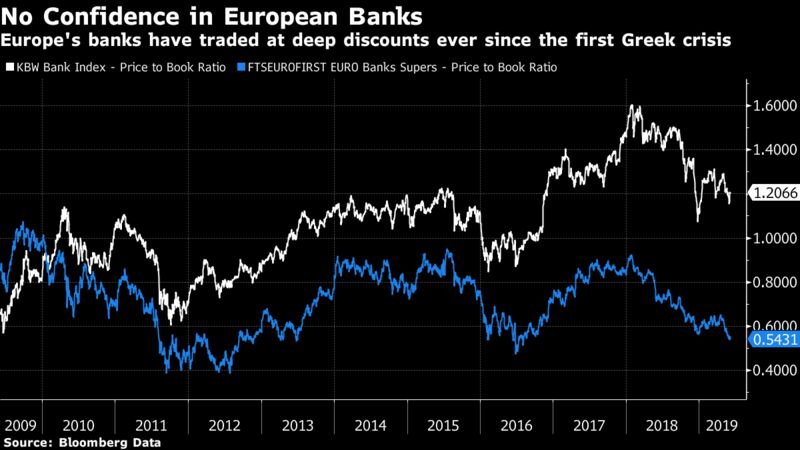
The Achilles heel responsible for Europe’s relative weakness is its banking system. The price-to-book multiple that shareholders pay for bank shares is as good an indicator of this as any. Ever since the first Greece bailout crisis broke out in early 2010, European banks have traded at a discount to their book value, and a big discount to banks in the U.S. This explains why the ECB needs to keep propping up the banking system with targeted help. But as it wants to avoid moral hazard, that help cannot be too generous, which is why I found the plans for the latest “TLTRO” loan program to shore up banks rather unconvincing.
Europe's banks have traded at deep discounts ever since the first Greek crisis
There is a decent argument that pessimism towards the euro zone has become excessive. But with the real possibility that we will have to wait months to learn the identity of Draghi’s successor – he is due to leave at the end of October, just when the U.K. is due to leave the EU – there is a nasty tail risk from the euro zone to look forward to over the summer.

sabato 8 giugno 2019

Banco Popular resolution casts long shadow over Europe's banks

Rushed Popular resolution casts long shadow over Europe's banks

Related images

  • Evolution of deposit outflows
  • Banco Popular’s final weeks
Banco Popular

At 8:33am on Monday June 5 2017, an email landed in a mailbox at Banco de Espana. A bank run was underway at Banco Popular, one of Spain’s biggest banks. Barely three minutes into the working week, the situation was already critical – Popular was running out of cash, and fast.

The email contained a formal request: Popular was appealing to the Spanish central bank for €1.9bn in emergency liquidity assistance.
For officials at Banco de Espana, the request was not unexpected. They had been working for more than two months with a team from Popular to prepare for this moment, ever since an internal audit at the lender had uncovered financial irregularities totalling hundreds of millions of euros at the end of March, irregularities that included a web of Luxembourg companies designed to hide the extent of Popular’s bad loan problem.

By 11:41am the same morning, the money was with Popular. The injection came just in time – according to people involved, the bank wouldn’t have survived another half an hour. But any relief was short-lived. As deposits continued to pour out, it soon became clear the bank would need more help. At 3:32pm, Banco de Espana received another email from the bank, this time requesting an increase in ELA to €9.5bn.

WITHIN THE LIMITS

Although high, the amount was within the limits previously discussed. Popular had €40bn of unencumbered assets available, and Banco de Espana had earlier indicated that €26bn of those would meet its secretive ELA criteria. Once haircuts – of between 35% for the best assets and 90% for the worst – were applied, officials calculated the central bank could lend Popular just over €10bn, albeit at a penal interest rate of more than 12%.

But, first, approval was needed from the European Central Bank, which had to sign off on any ELA request greater than €2bn. Despite it being a public holiday in Germany, the ECB governing council discussed the matter by phone. Popular was confirmed as solvent, and the request was approved. But what happened next came as a shock: Banco de Espana turned down the request, citing incomplete paperwork.

Popular staff worked through the night to meet the central bank’s last-minute demands, which were threatening its access to vital ELA. The bank still had €21bn of acceptable collateral left - €5bn had been used to secure the first tranche of ELA - and these issues with the paperwork hadn’t been flagged before. Banco de Espana eventually gave the green light to a further €1.9bn the next day, but it was too little, too late.

“It was embarrassing,” said one person involved. “In March we started discussions – in March! We were doing trial runs, going back and forth with the collateral. They had checked it. But the truth is they were absolutely determined not to take it. By the time they realised they had to, they just weren’t ready. We started hitting all these little hiccups, and then suddenly they told us they couldn’t do anything more.”
Popular available collateral and ELA
Popular had €26bn of collateral, entitling it to €10bn of ELA
Source: Banco de Espana

The sudden denial of ELA has puzzled many since.
“Crucially, the bank was still solvent,” said Jerome Legras, head of research at Axiom, an asset manager that focuses on banks and owned a small amount of Popular bonds. “They mostly had a cash problem. If it was possible to lend €80bn of ELA to Greek banks to keep them afloat when they were completely insolvent, then why couldn’t they do the same with Popular? There is a real problem of consistency.”

By the end of the day on Tuesday, Popular bosses concluded the bank simply could not open the next day. They notified the ECB, which declared Popular – a bank it had deemed solvent a day earlier – as “failing or likely to fail”. That morning Popular become the first, and to date only, bank to be put into resolution using new European rules brought in after the 2008 financial crisis to make bank failures more orderly.

STRUCTURAL WEAKNESSES

The mess around ELA is just one in a series of mishaps in the Popular case that have raised questions about whether the system to deal with failing banks is fit for purpose. Through dozens of interviews and a trove of confidential documents totalling thousands of pages, IFR has pieced together what happened during Popular’s final days. It is clear that, despite the bank’s problems being flagged many months in advance, when the crisis finally hit authorities found themselves ill-equipped and ill-prepared to adequately deal with the situation.

Indeed, far from being an orderly resolution, the Popular case has since become a legal quagmire. European institutions including the ECB and Single Resolution Authority, which was set up in 2015 specifically to plan for and oversee the resolution of failing banks, are now defendants in more than 100 legal cases. One common theme is that, despite plenty of warning and years of preparation, the approach of authorities was piecemeal and ad hoc.

The issue goes much wider than just Banco Popular; it has implications for the health of the entire European banking system. Since the resolution of Popular, there has been a dramatic increase in the cost of borrowing for even the healthiest of banks. While a multitude of factors is doubtless in play, many believe that the way the Spanish bank was dealt with is the biggest contributor. Investors no longer trust that failing banks will be dealt with in an orderly and legalistic way.

“It is absolutely critical that the law is complied with,” said Richard East, a lawyer at Quinn Emanuel, which is representing a group of disgruntled bondholders. “The SRB cannot make up the rules as it goes along. The EU legislator took years to design and lay down these rules in the wake of the financial crisis. Investors cannot invest with confidence if they see that the regulator is acting outside of its own rules.”

Former shareholders and bondholders of the failed Spanish bank are leading the charge for answers – and change. The two groups were hit hard: all shares were annulled, while €2bn of bonds were bailed in then written down to zero. The bank was then sold to Santander for a token €1. Investors argue that the resolution process, overseen by the SRB, was flawed. They are seeking billions of euros in compensation.

FLAWED VALUATION

Like Banco de Espana, the SRB missed vital opportunities in the run-up to Popular’s collapse that left it critically unprepared. It is clear that, as early as April, the resolution body was so concerned about the situation that, during a routine visit to visit Spanish banks in Madrid, it thought it prudent to move its long-standing meeting with Popular from the bank’s own offices to Banco de Espana, so as not to arouse any suspicions.

During the meeting, Popular’s worsening liquidity situation - more than €5bn of deposits would leave the bank that month - was discussed. That should have been cause for concern, given that almost all the SRB’s routine planning for a resolution of Popular had revolved around potential solvency issues - not liquidity problems. Despite that, the SRB critically saw no need to start a “special dialogue” with the bank at that stage.

Perhaps one reason was because the SRB knew it was seriously under-tooled to deal with a liquidity crisis. Due to a slow phase-in of funding for the resolution agency, and despite having been set up more than two years previously, the SRB had only €10bn of funds to fight a crisis, less than a quarter of its planned firepower. Internal rules also severely limited how those funds could be used.
“This was the first case in our history and all the elements were not in place,” said one person involved with the resolution process. “We built our strategy on the bail-in tool. But due to the characteristics of the crisis, it would have been difficult to implement. And we were not sure that all the tools would have been available from a liquidity perspective. At that moment, the available amount was limited.”

The person said that the SRB quickly realised that only one of the potential options in its resolution toolbox was really available: a sale of Popular to a healthier bank that could inject liquidity. Even then, it waited until May 23 to begin any serious work, when it commissioned Deloitte to put together a detailed valuation of Popular, which would inform any future sale of the bank.

HIGHLY UNCERTAIN

On May 28 the SRB ordered Deloitte to “strictly prioritise … focusing only on key assets and liabilities where there is considerable valuation uncertainty”. Three days later it called to say it that the accountancy firm had only two more days to complete its work.

As a result of the compressed timeline, when Deloitte completed the report, it warned that its findings were “highly uncertain”. It further prefaced its work with the warning that it had “not had access to certain critical information”. Reflecting this uncertainty, Deloitte’s report estimated Popular could be worth as much as €1.8bn in a best case, a negative €8bn in a worst case and a negative €2bn in a “best estimate” scenario.
Deloitte letter to Single Resolution Board
Source: Single Resolution Board

Despite the caveats, the negative €2bn number formed the basis for the sale of the bank and tallies exactly with the losses later imposed on bondholders.
On June 3, while Popular and Banco de Espana were doing final checks on the doomed ELA process, resolution authorities made contact with Santander and BBVA, piggybacking on a failed sales process (that involved five interested parties) Popular had run earlier in May. After signing non-disclosure agreements the next day, the two spent Monday and Tuesday going over Popular’s books. When Popular was declared “failing or likely to fail” on Tuesday evening, both were invited to submit binding offers.

Only one bid arrived: from Santander, for €1, but only on the condition that shareholders, AT1 holders and Tier 2 holders were bailed in.

UPPER HAND

With insufficient liquidity of its own to support Popular, and having already concluded that a winding up of the bank under normal insolvency proceeding would pose risks to financial stability, the SRB was left with little option but to accept the offer. Reports in the Spanish press allege that Santander’s own lawyers took the purchase agreement drawn up by resolution authorities and rewrote it.

“The auction was organised so quickly that it was difficult for anyone to make a serious offer, and the valuations they used to justify the sales price were also difficult to understand,” said Axiom’s Legras. “The range was enormous and the methodology looked more like doing a firesale on the entire balance sheet. With that sort of approach, any bank, even the most solid one, will look very weak.”
Critically, investors allege that the situation clearly compromised the SRB and its obligation to ensure that shareholders and bondholders were dealt with fairly. Santander had been given access to Popular’s financials as part of the private sales process for weeks, and internal presentations show it had considered paying up to €1.6bn for Popular just a few weeks before, but it held off on making an offer.
A man withdraws money from an ATM at a Spanish Banco Popular branch in Madrid
One person involved in that failed sales process said that because Popular was suddenly no longer working with its own advisers to arrange a deal, Santander held all the cards.

“Suddenly you change your counterparty from professional M&A bankers, with a whole structure of corporate governance and a board and shareholders to convince, to civil servants of something called the resolution authority who have never ever done anything like this,” said the person.

“These civil servants, who barely have the capabilities to understand how a bank is valued, are called in during the very last days with a mission – a mission impossible – to dispose of assets according to rules that were thought up years before and completely detached from the reality of the way things work and the speed at which things happen. Santander must have thought, ‘we have a great negotiating hand here’.”

INVESTOR PROTECTIONS

European lawmakers at least foresaw the possibility of a rushed resolution, and within the rules governing the SRB is a requirement to conduct an “independent” valuation of a bank after the event to determine whether or not shareholders and bondholders were short-changed, and whether they might have seen a better outcome in an insolvency. If so, compensation is due.
While the SRB says such an assessment was made, investors believe it was not “independent”. Deloitte, the same firm that did the first assessment, was asked to do it, which investors say is a clear conflict of interest. The second Deloitte report concluded that shareholder and bondholder losses would have been much greater under a normal insolvency process.

“This is the safety valve of the entire regime,” said East, the lawyer at Quinn Emanuel. “The SRB is simply making things up as it goes along; it doesn’t really seem to know what it is doing.”

“Unless there is serious and thorough review of the Banco Popular case by the EU General Court, no lessons will be learned,” he said. “This is our only hope because the SRB has vigorously denied shareholders and bondholders access to documents and data for the last two years … and will not admit that anything it did was wrong.”

The risk of botched resolutions will remain as long as the current regime remains in place, others believe.

“The process gives so much leeway and flexibility to authorities that they pretty much can do anything they want,” said Legras. “And the result is that you can end up with something that is fairly reasonable and well managed – or the exact opposite. There are very few safeguards for investors and stakeholders. It’s an open bar for the authorities.”

giovedì 23 maggio 2019

Economist Julie Nelson Says Much of Economics is a Sham

Economist Julie Nelson Says Much of Economics is a Sham Science

We undermine our survival if we continue to imagine economics as a ethics-free and care-free sphere

By Julie Nelson
Source: http://evonomics.com/pretending-hard-science-ethics-free-julie-nelson/

Most economists, rather than seeing ourselves as studying communities of human beings, pretend to a more physics-like discipline. We model market, national, and international phenomenon using ideas of presumably universal “principles,” “laws,” and “forces.” We consider extreme mathematicization, as well as distance from normative concerns, to be signs of objectivity and rigor. Social research, we think, is for the sociologists. Normative arguments are for philosophers. And this is precisely why serious discussions of ethics in economic research are far, far overdue.
A small crack in this “ethics are not our problem” edifice appeared after the financial crisis in 2008. Media coverage, including the movie Inside Job, revealed cases of, for example, the crass slanting of economic “research” results to fit a funder’s requirements. A very modest amount of self-reflection resulted, resulting in more attention to disclosure of sources of funds. Much bigger ethical issues, however, are yet to be addressed.
Get Evonomics in your inbox
The first, and most important, is the way in which certain core economic doctrines have infiltrated, and caused widespread damage to, academic and public discussion. Ideas that originated with economists have “poisoned the well” from which we now draw our ideas of appropriate personal, organizational, and national behavior. This is having severely detrimental effects on human life on the planet. My second, more inward-looking critique, has to do with the sham nature of much of our “science.”

Poisoning the Well

Economics 101 teaches that people act out of rational, individual self-interest, that the essence of business firms is to maximize profit, and that the measure of success in national policy is a growing GDP per capita. These teachings have become increasingly performative. That is, while they originally purported to merely describe the world, they are increasing shaping people’s behavior and the structure of organizations.
Some research has suggested, for example, that the study of Econ 101 tends to encourage self-interested behavior. The model of the economic agent as a self-interested, rational, autonomous individual utility-maximizer can make “looking out for number one” seem like a reasonable—and even the only reasonable—norm for behavior in economic life. In my economics classes, I increasingly find students willing to behave opportunistically, on the reasoning that if they don’t take advantage of a situation, someone else will. They are quite unapologetic about it, believing that this is simply the way the world works, and that to do otherwise would be foolish.
The “businesses maximize profit” story has even more thoroughly permeated the conceptual well from which, it seems, we all drink. There is, of course Milton Friedman’s famous dictum, “Few trends could so thoroughly undermine the very foundations of our free society as the acceptance by corporate officials of a social responsibility other than to make as much money for their stockholders as possible”. The idea that businesses have a single, narrow financial goal is now repeated ad nauseam in the business and popular press, as well as forming the foundation for teaching in economics and management. The widening chasm between the compensation of Chief Executive Officers and ordinary workers in the United States has been was spurred by the economic theory that CEOs must be “incentivized” CEOs to act in the interest of shareholders.
Yet the damage goes much further. Many critics of corporate abuses and rising inequality now also subscribe to the economist-created dogma about the essence of business. Arguing the case for an ethics of justice and sustainability from a Buddhist point of view, for example, David Loy argues that “Corporations are legally charted so that their first responsibility is not to their employees or customers, nor to other members of the societies thy are part of, nor to the ecosystems of the earth, but to those who own them, who with very few exceptions are concerned primarily about return on investment”. As a result, most aspirations for “alternative economies” tend to veer towards utopian or state-directed visions of communitarianism that are of limited practical value.
The message seems to be, from both right and left, that business is–by its very nature–an ethics-free, and care-free, sphere. And the pool of poison continues to spread, even beyond the business sphere. One recent article, for example, proclaimed “Whether we like it or not, colleges and universities are a business. They sell education to customers….While the typical for-profit firm tries to maximize its profit, non-profit universities generally try to maximize their endowments or operating revenue…” The poison has even spread to thinking about nations: Applying to nations the economists’ dictum that only actions that serve self-interest will be chosen, Posner and Weisbach argue that global climate “justice” will likely involve poorer nations, who are feeling this environmental crisis first, making payments to richer ones, to compensate them for the loss of GDP they will suffer by taking action.
These narrow, doctrinaire, and ethically scandalous claims could—and should—seem ridiculous to anyone with a modicum of social sophistication and humanistic sensibility. But even if you put ethics aside, standard economics doctrines don’t stand up to a pragmatically and empirically grounded view of the world. Any serious, grounded analysis shows that economic systems actually require a good deal of concern with ethics, interpersonal trust, and other-regarding behavior to function well. Purely opportunistic personal behavior, far from driving a market system, actually destroys it.
Moving to the organizational level, the widespread belief that profit maximization is required by corporate charters, or by other legal or economic mandates, is actually false (Stout, 2012). Even when leaders of corporations may seem to be trying to “maximize” something, in practice profits for shareholders is generally not the goal. Personal wealth and/or expansion for expansion’s sake are far more frequent, among the possible self-interested goals. The profit-maximization story also obfuscates socially positive business goals, supported by many leaders who have a broader and more long-term perspective. These include providing useful, healthy products; creating good places to work; promoting environmental sustainability; and supporting innovation. Among non-profits, some leaders act like self-interested business executives, but some still try to educate, promote health, or serve another social purpose. While short-sighted national self-interest may include a concern for GDP per capita, aspirations related to territorial power and pride seem to be at least as prominent. Taking a longer-term view, national interests clearly must include attaining the sort of global cooperation needed to seriously addressing climate change. Businesses, non-profits, and nations are social communities of humans, with all the complexity that this implies. A more accurate and balanced understanding of human personal and organizational behavior as including both reasonable self-interest and reasonable care–for others and for the natural environment–offers, I believe, our best chance for a survivable future.
So why do the economic ideologies have so much power? One explanation is that since such teachings serve the short-term interest of various wealthy and powerful parties, they can receive well-funded dissemination via education and the media. Yet there is another important reason: The effective disguising of economic doctrines as “scientific.”

Pretending to be a “Hard Science”

Good science can be described as a process of systematic and open-minded investigation. Results should be carefully and intelligently compared to evidence brought forth from a wide and diverse community of investigators before being accepted as reliable. Models should be presented as what they really are: devices that some particular group of humans have found to be useful for examining some particular set of issues.
Examined in light of these standards, much of economics is a sham science. Instead of being open-minded about our core models, assumptions, and methods, we have made narrow selections and then allowed these to harden into dogma. There is a clear “macho” bias in preferring explanations based on self-interest to consideration of community interest, preferring mathematical analysis to qualitative analysis, preferring consideration of rational motivations to inclusion of emotional ones, and so on. In our textbooks, we teach our narrow models as revealed truth, rather than as limited tools. Instead of seriously evaluating the reliability of our knowledge, we follow established habits of claiming “rigor,” based on the mathematics of our models and on econometric “tests.” The recent popularity of Randomized Control Trials has tended to revitalize a belief that objectivity can be achieved by simply following formulaic rules, with little attention to context or to the possibility of implicit biases.
Get Evonomics in your inbox
I could point out how these biases comprise economic practice with many examples, but for brevity let me focus on just one. Recently, there has been a growing awareness in many fields–particularly in the biomedical sciences and in psychology–about the dangers of using “statistical significance” to decide which results are worthy of dissemination. The notion of rejecting null hypotheses based on p-values had been, for a long time, taken as the definition of “rigor” in empirical practice. Yet, as is now being shown, the following of such simplistic, mindless rules can actually cause severe distortions to arise in a literature. With many variations in data samples and model specifications open to most researchers, “p-hacking” to create publishable results has become rife. In a recent meta-analysis I undertook of the economics literature on preferences for risk-taking, I found not only publication bias (a preference towards statistically significant results), but also confirmation bias (a preference for results which confirm an author’s own stereotypes about gendered behavior). Yet I have seen little action within the economics profession, much less within economics education, to—honestly and ethically–face up to the fact that our customary beliefs about “rigor” are seriously flawed.

Conclusion

We seriously undermine the ability of the economy to do its job—that is, to provide for the sustaining and flourishing of life—if we continue to imagine it as an ethics-free and care-free sphere. Economic dogmas, misleadingly presented as scientific and widely disseminated through education and the media, are largely to blame for this damage. The field of economics is far overdue for an thorough-going ethical wake-up call.
Originally published at ISRF Bulletin.
2016 December 6
References
Brennan, Jason and Phillip Magness (2016). “Estimating the Cost of Justice for Adjuncts: A Case Study in University Business Ethics.” Journal of Business Ethics.
Friedman, Milton (1982). Capitalism and Freedom. Chicago, University of Chicago Press.
Loy, David R. (2015). A New Buddhist Path: Enlightenment, Evolution, and Ethics in the Modern World. Boston, Wisdom publications.
Nelson, Julie A. (2014). “The Power of Stereotyping and Confirmation Bias to Overwhelm Accurate Assessment: The Case of Economics, Gender, and Risk Aversion.” Journal of Economic Methodology 21(3): 211-231.
Nelson, Julie A. (2016a). “Husbandry: a (feminist) reclamation of masculine responsibility for care.” Cambridge Journal of Economics 40(1): 1-15.
Nelson, Julie A. (2016b). Poisoning the Well, or How Economic Theory Damages Moral Imagination. The Oxford Handbook of Professional Economic Ethics. G. DeMartino and D. McCloskey. Oxford, Oxford Univesity Press: 184-199.
Posner, Eric A. and David Weisbach (2010). Climate Change Justice. Princeton, Princeton University Press.
Stout, Lynn (2012). The Shareholder Value Myth: How Putting Shareholders First Harms Investors, Corporations, and the Public. San Francisco, Berrett-Koehler.

Post in evidenza

The Great Taking - The Movie

David Webb exposes the system Central Bankers have in place to take everything from everyone Webb takes us on a 50-year journey of how the C...