mercoledì 18 settembre 2019

Central Bankers' Desperate Grab for Power

Central Bankers' Desperate Grab for Power 

by Ellen Brown, Truthdig, September 17, 2019

Source: https://www.truthdig.com/articles/bankers-will-stop-at-nothing-to-keep-their-grip-on-the-global-economy/

Central Bankers' Desperate Grab for Power
Eli Christman / CC BY 2.0
 
Central bankers are out of ammunition. Mark Carney, the soon-to-be-retiring head of the Bank of England, admitted as much in a speech at the annual meeting of central bankers in Jackson Hole, Wyo., in August. “In the longer-term,” he said, “we need to change the game.” The same point was made by Philipp Hildebrand, former head of the Swiss National Bank, in a recent interview with Bloomberg. “Really, there is little if any ammunition left,” he said. “More of the same in terms of monetary policy is unlikely to be an appropriate response if we get into a recession or sharp downturn.”

“More of the same” means further lowering interest rates, the central bankers’ stock tool for maintaining their targeted inflation rate in a downturn. Bargain-basement interest rates are supposed to stimulate the economy by encouraging borrowers to borrow (since rates are so low) and savers to spend (since they aren’t making any interest on their deposits and may have to pay to store them). At the moment, over $15 trillion in bonds are trading globally at negative interest rates, yet this radical maneuver has not been shown to measurably improve economic performance. In fact, new research shows that negative interest rates from central banks, rather than increasing spending, stopping deflation and stimulating the economy as they were expected to do, may be having the opposite effects. They are being blamed for squeezing banks, punishing savers, keeping dying companies on life support and fueling a potentially unsustainable surge in asset prices.
So what is a central banker to do? Hildebrand’s proposed solution was presented in a paper he wrote with three of his colleagues at BlackRock, the world’s largest asset manager, where he is now vice chairman. Released in August to coincide with the annual Jackson Hole meeting, the paper was co-authored by Stanley Fischer, former governor of the Bank of Israel and former vice chairman of the U.S. Federal Reserve; Jean Boivin, former deputy governor of the Bank of Canada; and BlackRock economist Elga Bartsch. Their proposal calls for “more explicit coordination between central banks and governments when economies are in a recession so that monetary and fiscal policy can better work in synergy.” The goal, according to Hildebrand, is to go “direct with money to consumers and companies in order to enliven consumption,” putting spending money directly into consumers’ pockets.

It sounds a lot like “helicopter money,” but he was not actually talking about raining money down on the people. The central bank would maintain a “standing emergency fiscal facility” that would be activated when interest rate manipulation was no longer working and deflation had set in. The central bank would determine the size of the facility based on its estimates of what was needed to get the price level back on target. It sounds good until you get to the part about who would disburse the funds: “Independent experts would decide how best to deploy the funds to both maximize impact and meet strategic investment objectives set by the government.”

“Independent experts” is another term for “technocrats”—bureaucrats chosen for their technical skill rather than by popular vote. They might be using sophisticated data, algorithms and economic formulae to determine “how best to deploy the funds,” but the question is, “best for whom?” It was central bank technocrats who plunged the economies of Greece and Italy into austerity after 2011, and unelected technocrats who put Detroit into bankruptcy in 2013.
Hildebrand and his co-authors are not talking about central banks giving up their ivory tower independence to work with legislators in coordinating fiscal and monetary policy. Rather, central bankers would be acquiring even more power, by giving themselves a new pot of free money that they could deploy as they saw fit in the service of “government objectives.”

Carney’s New Game

The tendency to overreach was also evident in Carney’s Jackson Hole speech when he said, “we need to change the game.” The game-changer he proposed was to break the power of the U.S. dollar as global reserve currency. This would be done through the issuance of an international digital currency backed by multiple national currencies, on the model of Facebook’s “Libra.”
Multiple reserve currencies are not a bad idea, but if we’re following the Libra model, we’re talking about a new, single reserve currency that is merely “backed” by a basket of other currencies. The questions then are who would issue this global currency, and who would set the rules for obtaining the reserves.

Carney suggested that the new currency might be “best provided by the public sector, perhaps through a network of central bank digital currencies.” This raises further questions. Are central banks really “public”? And who would be the issuer—the banker-controlled Bank for International Settlements, the bank of central banks in Switzerland? Or perhaps the International Monetary Fund, which Carney happens to be in line to head?

The IMF already issues Special Drawing Rights to supplement global currency reserves, but they are merely “units of account” which must be exchanged for national currencies. Allowing the IMF to issue the global reserve currency outright would give unelected technocrats unprecedented power over nations and their money. The effect would be similar to the surrender by European Union governments of control over their own currencies, making their central banks dependent on the European Central Bank for liquidity, with its disastrous consequences.

Time to End the “Independent” Fed?

A media event that provoked even more outrage against central bankers in August was an op-ed in Bloomberg by William Dudley, former president of the New York Federal Reserve and a former partner at Goldman Sachs. Titled “The Fed Shouldn’t Enable Donald Trump,” it concluded:
There’s even an argument that the [presidential] election itself falls within the Fed’s purview. After all, Trump’s reelection arguably presents a threat to the U.S. and global economy, to the Fed’s independence and its ability to achieve its employment and inflation objectives. If the goal of monetary policy is to achieve the best long-term economic outcome, then Fed officials should consider how their decisions will affect the political outcome in 2020.
The Fed is so independent that, according to former Fed chair Alan Greenspan, it is answerable to no one. A chief argument for retaining the Fed’s independence is that it needs to remain a neutral arbiter, beyond politics and political influence; and Dudley’s op-ed clearly breached that rule. Critics called it an attempt to overthrow a sitting president, a treasonous would-be coup that justified ending the Fed altogether.

Perhaps, but central banks actually serve some useful functions. Better would be to nationalize the Fed, turning it into a true public utility, mandated to serve the interests of the economy and the voting public. Having the central bank and the federal government work together to coordinate fiscal and monetary policy is actually a good idea, so long as the process is transparent and public representatives have control over where the money is deployed. It’s our money, and we should be able to decide where it goes.

domenica 15 settembre 2019

History of the statement of cash flows in accounting standards

History of the statement of cash flows in accounting standards


Source: 
2015 

EFRAG Short Discussion Series  
THE STATEMENT OF CASH FLOWS 
ISSUES FOR FINANCIAL INSTITUTIONS
http://old.efrag.org/files/Short%20Discussion%20series%20-%20cashflow%20institutions/EFRAG_SDS_The_Statement_of_Cash_Flows_Issues_for_Financial_Institutions.pdf

 1 - In 1961 the American Institute of Certified Public Accountants (AICPA) recognised the importance of the funds statement by publishing Accounting Research Study No.2 Cash Flow Analysis and the Funds Statement. The FASB’s predecessor, the Accounting Principles Board (APB), responded in 1963 by issuing APB Opinion No.3 The Statement of Source and Application of Funds and later Opinion No.19 Reporting Changes in Financial Position in 1971. Opinion No.19 permitted, but did not require, enterprises to report cash flow information in the statement of changes in financial position.  

2 - Later, the International Accounting Standards Committee, (the ‘IASC’, IASB’s predecessor) published the Exposure Draft E7 Statement of Source and Application of Funds in June 1976. In October 1977, the IASC published the standard Statement of Changes in Financial Position. It was commonly referred to as the ‘Funds Flow Statement’ (FFS), with the term funds referring to ‘cash, to cash and equivalents, or to working capital’. 

3 - In the FFS, funds from operation were normally shown separately and items which did not relate to the ordinary activities of an enterprise were referred to as ‘unusual items’. Entities were not required to classify the changes among operating, investing and financing, but needed to show separately changes other than the funds provided from, or used in, the operations. Examples of transactions that had to be separately presented included issues of shares, proceeds from sale and outlays from the purchase of long-term assets, and issues and repayments of long-term debt. 

4 - In the FFS, two different forms of presentations were allowed. A method commonly used was to show the net income (or loss) and to make adjustments for those revenues or expenses that did not involve a movement of funds in the current period (for example, depreciation). An alternative method was to begin with revenues that provided funds during the period and deduct the costs and expenses that involved a movement of funds. The resulting amount was described as funds from operations. 

5 - In 1986, the FASB issued the Exposure Draft Statement of Cash Flows that led to the publication in 1987 of FAS 95: Statement of Cash Flows that superseded APB Opinion No. 19. It required a statement of cash flows as part of a full set of financial statements for all business enterprises in place of a statement of changes in financial position. It also required classifying cash receipts and payments according to whether they stem from operating, investing, or financing activities. 

6 - The Basis for Conclusions of FAS 95 explains that the FASB observed a trend in practice toward statements of changes in financial position that focused on cash flows. It also states that an overwhelming majority of respondents to the ED and to the Discussion Memorandum agreed with that focus. Many made negative comments on the usefulness of working capital as a concept of funds, generally questioning its relevance since positive working capital does not necessarily indicate liquidity, nor does negative working capital necessarily indicate illiquidity. 

7 - A few years later, in 1991, the IASC published the Exposure Draft E36 Cash Flow Statements which appeared to be based on FAS 95. It proposed to replace the statement of funds with a statement of cash flows. IAS 7 was issued in 199

venerdì 13 settembre 2019

Money is too political a question to leave it to technocrats

Central banks were always political – so their ‘independence’ doesn’t mean much

The separation of monetary and fiscal policy serves the neoliberal status quo. It won’t survive the next crash 
 
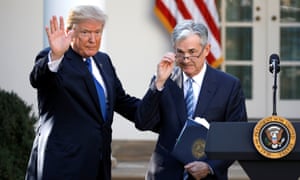
Donald Trump with Jerome Powell, then his nominee to become chairman of the Federal Reserve, Washington DC, November 2017.
Independent central banks were once all the rage. Taking decisions over interest rates and handing them to technocrats was seen as a sensible way of preventing politicians from trying to buy votes with cheap money. They couldn’t be trusted to keep inflation under control, but central banks could.
And when the global economy came crashing down in the autumn of 2008, it was central banks that prevented another Great Depression. Interest rates were slashed and the electronic money taps were turned on with quantitative easing (QE). That, at least, is the way central banks tell the story.

An alternative narrative goes like this. Collectively, central banks failed to stop the biggest asset-price bubble in history from developing during the early 2000s. Instead of taking action to prevent a ruinous buildup of debt, they congratulated themselves on keeping inflation low.

Even when the storm broke, some institutions – most notably the European Central Bank (ECB) – were slow to act. And while the monetary stimulus provided by record-low interest rates and QE did arrest the slide into depression, the recovery was slow and patchy. The price of houses and shares soared, but wages flatlined.
A decade on from the 2008 crash, another financial crisis is brewing. The US central bank – the Federal Reserve – is coming under huge pressure from Donald Trump to cut interest rates and restart QE. The poor state of the German economy and the threat of deflation means that on Thursday the ECB will cut the already negative interest rate for bank deposits and announce the resumption of its QE programme.

But central banks are almost out of ammo. If cutting interest rates to zero or just above was insufficient to bring about the sort of sustained recovery seen after previous recessions, then it is not obvious why a couple of quarter-point cuts will make much difference now. Likewise, expecting a bit more QE to do anything other than give a fillip to shares on Wall Street and the City is the triumph of hope over experience.

There were alternatives to the response to the 2008 crisis. Governments could have changed the mix, placing more emphasis on fiscal measures – tax cuts and spending increases – than on monetary stimulus, and then seeking to make the two arms of policy work together. They could have taken advantage of low interest rates to borrow more for the public spending programmes that would have created jobs and demand in their economies. Finance ministries could have ensured that QE contributed to the long-term good of the economy – the environment, for example – if they had issued bonds and instructed central banks to buy them.
This sort of approach does, though, involve breaking one of the big taboos of the modern age: the belief that monetary and fiscal policy should be kept separate and that central banks should be allowed to operate free from political interference.

The consensus blossomed during the good times of the late 1990s and early 2000s, and survived the financial crisis of 2008 . But challenges from both the left and right, especially in the US, suggest that it won’t survive the next one. Trump says the Fed has damaged the economy by pushing up interest rates too quickly. Bernie Sanders says the US central bank has been captured by Wall Street. Both arguments are correct. It is a good thing that central bank independence is finally coming under scrutiny.

For a start, it has become clear that the notion of depoliticised central bankers is a myth. When he was governor of the Bank of England, Mervyn King lectured the government about the need for austerity while jealously guarding the right to set interest rates free from any political interference. Likewise, rarely does Mario Draghi, the outgoing president of the ECB, hold a press conference without urging eurozone countries to reduce budget deficits and embrace structural reform.

Central bankers have views and – perhaps unsurprisingly – they tend to be quite conservative ones. As the US economist Thomas Palley notes in a recent paper, central bank independence is a product of the neoliberal Chicago school of economics and aims to advance neoliberal interests. More specifically, workers like high employment because in those circumstances it is easier to bid up pay. Employers prefer higher unemployment because it keeps wages down and profits up. Central banks side with capital over labour because they accept the neoliberal idea that there is a point – the natural rate of unemployment – beyond which stimulating the economy merely leads to higher inflation. They are, Palley says, institutions “favoured by capital to guard against the danger that a democracy may choose economic policies capital dislikes”.

Until now, monetary policy has been deemed too important to be left to politicians. When the next crisis arrives it will become too political an issue to be left to unelected technocrats. If that crisis is to be tackled effectively, the age of independent central banks will have to come to an end.

Larry Elliott is the Guardian’s economics editor

venerdì 6 settembre 2019

The largest tax scandal in the history of Germany ?

09/04/2019
First Cum-Ex-Process Begins in Bonn 

Cum-What? Everything about the billions tax trickery
By Christoph Rottwilm

Source: http://www.xing-news.com/reader/news/articles/2581422


It is probably the largest tax scandal in the history of the Federal Republic, with a damage to the Treasury in probably tens of billions. But who could out of the box explain what the tax tricks of banks, advisers, lawyers and investors, who have been raising the public's attention for years with slogans like "Cum-Ex" or "Cum-Cum", actually go in detail?

After many years, during which the financial industry operated the questionable business, and after a few years, the authorities spent trying to counteract it, begins on Wednesday in Bonn, the first lawsuit against actors of the scandal. A good opportunity to take a closer look.
display

Here's an overview - all you need to know about the billion-dollar dividend tax trickery a là Cum-Ex or Cum-Cum:


1st part: Cum-What? Everything about the billions tax trickery
     Part 2: The overview - what is it all about?
     Part 3: And where is the scandal now?
     Part 4: How does a cum-ex-business work?
     Part 5: How does a cum-cum deal work?
     Part 6: Why are the cum-ex and cum-cum deals controversial?
     Part 7: What is the process in Bonn?


Part 2: The overview - what is it all about?

Starting point are financial transactions that banks, consultants and lawyers have organized for investors over many years. How long exactly, this is difficult to reconstruct retrospectively. According to archives, there were first warnings of the tax tricks already in the early 1990s.

The approach of these financial transactions were special rules in the German tax law in connection with dividend payments of public limited companies. If an institutional investor (not a private individual!) Pays a dividend, he or she can have the tax office reimburse the proportion of capital gains tax that the company has paid. However, this only applies to investors in Germany - investors abroad do not have the option of a refund.

Many years ago, creative heads of the financial industry invented some sophisticated business models on this basis. In one of them, shares around the day on which the associated company pays its dividend, so quickly change the owner, that in the end several investors can claim a tax refund. So the state pays more money than it has previously received in capital gains tax. This trick has become known as "cum-ex-business" (for details see the chapter on Cum-Ex).
display

The "cum-cum-business" is a little different (see the chapter on this). This is always a foreign and a domestic investor involved. However, even in this case, the result is quite unpleasant for the tax authorities: they have to forego tax revenues that they would actually be entitled to with a reasonable assessment of the relationships.

The legal assessment of these transactions seems highly complicated. Initially, both cum-ex and cum-cum deals were tacitly accepted for years, probably because the financial industry spent a great deal of money on lawyers who legalized those practices. Meanwhile, at least the cum-ex-transactions are considered unlawful. The federal government, for example, explicitly stated in 2013 that so-called dividend stripping was "illegal". The lawmakers also took action against cum-cum deals. According to experts, they are still, albeit highly controversial, feasible.

However, one thing is clear: Through these transactions of the financial sector, the German state lost tax revenue in the tens of billions of dollars over the years. The former green finance politician Gerhard Schick, for example, spoke in the autumn of last year of up to ten billion euros in taxation. The Mannheim tax professor Christoph Spengel estimates the total damage even at 32 billion euros, referring to the period from 2001 to 2016. For the years before, depending on your taste, it may even be possible to add an unrecorded number.


Part 3: And where is the scandal now?

Where is the scandal with the whole thing? For some it is of course a huge scandal that the financial sector has brought the treasury billions over years.

But for years, the investment designs, where gaps in tax law were cleverly used, were considered legal. Only late did the legislator put a stop to the activities. Even the years of inaction of the federal government can therefore possibly be described as a scandal.

And anyway: Which country constructs itself already a tax law, which is so complex that such crazy tricks with billions of profits are possible for years? Maybe that's the biggest scandal on the subject.


Part 4: How does a cum-ex-business work?

4

Cum and Ex: Simplified model of a dividend deal

The basic principle of the cum-ex-business has already been described. Now to the representation in detail (although this is only partially possible, the reality is obviously much more complicated).

If you want to see through the cum-ex-business, it's best to take a step-by-step approach with five people involved: one company (for example, Allianz Insurance Stock Market Chart), three investors (it must be institutional investors, for simplicity's sake) Let's call them Karl, Franz, and Dieter, for example) - and the state looking into the tube.
display

Step 1: Karl owns Allianz shares worth € 150,000. He is looking forward to the dividend for his share package, which will amount to 5,000 euros this year. Franz has also turned a blind eye to these 5,000 euros, or rather, the tax refund. Therefore, Franz also acquires Allianz shares for € 150,000 immediately before the dividend payment.

Step 2: Franz buys his Allianz shares from Dieter. This is remarkable because Dieter does not own the shares. He is a short seller who initially lends Karl's papers only. That means: He concludes a deal with Karl's shares, which he does not have to do until some time later. And Franz pays Dieter 150,000 euros for a stock package that he gets delivered later.

Step 3: Day of Dividend Payment. Karl gets 5,000 euros (he has only lent his shares, but still owns them) - but not in full amount from the company. The alliance transfers only 3750 euros. Another 1250 euros (25 percent), the company has already paid as capital gains tax to the Treasury. So Karl receives a certificate with which he can get the tax refunded.
display

Step 4: Dieter had already sold the shares of Karl "empty" to Franz and received 150,000 euros for it. Now he actually buys the papers from Karl - but not to the original price - "Cum dividend" - of 150,000 euros, but "ex-dividend", so for only 145,000 euros (in the stock market, it is common for the price of a share on the day of the dividend payment, which is almost exactly the amount of the dividend per share).

Step 5: Dieter finally delivers these shares to Franz, who already paid for them. But wait: Franz had paid 150,000 euros, but now receives papers that are worth only 145,000 euros. As compensation, he receives from Dieter another 3750 euros. And more importantly, he receives a tax certificate from his bank, which he can also use to refund the capital gains tax of EUR 1250 from the tax office.

Step 6: Finally, Franz can return the shares to Karl for 145,000 euros. This would have turned the carousel once in a circle and everything would be back to normal. Except for a triviality: The government has collected only once from the alliance in this example, 1250 euros in capital gains tax for this dividend share. However, the Treasury paid the same amount twice.

Part 5: How does a cum-cum deal work?

The cum-cum business is much easier to understand than the cum-ex business. There are only four parties involved in this transaction: the company (let us take the alliance again), an institutional investor domestically (let's call it Karl), an institutional investor abroad (his name is George) - and again the state that belongs to the Tube looks.

Step 1: George owns an Allianz Share Package worth € 150,000. The day of the dividend payment is due, for this package it should be 5000 euros this year. The problem: As a foreign investor, George can not recover capital gains tax from the German Treasury. He does not want to give up the money.

Step 2: George lends his Allianz shares to Karl shortly before the dividend date. The latter collects the dividend including the certificate for the tax credit. With this he can have the capital gains tax returned by the tax office.
display

Step 3: Immediately after the dividend date, Karl returns the shares to George. He also pays him a rental fee, for example in the amount of the dividend received, as well as a part, for example, half of the tax refunded. After all, everyone should benefit from the deal - except the state, of course.


Part 6: Why are the cum-ex and cum-cum deals controversial?

Legal exploitation of loopholes in tax law or criminal tax evasion - the legal assessment of cum-ex and cum-cum deals, which will be the subject of upcoming litigation, may not be easy. After all, the financial industry has been able to pursue these practices fairly undisturbed for many years.

For years, tax experts, for example, considered cum-ex trades to be a potentially morally questionable but legally flawless tax trick. Only in 2013 did the federal government describe the "operated models" of dividend tripping as "illegal" in a response to a parliamentary question. In the meantime, investigators and prosecutors of cum-ex businesses are usually stealing tax evasion and are forging ahead with their investigations. In the recent past, numerous raids on banks such as the Deutsche Bank stock exchange chart have been shown, the Commerzbank stock market chart or the DZ Bank and other financial companies carried out. Recently, the investigators paid a few days ago the Deutsche Börse subsidiary Clearstream in Eschborn near Frankfurt an unwelcome visit.

Even the controversial cum-cum business wanted to legislate already created by the world. Whether this succeeded, however, seems unclear. According to tax experts, at least until recently, there seemed to be still scope for legalizing these questionable transactions.


Part 7: What is the process in Bonn?

On Wednesday starts in Bonn, the nation's first trial in connection with the Cum Ex scandal. Two former securities dealers of Hypovereinsbank are charged. The allegation of the Cologne public prosecutor's office is based on heavy tax evasion, divided into 34 individual cases. Overall, the dealers are said to have inflicted damage of around € 447.5 million on the Treasury. In the worst case, the defendants face imprisonment of up to ten years.
Christoph Rottwilm on Twitter

In addition, it was recently announced that the Bonn court also brought in five finance houses to the process. They are not sitting in the dock. However, they are said to have helped with the controversial practices - and could theoretically be asked to pay for the damage. According to media reports, the companies are the holding company of Hamburger Privatbank M.M. Warburg, whose subsidiary Warburg Invest, a fund company of the French major bank Société Générale, a subsidiary of the US Institute BNY Mellon and the Hamburg company Hansainvest.
     

Whistleblower alleges ethics breach at FMSB

Whistleblower alleges ethics breach at FMSB


Source: https://ftalphaville.ft.com/2019/09/03/1567541192000/Whistleblower-alleges-ethics-breach-at-FMSB-/

A whistleblower has accused top executives at the body set up by the Bank of England to guide financial market behaviour of perverting the course of justice, alleging that they put pressure on him not to testify as an expert witness in a case against a member bank.

The hearing against the FMSB -- the fixed income, currencies and commodities markets standard board -- could be a blow to the Bank of England and the Financial Conduct Authority, which recommended the establishment of the FMSB in 2015 to improve ethical standards in the sector after the Libor and foreign exchange rigging scandals rocked the City of London from 2011 onwards.

Craig Beevers, former technical adviser at the FMSB, used an employment tribunal hearing on Tuesday, on grounds of unfair dismissal, to accuse senior executives of serious misconduct. Mr Beevers claimed that his employers buckled to pressure from Deutsche Bank, an FMSB member, to limit his participation in a case brought against the bank in the US by Axiom Investment Advisors over possible abuses in foreign exchange trading.

Mr Beevers alleged that Gerry Harvey, thenchief executive of the FMSB, put pressure on him in June 2018 to stand down as an expert witness in the case against Deutsche, at the time one of the world’s largest forex traders. Mr Beevers says he was unfairly dismissed after he informed Mr Harvey and Mark Yallop, FMSB chairman, of his belief that Deutsche’s intimidation through the FMSB qualified as witness tampering and Axiom’s lawyers should be alerted.
Mr Beevers had been giving his expert opinion in the case against Deutsche on the practice of "last look" in foreign exchange markets, a controversial tactic in which a bank can renege on a deal with a customer at the last moment even after the latter has agreed to it.

Supporters argue its flexibility allows banks to deal with unforeseen problems like credit checks or shifting market prices. But many institutional investors are wary traders could use advance knowledge of a deal to benefit its own books ahead of clients’ interests.

In his expert testimony to the US district court filed on January 15 2018, Mr Beevers concluded that “Deutsche Bank recorded the behaviours complained of [by Axiom] and identified many instances of price manipulation in each format.”
A New York judge ruled in September 2018 that the case, which was seeking up to $1bn in damages from Deutsche Bank, could not be class-action certified and thus could not proceed. Axiom Investment Advisors is no longer operational.
Deutsche said of yesterday’s hearing: “Deutsche Bank is not party to these proceedings. We reject any suggestion that we acted improperly in any regard in relation to this matter. The FMSB is an independent organization that exercised its own decision making.”

The FMSB denied Mr Beevers’ claims and said he was dismissed for gross misconduct because his role as an expert witness against an FMSB member bank was a conflict of interest that had not been permitted. Mr Beevers, however, saidin documents made public on Tuesday that the FMSB were fully aware of and permitted this work when he was hired.
Mr Beevers began working for FMSB in June 2017, but a written contract was not drawn up until March 2018, the terms and versions of which are disputed by the parties. He was sacked in June 2019.

The unfair dismissal case further revealed that a probe launched by Mr Yallop to investigate Mr Harvey’s knowledge of Mr Beevers expert witness work -- later deemed a conflict of interest -- led to recommendations from an external investigator that Mr Harvey be suspended. Mr Harvey stepped down from his role as chief executive a few weeks later, before disciplinary action was taken.
At the time, the FMSB made no public announcement and the resignation was said to be for personal reasons. Martin Pluves, from LCH Group, was named as Mr Harvey’s successor in July this year, and will take office in October.
“FMSB completely refutes the claims that have been made against it in today’s employment tribunal hearing brought by a former employee, Mr Craig Beevers,” the FMSB told FT Alphaville.

“FMSB itself was made aware of allegations of serious misconduct concerning Mr Beevers during the course of last year. These allegations were thoroughly and independently investigated and that process led to him being dismissed for gross misconduct.”

Mr Beevers, however, alleged that Mr Harvey said to him in the lead up to the case that “fundamentally Deutsche Bank don’t want you to testify”. Mr Beevers alleged that after he informed Mr Harvey that Deutsche stood accused by Axiom’s lawyers, Korein Tillery, of attempting to manipulate a standards body, Mr Harvey said he “ought to resign from his position at the FMSB” and that Deutsche would back down if Mr Beevers withdrew as an expert witness.
Mr Beevers, who was suspended from normal duties on August 17 2018, believes the protected disclosures made to Axiom’s legal representatives about the pressure he was under were in the public interest, given his role as a senior technical adviser to the FMSB was to ensure the maintenance of transparent and effective markets.

Established in 2015, the FMSB’s self-regulating and largely voluntary structure was advocated as a more effective solution to the spate ofpost-crisisscandals than increased formal regulation.

As well as Mr Harvey and Mr Yallop, who has a 20-year history at Deutsche where he was chief operating officer from 2002 to 2004, the respondents to the claims brought on Tuesday were Stephen O’Connor, director of the FMSB as of December 2018, and Charles Nichols, FMSB board member and chair of the nominations committee.

Mr Beevers, who regularly made presentations on behalf of the FMSB about the nature of financial misconduct to bodies such as the New York Federal Reserve, is claiming for interim relief, which would require the FMSB to continue to employ or pay a salary to him until a formal judgment is made by the court.
A decision is due on whether to grant interim relief within six weeks.

Additional reporting by Thomas Hale, Jemima Kelly and Philip Stafford

giovedì 5 settembre 2019

Americans are trying to get Denmark's negative-interest mortgages


Americans are trying to get Denmark's negative-interest mortgages


A newly constructed single family home is shown as sold in Encinitas, California, U.S., July 31, 2019. 

REUTERS/Mike Blake

BERLIN - Two weeks ago Jyske Bank, Denmark’s third-largest bank, shocked the world by offering mortgages with a negative interest rate. Put simply, the bank would effectively pay customers to borrow money. It’s a bit more complicated than that, however, as borrowers have to pay fees that offset the savings.
The news got loads of attention, as people struggled to wrap their heads around being paid for something they are supposed to be purchasing. Consumers around the world wanted in on the action.
The weekend following the negative mortgages announcement, Jyske Bank received 80-90 inquiries from Americans who wanted these viral mortgages.
It’s all been rather amusing for Jyske Bank and its housing economist Mikkel Høegh, who has had to deal with all the attention.
“What I have said to the Americans is that they have to have a Danish property to get such a loan,” Høegh told Yahoo Finance in an email. “Some of the Americans then asked if I could help them buying a property in Denmark. I can’t with that but we can help them with the funding if they get the house.”
Jyske Bank has had to do a lot of clarifying; there’s a widespread misconception that the bank is actually paying borrowers to take their money. First of all, the bank is not actually paying anyone; it is simply forgiving part of the loan each time a payment is made. A mortgage borrower is likely to end up paying Jyske back a little more than they borrowed, factoring in fees and charges associated with arranging the mortgage loan.
And the bank can afford to do this without losing money because it borrows at negative interest rates as well.
“The experience has been quite good,” Høegh told Yahoo Finance in an email. “Many people like to hear about the loans and apply for them.” Høegh added that the country was amidst a historic refinancing of mortgages. Mortgage debt in Denmark increased in 88 of 98 municipalities, according to Denmark’s national bank, with most customers choosing fixed rates.

How it works

Denmark has had low interest rates for a long time, and the country’s banking system has a closer than normal relationship between borrowers and investors, facilitated by banks.
Because interest rates have gone down and the prices of mortgage bonds have gone up for investors, those rates can be passed on to borrowers — creating negative mortgages if they’re low enough.
The fact that banks and investors are willing to invest with negative returns is not necessarily a good thing, because it shows they would rather take a small loss than lose more elsewhere, because they view the economy as less-than-healthy. Though negative interest rates aren’t new in Europe, they are breaking new ground, from these types of mortgages to Germany selling a negative-yielding 30-year bond for the first time in August.
Despite being in “historic remortgaging,” Høegh said the negative interest rates don’t actually make it any easier for home buyers to get a loan, but makes it easier to get a bigger loan – a lower rate means a higher disposable budget.
“People find the new loans very attractive, but I don’t think that it is a big surprise for them,” said Høegh. “The most surprising thing is that de-link between the real estate prices and the interest rate is in these years less significant.”


View photos
Jyske Bank's graph showing the amount of new loans over time.
In other words, a flurry of borrowing and higher-value loans hasn’t had a big effect on housing prices, even though many of these loans are used to buy property or renovate.
Nordea, another bank in Denmark that began offering zero-interest 30-year loans, hasn’t seen much of a change, on the other hand, perhaps illustrating that despite global coverage, it hasn’t had much of an effect.
“We don’t think that anything has changed,” said Lise Bergmann, housing economist and chief analyst at Nordea. “The investor interest is more or less the same as before the news coverage.”
Looking at a chart regarding new loans provided to Yahoo Finance by Jyske Bank, the answer is probably somewhere in the middle. There has, indeed, been a surge in new loans this summer, but on a 20-plus year chart, it’s not as breathtaking as one might expect from a negative-interest mortgage.-
Ethan Wolff-Mann is a writer at Yahoo Finance focusing on consumer issues, personal finance, retail, airlines, and more. Follow him on Twitter @ewolffmann.

martedì 3 settembre 2019

The Guide To Real History: Profit & World Domination

The Guide To Real History: Profit & World Domination

Authored by Sylvain LaForest via OrientalReview.org,

In the last two centuries, all wars have been machinations orchestrated by bankers pursuing two very simple objectives: profit and a world domination that bears a name: the New World Order.

Education and medias are the main culprits to blame for keeping the important role of bankers in the dark shadows of history. The genuine relevance of Rothschild, Rockefeller, Warburg, Morgan and their peers is voluntarily kept hidden from public scrutiny, so that any investigator that digs in the realms of our past can easily be discredited as a «conspiracy theorist». Author Carroll Quigley once had full access to the Council on foreign relations documents and he confirmed the very real world banking conspiracy designed to dominate the world, in his book «Tragedy and hope».
Bizarrely, education and medias prefer to bring everything back to public figures and politicians like Churchill, Hitler or Stalin, but they will never tell you that these charismatic monsters had no money, nor created it. Hitler was a failed artist that built the most formidable war machine the world had seen in 6 years only, in a near-bankrupt country deprived of any oil production, so do you think he might have had some help?

The Grand Scheme

Before 1971, bank loans were based on their gold reserves, but no bank really owned the value in gold of the money it lent over the years, so the scheme wasn’t very different than today’s fractional system of money creation, in which banks have to own 1/10th of their loans. For example, if bank A has a million dollar, it can lend 10 millions to bank B, which can lend 100 millions to a country, since bank B owns 10 millions. This is basically how the world ended up owing 184 trillion dollars (184 000 000 000 000$) to private banks as of today.

If you doubt this private money creation scheme, just tell me where that money was before we owed it to them? I guess that settles it.

When a country goes to war, it borrows money from private banks that lend funds that they create out of thin air. Now, bankers will not only get back the funds that they never had, but will also charge interest on these loans. They will even change the interest rate at will, trying to hold in their laughter. Next step, countries will use this fake money to buy military equipment from industries in which international bankers are major shareholders or partners in investment. This equipment is then used to destroy as much infrastructure as possible in the countries at war, so that everything needs to be rebuilt by governments that will borrow more money from bankers, to pay construction companies partially or totally owned by bankers. This is why carpet-bombing on civilians was invented. All of these loans and interests add up to the national debt, or if you prefer, the bill that citizens have to repay through their taxes that they hand to the government with much trust on their good use.

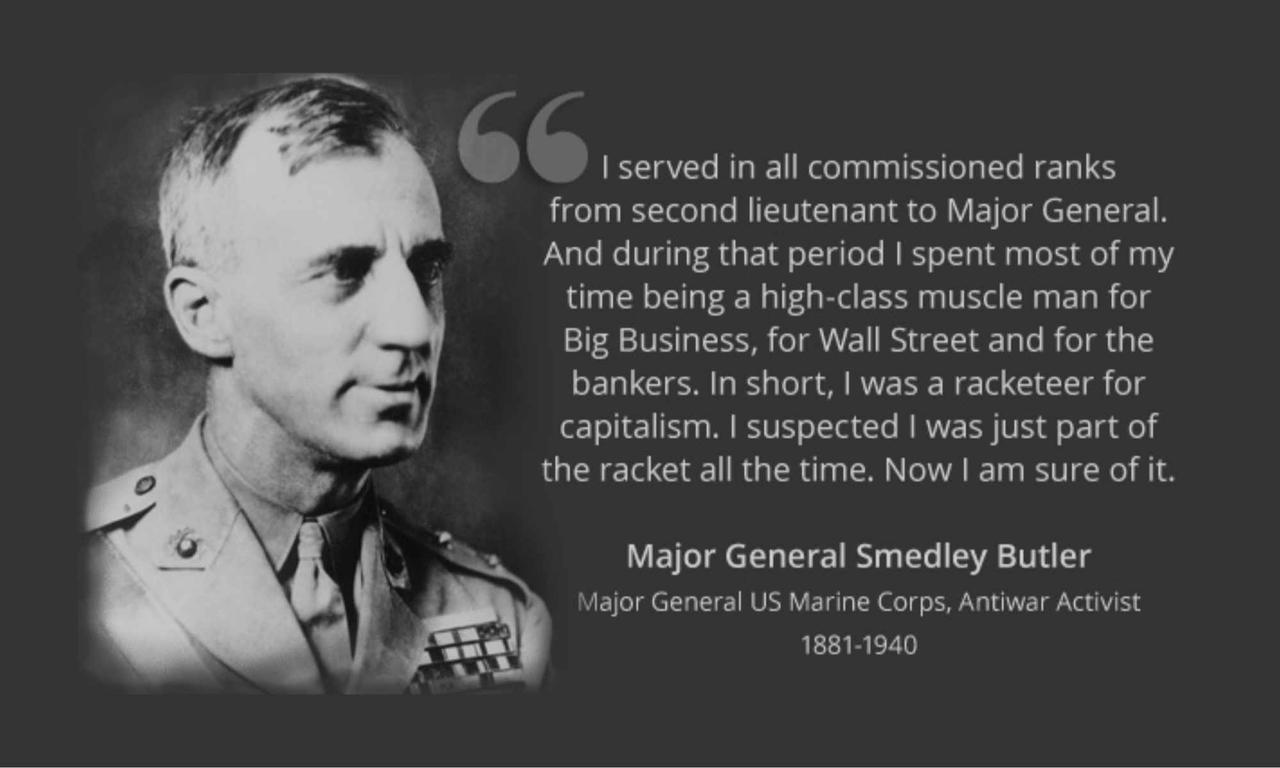
«War is a racket», wisely said General Smedley Butler. Therefore, why would the almighty central banks that hold a permanent private power and control over countries, would kindly accept to share it with a puppet president on his 4-year journey?

But the plot thickens.

Splitting ideologies

Just when you think that you’ve discovered the ultimate manipulations that have been set on us for centuries, thorough researches will lead you even further in the abyssal depth of the conspiracy that few have talked about. Thanks to James Madison, we know that the American founding fathers had designed the bipartite electoral system as a way to confine democracy in a tiny box limiting the choice of the people between two heads of the same monster, so that a mass of poor people could only maintain an effective plutocracy with their votes. All that was left to do would be to polarize opinions, by adding different ideologies and characteristics to each party, to give the impression that your vote could really determine the future of the country, but we all know by now that it never fundamentally changed anything. Therefore, an objective analysis will quickly take over the initial astonishment of your findings, since what’s next describes more likely than not how politics really work.
We often imagine Karl Marx as a lone writer in some crummy apartment, designing his great Communist Manifesto in 1848 under a flickering candlelight to break the capitalist tyranny, in the name of the workingman. Nothing could be further from the truth, since the general plan was to divide the world and bring it to wage perpetual wars, for perpetual revenues. Guy William Carr just wasn’t anybody; he was an officer in the Canadian Secret Services and had been in charge of the whole Royal Canadian Navy. Much like Carroll Quigley, he was a real insider with access to secret plans that we’re never told. Here’s what he had to say in his 1958 praised book «Pawns in the game».

Karl Marx

While Karl Marx was writing the Communist Manifesto under direction of one group of Illuminists, Professor Karl Ritter of Frankfurt University was writing the antithesis under direction of another group, so that those who direct the conspiracy at the top could use the differences in these two ideologies to start dividing larger and larger numbers of the Human Race into opposing camps, so they could be armed and then made to fight and destroy each other, together with their political and religious institutions.

It is public knowledge by now that the Rothschild family had financed both Napoleon and his British foes early 19th century, which set a most successful example for profiting from double funding. One cannot lose a war if one owns both sides of the front line! Thus, author Anthony Sutton made a lot of sense when he described the details on how Zionist bankers and Wall Streeters funded communism in «Wall Street and the Bolshevik Revolution», published in the mid-seventies.

This activity in behalf of the Bolsheviks originated in large part from a single address: 120 Broadway, New York City. The Federal Reserve Bank of New York was at 120 Broadway. The vehicle for this pro-Bolshevik activity was American International Corporation — at 120 Broadway. AIC views on the Bolshevik regime were requested by Secretary of State Robert Lansing only a few weeks after the revolution began, and Sands, executive secretary of AIC, could barely restrain his enthusiasm for the Bolshevik cause. Ludwig Martens, the first Soviet ambassador, had been vice president of Weinberg & Posner, which was also located at 120-Broadway. Guaranty Trust Company was next door at 140 Broadway but Guaranty Securities Co. was at 120 Broadway. John MacGregor Grant Co., which was financed by Olof Aschberg in Sweden and Guaranty Trust in the United States, and which was on the Military Intelligence black list, was at 120 Broadway. The Guggenheims and the executive heart of General Electric (also interested in American International) were at 120 Broadway. We find it therefore hardly surprising that the Bankers Club was also at 120 Broadway, on the top floor.

You get the idea. So here’s what a timely little mustached totalitarian then said in «Mein Kampf», right after WW1 and the Bolshevik Revolution:
This colossal Empire in the East is ripe for dissolution. And the end of the Jewish domination in Russia will also be the end of Russia as a State. We are chosen by Destiny to be the witnesses of a catastrophe, which will afford the strongest confirmation of the nationalist theory of race.

Destiny, really Adolf? This looked more like a boxing match between artificial ideologies created decades earlier, with Hitler and Stalin wearing the gloves, accompanied by Karl Ritter in one corner and Karl Marx in the other, holding the spit-buckets.

A twist in history

Thing is, Hitler had been vastly funded by American banks and industries to pressure the Rothschild to share their hegemony on the world, which was confirmed in Bretton-Woods in 1944, where the US dollar replaced the English pound as the world reserve currency. In other words, the American Empire replaced the British Empire to lead the New World Order, but it was the same banking scheme, just a different set of owners.

Winston Churchill, Franklin D. Roosevelt and Josef Stalin at the Yalta Conference in 1945. Source: US Library of Congress/wikipedia.org

In Yalta, Stalin and Roosevelt effectively divided the world in two ideologies for their masters, while Churchill was wondering what had bloody happened, since the other two seem to have a lot of fun together. That left him with ample time to think about his next historical quote for posterity.

After WW2, NATO and the CIA were created to counter the lurking Red Menace. Soviet citizens were depicted everywhere like cold-blooded killing robots, as if they were something else than ordinary folks making a living for their kids and having fun on the weekend. The whole planet got in the Cold War, providing great tension zones such as Eastern Europe and Southern Asia, justifying insane military funding and the industrial production of nukes. Wars could be waged without any objective, just for the sheer pleasure of making big money to the profit of bankers and military industrialists; on both sides of the Iron Curtain, I should add.

Perpetual wars

The case of the Korean War is sad and appalling. The UN conducted the aggression on North Korea as soon as 1950, because neither China nor USSR vetoed the attack at the Security Council. There are a few reasons that were given for this, but none as likely as the existence of Bigfoot.

General MacArthur quickly pushed back the North Koreans all the way to the Chinese frontier and only had to blow up the bridges on Yalou River to break any hopes of reinforcement from China, when he got a call from CFR member General Marshall, whom ordered him to leave the bridges untouched. A Chinese army crossed them, the communists pushed the UN troops back to the middle of the country, MacArthur resigned, and they settled for a tie. After a couple of years of bombing and 3 million dead Koreans later, the separation line was put back in its original place on the 38th parallel, but if we look at the bright side, banks and military industries had made an impressive bundle ending with 9 zeros, and we owed it to them, with interests.

United Nations forces cross the 38th parallel while withdrawing from Pyongyang, the North Korean capital, 1950
Then there was Vietnam. And then Afghanistan. Fighting communism was the motto for perpetual purposeless wars. We cannot have any serious analysis about the 75-year Cold War, without taking account of how and why the communist movement was created. This manipulation ended with the fall of USSR in 1991, which was immediately replaced by the fear of Islamism, ignited that very same year with the Gulf War in Iraq. Since history repeats itself over and over, what happened in Korea solves the mystery of why George Bush Sr didn’t go all the way to Saddam.

What used to be communism vs. capitalism is now Islam vs. Christianity. If we listen to medias, every Muslim is a potential jihadist that wants to impose the sharia law on us, as if they were something else than ordinary folks that make a living for their kids and have fun on the weekend. We’re stuck in a carbon-copy replica of the Cold War that scared the world for three-quarters of a century.

Conclusion

The sad reality appears to be that politics and ideologies are nothing more than bullcrap created to polarize opinions and divide the population, while central bankers don’t give a hoot if a country is run by democrats, communists, fascists, Nazis, dictators, socialists, green parties, a king or even plumbers, as long as the government maintains the plutocracy that enslaves the population through debt, that plunders our natural resources, and fully controls our economy through their money creation monopole.
Dividing the population prevents it from uniting against our real common enemy, who gives the true meaning to «Divide and conquer». For example, independence movements are perfect to polarize opinions and split people apart, and once a nation becomes independent, it is from the neighbor who’s stuck in the same crappy plutocracy as yours, not from bankers who will keep looting your money and profit from your resources. Think about it next time you argue with your brother-in-law about politics, when you praise your party that is so much better than his. Think about it when you vote.

If we got rid of private banking in public affairs, and governments issued all currencies, unbearable peace and prosperity would roam the earth. Today, a few men are fighting this deeply corrupted world financial system: Putin was the first and main one by helping President Assad to keep Syria free from international banks, then came Xi and Trump. Now you know what Donald means by «giving back the country to the people»! He’s openly fighting the Federal Reserve, talks about the nationalization of this private institution, and he’s been the most efficient politician ever to convince the people on the constant media lying, the base of our general ignorance.

US Department of Defence conducted a flight test of a conventionally configured ground-launched cruise missile at San Nicolas Island on August 19, 2019, less than 3 weeks after the U.S. officially abandoned the INF Treaty.

But neither mainstream medias, nor official history books ever talked about the grand scheme, and that makes me a «conspiracy theorist» to most. Even independent journalists and analysts rarely mention banks by fear of the conspiracy theory curse, a label that was created by the CIA in 1967 to ridicule those who disputed the Warren Commission conclusion on JFK’s murder, by the same agency. Conspiracy theories now apply on everything that mainstream medias can’t justify with lies that appear to make some sense and are not too obvious.

If you do a quick check on Wikipedia, Carroll Quigley, Guy William Carr, General Smedley Butler and Anthony Sutton are all described as conspiracy theorists today, because they all decided to use their access to extremely serious files and secrets for the benefit of the people through a denunciation of international banks as the source of every war, and the conspiracy curse is the last desperate attempt to discredit them. The CIA technique works on those whose minds are still programmed by mainstream medias, though more and more people now understand that these amazing analysts and genuine humanists weren’t some dumb lunatics, but were simply describing a reality that many of us find difficult to accept.

So, I’m sorry, forget what I said, nothing wrong happened. Just keep working, whistle and look away as you’re being robbed, carpet-bombed, spied-on or sent to war, as you’re being told what you can or can’t do with your life, when you vote or argue with someone who’s trying to explain, like you’ve done all of your life, and like your great-grandfather also did.

But at least, your old man didn’t know.

Post in evidenza

The Great Taking - The Movie

David Webb exposes the system Central Bankers have in place to take everything from everyone Webb takes us on a 50-year journey of how the C...