It is possible to introduce a Masonic currency to free the lodges from the economic-monetary constraints by using the Kabbalah.
First of all, I refer the reader to the article that appeared in the Alpine Review of May 2020 where the use of the "Widow's Trunk" as a means of collecting money for philanthropic purposes is explained: "The myth of Isis and the widow's children", https://freimaurerei.ch/it/il-mito-di-iside-e-i-figli-della-vedova/
Having made this premise, we could implement the use of Kabbalah as a means of introducing a hypothetical currency that we will call "Tubal Coin".
Kabbalah means "receipt" and in modern Hebrew this word is used to request a receipt, a tax receipt, a prescription from the doctor. One could then match every donation in traditional currency made with the widow's trunk through the issuance of a corresponding Kabbalah, or the equivalent allocation of Tubal Coin to the donor on his electronic purse (wallet). In this way, in a short time, each brother would become familiar with the use of Masonic currency which he could use to exchange goods and services with other brothers, and this on a global level, if each lodge had quantities of Tubal Coin which could be distributed for the purpose.
The attribution of Tubal Coins for specific purposes could then take place even without a counterpart of traditional currency, once the mechanism is understood and the benefit it can bring to universal Freemasonry.
But how much is Tubal Coin worth?
Having to have a specific universal value, Tubal Coin has been issued in quantity corresponding to the Special Drawing Rights in circulation at the time of issue. This means that a Tubal Coin is equal to a SDR. In turn, the SDR bases its value on a basket of currencies and its daily quotation with national currencies can be found here: https://www.imf.org/external/np/fin/data/rms_five.aspx
The enfranchisement, or emancipation, from the political monetary system currently in place and dominated by actors who may have purposes that conflict with those of freemasonry is realized over time.
How to save banks and the economy with the euro on blockchain
By Marco Saba, September 17, 2021
In this article I explain how a plan to save commercial banks using the euro on blockchain could work. First, let's imagine a limited liability company based outside the EU, for example in London, which we will call "Central Euro Bank on blockchain" (BCEB Ltd). This company - which already exists - would issue euros on blockchain that it would exchange exclusively with commercial banks at par (one-to-one, one euro on blockchain against one euro bank), avoiding inflationary phenomena. In turn, the commercial bank would make this euro on blockchain available to customers, which it transfers to the customer via a dedicated wallet, for example: rapidobank.com
The customer, of course, buys through bank money that he transfers to the bank. The customer would thus have the privilege of using an innovative tool that officially would only be available to the public in 5 years. This euro on blockchain has advantages: the customer's wallet is technically an "inviolable segregated deposit", a bearer sum - the owner of the wallet - that cannot be stolen or confiscated. Should the bank go bankrupt, the deposit still remains intact available to the customer in his wallet. There are other notable advantages: the transaction cost is fixed at one cent for any amount; the transfer of the sum is immediate; the blockchain used is the most Green currently existing on the market: it consumes 175KWh against the 38GWh currently consumed by Bitcoin.
Now we come to the benefits for the commercial bank, in addition to the image one for providing an innovative service. When the bank sells euros on blockchain to the customer who pays with the bank's own bank money, it decreases the liabilities from customer debt in the balance sheet of the bank. The more euros on blockchain are sold by the banking system, the more liabilities are withdrawn from the banking system, consolidating it. In fact, while the euro on blockchain is NOT a liability of the issuer (and this is true even for the ECB's euros, which however enters false liabilities on the balance sheet to hide seigniorage profits), bank money is. But we said that previously banks had bought euros on blockchain from the ECB, and thus transferring liabilities (deposits) to the same ECB. So in the long run all the liabilities of the banking system would be in the hands of the BCEB. But the BCEB can create enough euros on blockchain to cover them - completely sterilizing the amounts and cancelling the liabilities (i.e., zeroing out the bank euro account). The BCEB can also decide to further its service by buying NPLs and other bad loans from commercial banks further improving balance sheets with a reflective policy.
Once the bank balance sheets have been saved, the country's economy can restart without delay even after this ugly pandemic period that has already had devastating deflationary effects, for example in the commercial rental property market.
Dennis Kelleher, Co-Founder, President and Chief Executive Officer of Better Markets
Dennis Kelleher, the co-founder, President and CEO of the nonpartisan
Wall Street watchdog, Better Markets, has issued a scathing rebuke of
the Federal Reserve’s so-called “stress tests” of the mega banks on Wall Street, calling them “toothless.”
Kelleher’s criticisms revolve around two key points. The Fed is
preordaining the outcome of the tests by (1) pumping up the banks’
capital with financial handouts prior to the tests and (2) by removing
key aspects of the stress tests that would negatively impact the
outcome.
Kelleher writes that the Fed’s “unprecedented” support to financial
markets and the economy since last March was $4 trillion and “has
materially helped to bolster bank balance sheets and capital
levels.” But Kelleher is overlooking the more than $9 trillion in cumulative repo loans
that the Fed showered on the trading units of these mega Wall Street
banks, at far below market interest rates, from September 17, 2019
through early July of 2020, the month that the Fed simply stopped reporting this handout to the Wall Street banks.
This is also how the Fed has ginned up the tests, writes Kelleher:
“Making matters worse, the stress test
program has been seriously weakened under the Powell chairmanship by,
among other things, the removal of two key components: the inclusion of
dividend payouts and a growing balance sheet. If those factors were
included, as they should have been, the banks would have had materially
lower post-stress capital ratios.”
Kelleher says the Fed “trumpeted” the fact that all of the banks
passed the stress tests to justify letting the banks launch a “flood of
dividends and share buybacks likely to approach $200 billion and exceed bank earnings by as much as 167%.”
When banks are paying out more than they’re earning, it implies a
“reduction in capital, making the banking system less safe,” Better
Markets notes in a related five-page fact sheet. The fact sheet includes this warning for Powell:
“History may judge the Fed’s decisions to
deregulate and weaken the stress tests as to allow such outsized,
capital-depleting payouts to be as dangerous as many of the Fed’s
actions were before the 2008 GFC [Global Financial Crisis], which made
that financial crash much worse, if not inevitable, and all but
guaranteed the need for taxpayers to bailout Wall Street’s biggest
banks.”
This would not be the first time that the Wall Street mega banks paid
out more in dividends and share buybacks than their net income. In
fact, they’ve been doing it for years under the unwatchful eye of their
captured regulator, the Fed.
Bloomberg News reporters Lisa Lee and Shahien Nasiripour broke the story
in June of last year that Bank of America, Citigroup, JPMorgan Chase
and Wells Fargo had, since 2017, spent more on dividends and share
buybacks than they had earned. The reporters wrote:
“From the start of 2017 through March,
the four banks cumulatively returned about $1.26 to shareholders for
every $1 they reported in net income, according to data compiled by
Bloomberg. Citigroup returned almost twice as much money to its
stockholders as it earned, according to the data, which includes
dividends on preferred shares. The banks declined to comment.”
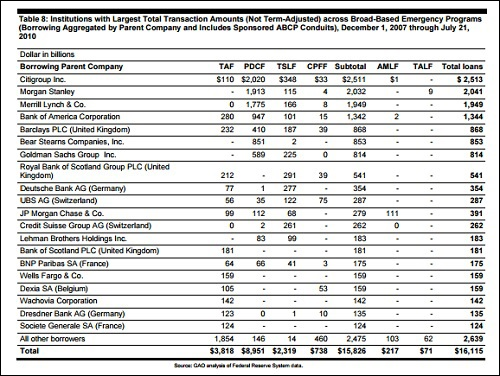
According to an audit conducted by the Government Accountability
Office (GAO), those four banks named above that are paying out more to
shareholders than they are earning received the following amounts in
cumulative secret loans from the Fed, at interest rates of almost zero,
from 2007 to 2010: (See chart below.)
Citigroup $2.5 trillion
Bank of America $1.3 trillion
JPMorgan Chase $391 billion
Wells Fargo $159 billion
Where exactly are all of these trillions of dollars of bailouts to
the Wall Street mega banks coming from? (You should probably sit down
any hot liquids you are drinking before you read the answer to that
question.)
The money is coming from the same regional arm of the Federal
Reserve, the Federal Reserve Bank of New York (New York Fed), that
bailed out these banks and their foreign counterparties during the last
financial crisis. The New York Fed is permitted by Congress to
electronically create this money out of thin air. The Fed released a
video with Senior Adviser, Steve Meyer, explaining how it’s done: (See
3:42 minutes on the video.)
In this example Meyer is talking about how the Fed creates money for
its QE purchases of bonds from the Wall Street banks. It works the same
way for the Fed’s collateralized loans to Wall Street.
Meyer explains:
“You may wonder how the Fed pays for the
bonds and other securities it buys. The Fed does not pay with paper
money. Instead, the Fed pays the sellers’ bank using newly created
electronic funds, and the bank adds those funds to the sellers’ account.
The seller can spend the funds or can simply leave them in the bank. If
the funds stay in the bank, then the bank can increase its lending,
purchase more assets, or build up the reserves it holds on deposit at
the Fed. More broadly, the Fed’s securities purchases increase the total
amount of reserves that the banking system keeps at the Fed.
“Whether the Fed’s purchases lead to an
increase in the amount of money circulating in the economy depends on
what banks do with the new reserves and on what sellers do with the
funds they receive.”
What the mega banks are doing with a lot of this cheap, no-strings attached money from the Fed is to loan out their balance sheets to hedge funds to make insanely leveraged trades in risky stocks and derivatives.
And exactly what is the structure of the New York Fed? It’s one of the 12 regional Federal Reserve Banks but it’s privately owned by the mega banks that it’s propping up with all these trillions of dollars in loans.
The largest shareowners of the New York Fed are the following five
Wall Street banks: JPMorgan Chase, Citigroup, Goldman Sachs, Morgan
Stanley, and Bank of New York Mellon. Those five banks represent
two-thirds of the eight Global Systemically Important Banks (G-SIBs) in the United States.
The other three G-SIBs are Bank of America, a shareowner in the
Richmond Fed; Wells Fargo, a shareowner of the San Francisco Fed; and
State Street, a shareowner in the Boston Fed.
What’s happening between the Wall Street mega banks today and the Fed
is a replay of the dynamics that led to the 2008 crisis. The question
is, will the Biden administration take action in time to thwart another
economic crash that America can ill afford?
GAO Data on Fed’s Emergency Lending Programs During 2007-2010 Financial Crisis
Corporate media outlets like Bloomberg News, the CBS news program 60 Minutes, and CNBC
have been seduced into obsequious behavior when it comes to Jamie
Dimon, the Chairman and CEO of JPMorgan Chase, despite the fact that
Dimon has presided over the most unparalleled crime spree in the history
of U.S. banking. Between 2014 and September of last year, JPMorgan
Chase has been charged with five criminal felony counts by the U.S. Department of Justice. The bank admitted to all five counts. (See the bank’s detailed rap sheet here.)
Despite this crime spree and endless probation periods followed by
more crime, Dimon has further seduced federal bank regulators into
allowing his unrepentant behemoth to become the most systemically risky
bank in America. That assessment is not our opinion. It is the
assessment of the federal government based on hard data.
The National Information Center is a repository of bank data collected by the Federal Reserve. It is part of the Federal Financial Institutions Examination Council (FFIEC),
which was created by federal legislation to create uniformity in the
examination of U.S. financial institutions by the various banking
regulators.
Each year the National Information Center creates a graphic profile of banks measured by 12 systemic risk indicators. The data used to create these graphics come
from the “Systemic Risk Report” or form FR Y-15 that banks are required
to file with the Federal Reserve. To measure the systemic risk that a
particular bank poses to the stability of the U.S. financial system, the
data is broken down into five categories of system risk: size,
interconnectedness, substitutability, complexity, and
cross-jurisdictional activity. Those measurements consist of 12 pieces
of financial information that banks have to provide on their Y-15 forms.
The most recent data for the period ending December 31, 2019
indicates that in 8 out of 12 measurements – or two-thirds of all
systemic risk measurements – JPMorgan Chase ranks at the top for having
the riskiest footprint among its peer banks.
To put it another way, the largest bank in the United States with an
apparent insatiable appetite to commit felonies is also the riskiest
bank based on other key metrics.
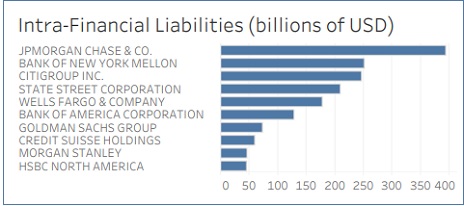
One of the 12 financial metrics is based on the Intra-Financial
System Liabilities of each bank. This shows how much money a particular
bank has at risk at other banks by using inputs such as how much of its
funds it has on deposit with, or has lent to, other financial
institutions; the unused portion of any credit lines it has committed to
other financial institutions; and its holdings of debt, equity,
commercial paper, etc. of other financial institutions. The idea,
obviously, is to understand the interconnectivity of systemically-risky
banks and whether one could cause a daisy-chain of contagion with other
banks. (Think Lehman Brothers and Citigroup in 2008.)
JPMorgan Chase looks particularly dicey in terms of its
Intra-Financial System Liabilities. The 2019 data indicate that JPMorgan
Chase has $394.86 billion exposure in that category, which is $143
billion more than the next riskiest bank in that category, the Bank of
New York Mellon.
Source: National Information Center
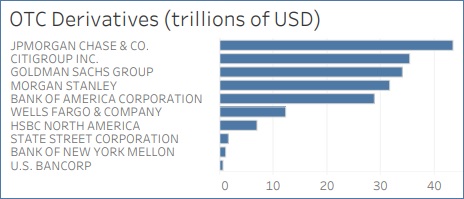
Equally unnerving, JPMorgan Chase ranks number one in the instruments
that assisted mightily in blowing up Wall Street in 2008 – OTC
(Over-the-Counter) derivatives. These are private contracts between two
parties and lack the transparency or protections of being traded on an
exchange. This means if the counterparty defaults and the exposure is
large enough, it could put a federally-insured bank at risk. This is not
a hypothetical outcome. The giant insurer, AIG, blew itself up in 2008
because it was holding tens of billions of dollars in OTC derivative
contracts for the biggest banks on Wall Street that it could not pay its
obligations on. The U.S. government was forced to nationalize AIG and
paid more than $90 billion to the banks for their AIG derivative
contracts and securities lending obligations that AIG could not make
good on.
Among the biggest banks on Wall Street, JPMorgan Chase has the largest exposure to OTC derivatives, with $43.5 trillion exposure, according to the National Information Center data.
Source: National Information Center
As you might recall, the Dodd-Frank financial reform legislation of
2010 was supposed to end the hubris of OTC derivatives and force these
vehicles into the sunlight of exchanges and central clearinghouses. But
that hasn’t happened. Corporate business media is simply declining to
report on it. According to the Office of the Comptroller of the
Currency, the federal regulator of national banks, as of December 31,
2020, only “35 percent of banks’ derivative holdings were centrally
cleared.” That’s more than a decade after the “reform” legislation was
signed into law.
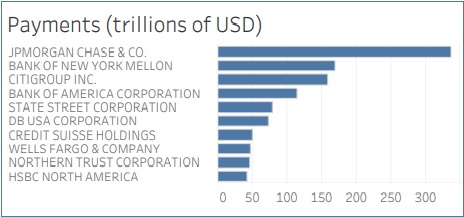
What you don’t want a high-risk institution to be is a pivotal cog in
the U.S. payments system. But according to the Center’s data, that’s
exactly how JPMorgan Chase has maneuvered itself. The bank was
responsible for $337.49 trillion of the U.S. payments system in
2019. That’s more than the next two largest banks in that category
combined: Bank of New York Mellon at $169 trillion; and Citigroup at
$158 trillion.
Source: National Information Center
Outside of Wall Street On Parade, there are only two trial
lawyers who seem to comprehensively understand what is really going on
at JPMorgan Chase. In 2016 Helen Davis Chaitman and Lance Gotthoffer,
wrote a book, JPMadoff: The Unholy Alliance Between America’s Biggest Bank and America’s Biggest Crook, comparing the bank to the Gambino crime family. The lawyers wrote:
“In Chapter 4, we compared JPMC to the
Gambino crime family to demonstrate the many areas in which these two
organizations had the same goals and strategies. In fact, the most
significant difference between JPMC and the Gambino Crime Family is the
way the government treats them. While Congress made it a national
priority to eradicate organized crime, there is an appalling lack of
appetite in Washington to decriminalize Wall Street. Congress and the
executive branch of the government seem determined to protect Wall
Street criminals, which simply assures their proliferation.”
Chaitman and Gotthoffer write further in their book:
“If Jamie Dimon is running a criminal
institution, he should be prosecuted for it. And law enforcement has the
perfect tool for such a prosecution: the Racketeer Influenced and
Corrupt Organizations ACT (RICO).
“Congress enacted RICO in 1970 in order
to give law enforcement the statutory tools it needed to prosecute the
people who committed crimes upon orders from mob leaders and the mob
leaders themselves. RICO targets organizations called ‘racketeering
enterprises’ that engage in a ‘pattern’ of criminal activity, as well as
the individuals who derive profits from such enterprises. For example,
under RICO, a mob leader who passed down an order for an underling to
commit a serious crime could be held liable for being part of a
racketeering enterprise. He would be subject to imprisonment for up to
twenty years per racketeering count and to disgorgement of the profits
he realized from the enterprise and any interest he acquired in any
business gained through a pattern of ‘racketeering activity.’ ”
On September 16, 2019 two current and one former trader at JPMorgan
Chase were charged under the RICO statute for turning the precious
metals desk of JPMorgan Chase into a racketeering enterprise. Dimon got a
pay bump for his “performance” that year to $31.5 million.
The
Federal Reserve will release the results of its stress tests of the
mega banks on Wall Street on June 24. That exercise is nothing more than
a shell game to mislead Congress and the public into believing that
actual due diligence is being done by the Fed on these massive federally
insured banks with their inhouse trading casinos. (See Three Federal Studies Show Fed’s Stress Tests of Big Banks Are Just a Placebo.) In reality, the Fed is a completely captured appendage of Wall Street.
That the Fed is still allowed by Congress to have anything to do with
supervising these banks shows just how far down the rabbit hole Wall
Street’s money and influence in Washington has taken the country.
There is only one institution in America that has less credibility
than the mega banks on Wall Street. That’s the Federal Reserve. Despite
not having one elected official among its ranks, the Fed has
unilaterally altered the U.S. financial system into a grotesque version
of itself.
Let’s start with what the Fed did beginning in December of 2007
without any approval from Congress. The Fed created a sprawling octopus
of bailout programs for the mega banks and their foreign derivative
counterparties. The Fed then battled in court for years to keep Congress
and the public from learning the astronomical sums the Fed had spent to
prop up failed banks across Wall Street. When the government finally
released an audit
of the Fed’s bailout programs on July 21, 2011, the tally came to a
cumulative $16 trillion. (See chart below.) But when the Levy Economics
Institute added in other Fed bailout programs that the government audit
had bypassed, the actual tally came to $29 trillion.
In what kind of democracy does an institution lacking even one
elected official get to unilaterally prop up insolvent banking behemoths
after those same banks cratered the U.S. economy through the creation
of fraudulent mortgage products?
When the government audit was released, the office of Senator Bernie Sanders of Vermont released a statement, which read in part:
“The Fed outsourced virtually all of the
operations of their emergency lending programs to private contractors
like JP Morgan Chase, Morgan Stanley, and Wells Fargo. The same firms
also received trillions of dollars in Fed loans at near-zero interest
rates. Altogether some two-thirds of the contracts that the Fed awarded
to manage its emergency lending programs were no-bid contracts. Morgan
Stanley was given the largest no-bid contract worth $108.4 million to
help manage the Fed bailout of AIG.”
Sanders stated at the time, “The Federal Reserve must be reformed to
serve the needs of working families, not just CEOs on Wall Street.”
That statement from Sanders came almost a decade ago in July 2011.
Not only has the Fed not been reformed but it has unilaterally given
itself new powers to replace the free market’s setting of interest rates
for its own regime of Fed administered rates.
How is the Fed administering rates? It has ballooned its balance sheet to $7.9 trillion (yes, trillion)
by gobbling up Treasury securities and mortgage-backed bonds from the
surpluses on Wall Street and parking them on its own balance sheet. It’s
been engaged in this sleight-of-hand, which it quaintly calls
“quantitative easing” since the financial crisis of 2008.
On December 12, 2007, the Fed’s balance sheet stood at $881.75
billion. It has exploded to nine times that amount in the span of 13-1/2
years.
Even Fed insiders have spoken out against these artificially low
interest rates administered by the Fed. Eric Rosengren, President of the
Boston Fed, noted the following in a speech he delivered to the
Marquette University Economics Department on October 8, 2020:
“…the extended low interest rate
environment after the Great Recession helps explain why the leverage
ratio rose over the past 10 years. Corporations increased their leverage
as the prevailing low interest rate environment provided more capacity
to take on debt.
“However, in an economic downturn,
greater leverage – with its principal and interest repayment demands –
may prove problematic for firms, or by extension the economy. This can
result in firms being forced into bankruptcy, which hurts a wide range
of stakeholders in addition to lenders and investors, including
customers, suppliers, and employees.”
Rosengren added later in the speech:
“Clearly a deadly pandemic was bound to
badly impact the economy. However, I am sorry to say that the slow
build-up of risk in the low-interest-rate environment that preceded the
current recession likely will make the economic recovery from the
pandemic more difficult.”
The mega banks on Wall Street that are supposed to be supervised by
the Fed are among those corporations that have gorged on debt. According
to a June 2020 article at Bloomberg News,
four of those banking behemoths have also been paying out more than
they earned for years. The article revealed the following about the
dividends and stock buybacks at Bank of America, Citigroup, JPMorgan
Chase, and Wells Fargo:
“From the start of 2017 through March,
the four banks cumulatively returned about $1.26 to shareholders for
every $1 they reported in net income, according to data compiled by
Bloomberg. Citigroup returned almost twice as much money to its
stockholders as it earned, according to the data, which includes
dividends on preferred shares. The banks declined to comment.”
Citigroup was the largest of the bank basket cases during the crash of 2008. It received a secret $2.5 trillion
in cumulative loans from the Fed. (See chart below.) The Fed was not
permitted by law to make loans to an insolvent institution. But it
decided, on its own, to make loans to this highly questionable
institution.
The Fed is not just administering interest rates. It is also
administering the stock market. On March 12 of last year, the Dow was
down 1900 points intraday and looking like it was about to plunge
further. The Fed directed the New York Fed to make the announcement that
it would be offering an unprecedented $1.7 trillion in repo
loans to its primary dealers (trading houses on Wall Street) over that
day and the next. The Dow immediately shaved 500 points from its losses.
“To prop up the stock market further, the
Fed announcement indicated that the $500 billion in 3-month loans and
$500 billion in one-month loans will be offered weekly ‘for the
remainder of the monthly schedule.’ That means $1 trillion a week will
be available at below-market interest rates. That will be on top of the
$175 billion the Fed is offering daily in one-day loans and the $45
billion it is offering each Tuesday and Thursday in 14-day loans. This
is a dramatic expansion of the Fed’s balance sheet to support Wall
Street — all without one vote, or debate, or hearing occurring in
Congress.”
GAO Data on Fed’s Emergency Lending Programs During 2007-2010 Financial Crisis
Morgan Stanley has more than 15,000 financial advisors calling
clients each day with investment recommendations that are frequently
engineered inside the firm. (These are known as in-house or proprietary
products.) For the past two decades, we have been reading about
regulatory fines against Morgan Stanley for abusing its customers in
these home-grown offerings.
In November 2000, Morgan Stanley’s Dean Witter unit was charged by
the National Association of Securities Dealers’ regulatory arm with
selling over $2 billion of Term Trusts to more than 100,000 customers
using an internal marketing campaign that characterized the investments
as safe and low-risk. The NASD Regulation complaint said that Dean
Witter targeted “certificate of deposit holders and other conservative
investors, many of whom were elderly with moderate, fixed incomes…” The
risky Term Trusts at one point had lost over 30 percent of their value
and had to reduce their dividends by nearly a third.
The NASD Regulation complaint noted that “Dean Witter’s marketing
effort for the Term Trusts also included high-pressure sales efforts at
the regional and branch levels, include the use of sales contests and
sales quotas.”
In 2003, Morgan Stanley was fined $50 million by the Securities and Exchange Commission
for improper mutual fund sales practices. The SEC said the firm had set
up a “Partners Program” in which a “select group of mutual fund
complexes paid Morgan Stanley substantial fees for preferred marketing
of their funds.” The firm further incentivized its brokers to recommend
the purchase of the “preferred” funds by paying them increased
compensation. The SEC said Morgan Stanley also failed to disclose the
higher fees imposed on Class B shares of its proprietary funds versus
sales of Class A shares.
In November 2019, the SEC again charged and fined Morgan Stanley
for selling its customers more expensive share classes of mutual funds
when less expensive share classes were available. The SEC noted that
Morgan Stanley’s recommendations of more expensive share classes
negatively impacted the overall return on the customers’ investments.
According to the SEC, the activity had occurred for more than seven
years, from at least July 2009 through December 2016.
One would think that Morgan Stanley might now be cautious and try to
avoid further wrath from regulators over its mutual fund practices. Just
the opposite appears to be the case. As we pointed out earlier this
week, Bitcoin has been thoroughly discredited
by some of the smartest people in the investment community. The only
thing more risky than buying Bitcoin with cash is buying Bitcoin with
leveraged futures contracts. And that’s just what Morgan Stanley told
the SEC in recent filings that it plans to do.
Yes, Morgan Stanley plans to stuff Bitcoin futures contracts into a
host of its own mutual funds. If that’s not troubling enough, Cayman
Island subsidiaries also come into play with these Bitcoin futures
contracts . Per the April 30, 2021 prospectus from Morgan Stanley:
“Special Risks Related to the Cayman Islands Subsidiary. Each
of the Advantage Portfolio, Asia Opportunity Portfolio, Counterpoint
Global Portfolio, Developing Opportunity Portfolio, Global Insight
Portfolio, Global Opportunity Portfolio, Global Permanence Portfolio,
Growth Portfolio, Inception Portfolio, International Advantage
Portfolio, International Opportunity Portfolio and Permanence Portfolio
may, consistent with its principal investment strategies, invest up to
25% of its total assets in a wholly-owned subsidiary of the Fund
organized as a company under the laws of the Cayman Islands. Each
Subsidiary may invest in GBTC [Grayscale Bitcoin Trust], cash-settled
bitcoin futures and other investments…
“While each Subsidiary may be considered
similar to investment companies, it is not registered under the 1940 Act
and, unless otherwise noted in the Prospectus and this SAI, is not
subject to all of the investor protections of the 1940 Act and other
U.S. regulations. Changes in the laws of the United States and/or the
Cayman Islands could result in the inability of a Fund and/or
the Subsidiary to operate as described in the applicable Prospectus and
this SAI and could eliminate or severely limit the Fund’s ability
to invest in the Subsidiary which may adversely affect the Fund and its
shareholders.”
Morgan Stanley includes numerous risks concerning its Bitcoin strategy, including the following:
“Exchanges on which bitcoin is traded
(which are the source of the price(s) used to determine the cash
settlement amount for a Fund’s bitcoin futures) have experienced, and
may in the future experience, technical and operational issues, making
bitcoin prices unavailable at times. In addition, the cash market in
bitcoin has been the target of fraud and manipulation, which could
affect the pricing of bitcoin futures contracts.
“In addition, bitcoin and bitcoin futures
have generally exhibited significant price volatility relative to
traditional asset classes. Bitcoin futures may also experience
significant price volatility as a result of the market fraud and
manipulation noted above.”
Assuming that there are investors in America that want exposure to
potential “market fraud and manipulation,” we’re pretty sure that group
of investors does not include retirees seeking safety through annuities.
And yet, we found this stunning prospectus
from Morgan Stanley that was filed with the SEC on March 31 and updated
on April 30 of this year. It pertains to the mutual funds offered by
the Morgan Stanley Variable Insurance Fund, which it explains as
follows:
“The Portfolios are not available for
direct investment. Shares of the Portfolio are offered exclusively to
certain life insurance companies in connection with particular variable
life insurance and/or variable annuity contracts they issue. The
insurance companies invest in shares of the Portfolios in accordance
with instructions received from owners of variable life insurance or
annuity contracts.
“Variable annuities are long-term investments designed for retirement purposes.”
Got that? Retirement purposes.
The prospectus includes the following among numerous risks involved with bitcoin:
“Bitcoin futures expose a Fund to all of
the risks related to bitcoin discussed below and also expose the Fund to
risks specific to bitcoin futures. Regulatory changes or actions may
alter the nature of an investment in bitcoin futures or restrict the use
of bitcoin or the operations of the bitcoin network or exchanges on
which bitcoin trades in a manner that adversely affects the price of
bitcoin futures, which could adversely impact a Fund and necessitate the
payment of large daily variation margin payments to settle the Fund’s
losses.”
Underscoring just how volatile Bitcoin is, consider this headline from CNBC on March 13 of last year: “Bitcoin loses half of its value in two-day plunge.”
Do folks nearing retirement really want something in their investment
portfolio that has already demonstrated the ability to lose half its
value in the span of 48 hours?
On Tuesday, the SEC sent a tepid warning
to Morgan Stanley and other Wall Street firms planning to stuff bitcoin
futures into their mutual funds. The statement came from the SEC’s
Division of Investment Management (IM) and included this:
“IM staff understands that some mutual
funds are investing or seek to invest in Bitcoin futures and that these
funds believe they can do so consistent with the substantive
requirements of the Investment Company Act and its rules and other
federal securities laws. IM staff, in coordination with staff from the
Division of Examinations, will closely monitor and assess such mutual
funds’ and investment advisers’ ongoing compliance with the Investment
Company Act and the rules thereunder and the other federal securities
laws. Investor protection and assessing the ongoing compliance of these
funds is a top priority for the staff.
“In addition, IM staff, in coordination
with staff from the Division of Economic and Risk Analysis and Division
of Examinations, will closely monitor the impact of mutual funds’
investments in Bitcoin futures on investor protection, capital
formation, and the fairness and efficiency of markets.”
For how the SEC is rapidly evolving into the LifeLock commercial,
where it simply “monitors” a situation rather preventing financial
crimes against the public, see our previous reporting here.
It should also be noted that Morgan Stanley is the least appropriate
firm to be engaging in a high stakes game with its reputation. During
the last financial crisis, the firm was in such dire straits that the
Federal Reserve had to loan it a cumulative total of $2.04 trillion in emergency bailout funds. (Yes, trillion.) See page 131 of the GAO’s Audit of the Fed’s secret loans here.
A Bitcoin futures contract is a derivative and Morgan Stanley, in
particular, does not have a good history with derivatives. Part of
Morgan Stanley’s stresses during the last financial crisis on Wall
Street came from one of its traders, Howie Hubler, losing $9 billion of the firm’s capital betting on subprime debt. Michael Lewis, in his book The Big Short,
describes Hubler as a star bond trader at Morgan Stanley, making $25
million in one year prior to the collapse of the subprime mortgage
market. Hubler was one of those who made early bets that the lower-rated
subprime bonds would fail. Hubler used credit default swaps
(derivatives) to make his bets. But because he had to pay out premiums
on these bets until the collapse came, he placed $16 billion in other
bets on higher-rated portions of the subprime market, according to
Lewis. When those bets failed, Morgan Stanley lost at least $9 billion.
It’s time for the Biden administration to appoint real watchdogs to police, rather than “monitor,” Wall Street.
Donald Turnbull, a former Global Head of Precious Metals Trading at
JPMorgan Chase, has filed a doozy of a federal lawsuit against the bank.
Turnbull worked on the same JPMorgan Chase precious metals desk that
was deemed to be a racketeering enterprise by the U.S. Department of Justice
when it handed down indictments in 2019. This was the first time that
veterans on Wall Street could recall employees of a major Wall Street
bank being charged under the Racketeer Influenced and Corrupt
Organizations Act or RICO statute, which is typically reserved for
organized crime.
JPMorgan Chase, the largest bank in the United States, has the further unprecedented distinction for a U.S. bank of being charged with five felony counts by the Department of Justice
in a six-year span of time, running from 2014 to 2020. The bank
admitted to all of the charges while its Board kept Chairman and CEO,
Jamie Dimon, at the helm throughout the unprecedented crime wave, giving
the impression that crime is an accepted business model at the bank.
Turnbull’s lawsuit, filed earlier this month in the federal district
court for the Southern District of New York, alleges that the bank
trumped up false charges against Turnbull as a pretext to terminate him
when it was actually terminating him for cooperating with the Department
of Justice’s investigation.
Turnbull was not one of the traders that was indicted by the
Department of Justice. Nonetheless, Turnbull states in the lawsuit that
the indicted traders received better benefits when they were released
from employment than he did. Despite a seriously-ill wife, Turnbull
states in the lawsuit that JPMorgan Chase cancelled his health
insurance, did not pay him severance, and took away his unvested stock
awards.
The lawsuit offers multiple examples of how indicted traders were
treated in a far more favorable manner than was Turnbull. One example,
of many cited in the lawsuit, reads as follows:
“Trader C was employed by JPMorgan
between 2008 and 2019. JPMorgan recognized that Trader C’s trading
practices ‘could be perceived as spoofing’ when it began an internal
investigation of his conduct in 2016. JPMorgan—having concluded that his
conduct did not meet company standards—issued a verbal warning. But
Trader C’s conduct so obviously violated JPMorgan’s ‘could be perceived
as spoofing’ ‘standard’ that the Bank used examples of his order
sequences in employee training materials as illustrations of how not to
trade— because the conduct looked like spoofing. Nevertheless, JPMorgan
retained him in its employ until he resigned three years later to plead
guilty to eight years of spoofing, and a related CFTC enforcement action
acknowledged that he placed ‘thousands’ of spoof orders.”
The lawsuit offers the court this analysis of why Turnbull had to be “neutralized.”
“Mr. Turnbull’s account lent credibility
to the notion that the Bank itself was the most culpable entity in the
alleged conspiracy; the risk he posed had to be neutralized…JPMorgan
sought to reframe the narrative as though the defendants operated in
their allegedly manipulative manner without JPMorgan’s knowledge.”
This is not the first time that an employee at JPMorgan Chase has
alleged that they were fired and then framed for reporting wrongdoing.
In 2013, one of JPMorgan Chase’s licensed brokers, Johnny Burris, was
employed in a JPMorgan Chase branch near Phoenix, Arizona. He
complained that the bank was pressuring him to sell its own proprietary
mutual funds to clients rather than allowing him the independence to
select the funds that he felt were in the clients’ best interests. After
Burris refused to sell the in-house funds, the bank terminated his
employment. The bank then had one of its own employees draft bogus
customer complaints against Burris and file them with FINRA, the
self-regulator that also oversees Wall Street’s private justice system
known as binding or mandatory arbitration, according to the New York
Times. During the arbitration hearing, the JPMorgan employee denied that
he had authored the claims for the customers.
In 2015, New York Times’ reporter Nathaniel Popper wrote an article on
the Burris matter. Popper quoted the customers, by name, denying that
they had made the complaints or had even seen the text of what they were
supposed to have alleged against Burris.
In December 2015, the Securities and Exchange Commission appeared to
validate the very complaints alleged by Burris, fining JPMorgan Chase
$267 million and making it admit to wrongdoing. JPMorgan Chase paid an
additional fine of $40 million to the Commodity Futures Trading
Commission in a parallel action. Julie M. Riewe, Co-Chief of the SEC
Enforcement Division’s Asset Management Unit, stated the following in
the SEC’s announcement of the fine:
“In addition to proprietary product
conflicts, JPMS [JPMorgan Securities] breached its fiduciary duty to
certain clients when it did not inform them that they were being
invested in a more expensive share class of proprietary mutual funds,
and JPMCB [JPMorgan Chase Bank] did not disclose that it preferred
third-party-managed hedge funds that made payments to a J.P. Morgan
affiliate. Clients are entitled to know whether their adviser has
competing interests that might cause it to render self-interested
investment advice.”
“Back in 2006, as a deal manager at the
gigantic bank, Fleischmann first witnessed, then tried to stop, what she
describes as ‘massive criminal securities fraud’ in the bank’s mortgage
operations.”
Fleischmann, a lawyer, put her concerns in writing to management.
Taibbi writes that she was “quietly dismissed in a round of layoffs” the
following year.
The crime culture at JPMorgan Chase has another distinction. As far
as we are aware, it is the only major bank on Wall Street to be compared
to the Gambino crime family in a book authored by two trial attorneys.
“In Chapter 4, we compared JPMC to the
Gambino crime family to demonstrate the many areas in which these two
organizations had the same goals and strategies. In fact, the most
significant difference between JPMC and the Gambino Crime Family is the
way the government treats them. While Congress made it a national
priority to eradicate organized crime, there is an appalling lack of
appetite in Washington to decriminalize Wall Street. Congress and the
executive branch of the government seem determined to protect Wall
Street criminals, which simply assures their proliferation.”
Chaitman and Gotthoffer then offered the path going forward:
“If Jamie Dimon is running a criminal
institution, he should be prosecuted for it. And law enforcement has the
perfect tool for such a prosecution: the Racketeer Influenced and
Corrupt Organizations ACT (RICO).
“Congress enacted RICO in 1970 in order
to give law enforcement the statutory tools it needed to prosecute the
people who committed crimes upon orders from mob leaders and the mob
leaders themselves. RICO targets organizations called ‘racketeering
enterprises’ that engage in a ‘pattern’ of criminal activity, as well as
the individuals who derive profits from such enterprises. For example,
under RICO, a mob leader who passed down an order for an underling to
commit a serious crime could be held liable for being part of a
racketeering enterprise. He would be subject to imprisonment for up to
twenty years per racketeering count and to disgorgement of the profits
he realized from the enterprise and any interest he acquired in any
business gained through a pattern of ‘racketeering activity.’ ”