domenica 22 dicembre 2019

The Democratic People’s Republic of U.S. Monetary Policy


Argument

The Democratic People’s Republic of U.S. Monetary Policy

Congress is outsourcing more and more policymaking to the Federal Reserve.

$100 notes are printed at the U.S. Bureau of Engraving and Printing in Washington, D.C., on May 20, 2013.
$100 notes are printed at the U.S. Bureau of Engraving and Printing in Washington, D.C., on May 20, 2013. Mark Wilson/Getty Images
In a post-Great Recession world, monetary policy just looks different. For one thing, central bank independence is dead—but the U.S. Congress doesn’t know it yet. We could argue for hours, or days, about whether it ever really existed or when exactly it died, but suffice to say that the moment quantitative easing started, the Federal Reserve stepped out of its well-defined monetary box, and independence was no more. Central bankers know it: In a recent survey, 61 percent of former central bankers surveyed from around the world predicted that central banks would be less independent in the future.

The U.S. Congress has not acknowledged this reality. Members of Congress depend on the doctrine of central bank independence to keep the dirty business of monetary policy off their hands. The question is whether Congress will continue to ignore reality and let the Fed take on more power—and increasingly fiscal rather than just monetary—over the economy or whether it will choose to step in, reassert its political power, and get more involved. Most important of all is a question no one seems willing to ask: What might the answer to this question say about the state of U.S. democracy?

The Fed’s policymaking power comes from its congressional mandate “to promote effectively the goals of maximum employment, stable prices, and moderate long-term interest rates.” That’s a pretty vague mandate. Imagine the range of policies that might influence employment, price stability, and interest rates: job creation, education, health care, climate change, electoral politics, the list goes on. Prior to the 2008 financial crisis, the Fed’s delegated powers were restricted by a set of informal limitations. Namely, the Fed, an independent central bank populated by experts, would execute monetary policy according to internationally accepted best practices. But the crisis exploded the conventional consensus on best practices and, in so doing, broke the restrictions on the Fed’s power. That’s a problem. As Paul Tucker, a former deputy governor of the Bank of England, wrote in 2018, without clarity on the limits of their power, central bankers would “be incentivized to do whatever is needed to deliver their mandate, however far that reaches into fiscal territory.”
One of the initiatives they tried during the financial crisis was quantitative easing. After conventional approaches, like manipulating the short-term interest rate, proved insufficient, they turned to QE. QE is a form of large-scale asset purchase in which the Fed buys a huge number of longer-term government-backed securities using newly created central bank reserves in an effort to change the contours of the market. Although the world is a decade past the crisis, central banks have struggled to restore conventional policy. The post-2008 economy is not like the pre-2008 economy. In particular, policymakers are staring down the barrel of persistently low natural real interest rates and the realization that inflation seems to be determined more by inflation expectations than by real economic slack. The upshot of this new economic environment is that, from now on, conventional monetary policy will not be sufficient to maintain price stability.
In June, the Fed convened a conference to address the problem. In his opening remarks, Federal Reserve Chair Jerome Powell posed three guiding questions that can be summed up in one: How can the Federal Reserve continue to reach its stated aims in the face of this new economic environment, taking existing governance structures as given? He went on to suggest an answer: “Perhaps it is time to retire the term ‘unconventional’ when referring to tools that were used in the crisis.” This was more or less the prevailing theme of the entire conference: Make the unconventional conventional. In other words, quantitative easing will be part of the new normal. That’s already started to happen. Take one example: The New York Fed recently implemented large repurchase agreement operations, essentially launching a targeted version of QE to prevent the collapse of one far-away corner of the financial markets with a liquidity problem. This has gone largely unnoticed in the public domain.
There are two ways to interpret the Fed’s so-called normalization of the abnormal.
It is either a power grab or an administrative agency doing its best to fulfill its congressional mandate in a new economic environment. In reality, it is probably both. The fact that such blatant overreach is necessary should perhaps tell us something about the job itself, the state of the economy, and the state of the U.S. democracy. Under either interpretation, Congress is shirking its responsibility to govern the macroeconomy by allowing the Fed to redraw the boundaries of its own policy jurisdiction.

Money is the stuff of our collective life. It is what binds us together as citizens; it determines who is permitted to do what in society, what society values, what it wishes to create, and much more. Money represents our social, economic, and political interdependence. The central bank is not the only institution that creates money. Banks do. Every time a bank extends credit, it creates money. The Fed’s power over the money supply, then, is not all about choosing how many dollars to print. In large part it comes from the Fed’s ability to incentivize banks to extend more or less credit, on easier or more stringent terms. Right now, the Fed’s monetary authority—the Federal Open Market Committee—is made up of only 10 people: All are white, none are elected.

Both conventional and unconventional monetary policy involve open market operations, in which the Fed executes monetary policy by buying or selling assets on the so-called open market. The use of the term “open market” here is a bit misleading. Whenever the Fed buys and sells Treasurys in order to execute monetary policy, it interacts with a predetermined set of primary dealers. There are about 20 designated primary dealers at any given time. The list changes fairly regularly and is not limited to U.S.-owned financial institutions. Today’s primary dealers include BNP Paribas; Barclays; Bank of Nova Scotia, New York Agency; BofA Securities; Citigroup Global Markets; and Goldman Sachs, to name a few.

The expectation is that the Fed’s buying and selling Treasurys to and from primary dealers will stimulate the entire economy. The enormous asset purchases the Fed made from primary dealers as part of QE were meant to encourage investors to put their money in riskier assets and thereby reduce the cost of borrowing across the economy. It was up to the investors, of course, to decide which assets to invest in, when, how much, and why. In sum, trickle-down economics is alive and well in U.S. monetary policy.
To see how, consider that when the United States creates new money, whether through QE or more conventional channels, it disseminates that money through private financial institutions run by individuals who are extremely rich and are explicitly profit-seeking. These financial institutions decide how much money to create, whom to extend credit to, and on what terms. These same private financial institutions have a history of disseminating credit to the rest of the population in a highly lopsided manner. The U.S. approach to governing money leaves much to be desired. The public does not decide democratically what it values or wishes to create—instead, it lets Fed officials and private financial institutions do that on its behalf.

The Fed’s recent efforts to normalize QE will only make things worse. The locus of power over monetary policy is drifting further and further away from the people and their elected representatives. This poses a threat to U.S. democracy. That should be no surprise, really, because it means unelected bureaucrats taking on more power and responsibility while elected officials continue to shirk.

Perhaps this system is the best option. In today’s world, one must at least entertain the idea that a good bureaucratic policy is better than a bad democratic one. From one vantage point, technocratic monetary policy has come to the United States’ rescue, especially when contrasted with the Trump administration’s abysmal policies on the environment, taxes, the provision of public goods, and more. The Fed, for its part, is starting to focus more and more on the fight against inequality, and elsewhere in the world central banks are beginning to turn their attention to addressing climate change. To steal a phrase from a recent opinion piece in the New York Times, civil servants are sexy—“they are heroes of the resistance.”

The idea of the heroic bureaucrat is not new in monetary policy, a sector dominated by the idea that expert technocrats can implement optimal policy. As four former Fed chairs wrote in a piece in the Wall Street Journal this past August, “History, both here and abroad, has shown repeatedly … that an economy is strongest and functions best when the central bank acts independently of short-term political pressures and relies solely on sound economic principles and data.”

Good technocratic monetary policy, in other words, is not an opportunity to be missed. It is a unicorn in economic theory: a free lunch. In the short run, according to conventional theory, monetary policy can be used to stabilize aggregate demand to meet aggregate supply, thereby dampening business cycles and achieving price stability. In the long run, monetary policy is nothing more than deciding the price of money, thereby influencing how much money is in the system—if bread costs $1 or $100. Monetary policy is assumed to have no lasting effect on output or unemployment and, thus, no real cost. The conventional view can be summed up as follows: Fiscal policy is what shapes the real economy; monetary policy merely matches it. Or as one Bloomberg commentator put it, “the point of the Fed is to read and react.”

This is all very neat and tidy, but what does monetary policy acting only to match the real economy actually look like? It’s more complicated than you might think. Take the example of U.S. President Donald Trump’s recent war with the Fed. Trump is not only berating the Fed on Twitter, he is also creating an economic world in which his coveted lower interest rates actually make sense. His trade war with China has contributed to an economic environment in which the Fed, relying “solely on sound economic principles and data,” would likely lower rates. Trump has contributed to the development of an economic situation in which, on the numbers alone, it makes sense for the Fed to what exactly what Trump demands it does: lower rates.

In such a situation, what should the Fed do? Should it comply? Or should the Fed refuse to play along with the president in pursuit of longer-term price stability—that is, not lower rates to avoid a trade-induced economic disaster? The latter option was the forceful suggestion of former New York Fed President and CEO William Dudley in a now-infamous Bloomberg op-ed. Dudley went on to suggest, “There’s even an argument that the election itself falls within the Fed’s purview. After all, Trump’s reelection arguably presents a threat to the U.S. and global economy.” Let’s be clear about what this former Federal Open Market Committee member is suggesting: The Federal Reserve, the independent central bank of the United States, should interfere in the nation’s general election.
Let’s be clear about what this former Federal Open Market Committee member is suggesting: The Federal Reserve, the independent central bank of the United States, should interfere in the nation’s general election.
Here we have a direct conflict between good bureaucracy and bad democracy—the good bureaucrats correcting for bad democratic impulses. As much as observers fretted over the idea that a foreign power could, and had, interfered with the integrity of the U.S. election system, fewer were outraged by the idea of the Fed interfering. Sure, Russia is a foreign power, and the Fed is a U.S. institution, but when it comes to the integrity of the democratic system, that distinction should not really matter. What is the difference, after all, between a sexy bureaucrat and a benevolent dictator? Both are unelected officials who some set of observers think are doing the right thing.

To be sure, it is inevitable that some policymaking power will be delegated to bureaucrats. There will always be unelected officials making policy decisions that influence citizens’ lives. This is no threat to democracy, so long as ultimate political power remains with the people and their elected representatives. But if those officials delegate immense power, in perpetuity, with no intention of ever reevaluating the terms and conditions of delegation, then delegated power starts to look increasingly like usurped power. The unelected bureaucrat starts to look more like a dictator—benevolent or not.

Today’s political environment is forcing voters to decide how much they really care about democracy as such. To properly answer this question, it is important to separate out the following two questions: Who should decide on policy? And which policies should be implemented? For those who believe that democracy is of fundamental importance, the who question must be prior to the which matter. In today’s political environment, that means swallowing some awful policies—the Muslim travel ban, the 2017 tax cuts, putting children in cages, and much more.

Given the fundamental importance of democracy, Congress should take its fingers out of its ears and reassert its political power over monetary policy. Some might like to see U.S. monetary policy used to fight inequality, the perils of climate change, and existing biases in credit allocation under the watchful eye of Congress. Others might want it to promote political goals such as building a wall on the southern border. In a world in which Congress wakes up and governs the economy, rather than leaving it to the Fed, selecting from among those policies would ultimately be in the hands of the people. That is a risk those who believe in democracy should be willing to take. If the people are allowed to choose only when they make the right choices, then the United States would not be a democracy. It would be something more like the Democratic People’s Republic of U.S. Monetary Policy.


Leah Downey is a PhD candidate in the Harvard Government department and a graduate fellow at the E. J. Safra Center for Ethics.

Against Economics

Against Economics

Men’s Retreat, 2005; painting by Dana Schutz
Dana Schutz/Petzel, New York CityDana Schutz: Men’s Retreat, 2005
There is a growing feeling, among those who have the responsibility of managing large economies, that the discipline of economics is no longer fit for purpose. It is beginning to look like a science designed to solve problems that no longer exist.

A good example is the obsession with inflation. Economists still teach their students that the primary economic role of government—many would insist, its only really proper economic role—is to guarantee price stability. We must be constantly vigilant over the dangers of inflation. For governments to simply print money is therefore inherently sinful. If, however, inflation is kept at bay through the coordinated action of government and central bankers, the market should find its “natural rate of unemployment,” and investors, taking advantage of clear price signals, should be able to ensure healthy growth. These assumptions came with the monetarism of the 1980s, the idea that government should restrict itself to managing the money supply, and by the 1990s had come to be accepted as such elementary common sense that pretty much all political debate had to set out from a ritual acknowledgment of the perils of government spending. This continues to be the case, despite the fact that, since the 2008 recession, central banks have been printing money frantically in an attempt to create inflation and compel the rich to do something useful with their money, and have been largely unsuccessful in both endeavors.
We now live in a different economic universe than we did before the crash. Falling unemployment no longer drives up wages. Printing money does not cause inflation. Yet the language of public debate, and the wisdom conveyed in economic textbooks, remain almost entirely unchanged.

One expects a certain institutional lag. Mainstream economists nowadays might not be particularly good at predicting financial crashes, facilitating general prosperity, or coming up with models for preventing climate change, but when it comes to establishing themselves in positions of intellectual authority, unaffected by such failings, their success is unparalleled. One would have to look at the history of religions to find anything like it. To this day, economics continues to be taught not as a story of arguments—not, like any other social science, as a welter of often warring theoretical perspectives—but rather as something more like physics, the gradual realization of universal, unimpeachable mathematical truths. “Heterodox” theories of economics do, of course, exist (institutionalist, Marxist, feminist, “Austrian,” post-Keynesian…), but their exponents have been almost completely locked out of what are considered “serious” departments, and even outright rebellions by economics students (from the post-autistic economics movement in France to post-crash economics in Britain) have largely failed to force them into the core curriculum.
As a result, heterodox economists continue to be treated as just a step or two away from crackpots, despite the fact that they often have a much better record of predicting real-world economic events. What’s more, the basic psychological assumptions on which mainstream (neoclassical) economics is based—though they have long since been disproved by actual psychologists—have colonized the rest of the academy, and have had a profound impact on popular understandings of the world.

Nowhere is this divide between public debate and economic reality more dramatic than in Britain, which is perhaps why it appears to be the first country where something is beginning to crack. It was center-left New Labour that presided over the pre-crash bubble, and voters’ throw-the-bastards-out reaction brought a series of Conservative governments that soon discovered that a rhetoric of austerity—the Churchillian evocation of common sacrifice for the public good—played well with the British public, allowing them to win broad popular acceptance for policies designed to pare down what little remained of the British welfare state and redistribute resources upward, toward the rich. “There is no magic money tree,” as Theresa May put it during the snap election of 2017—virtually the only memorable line from one of the most lackluster campaigns in British history. The phrase has been repeated endlessly in the media, whenever someone asks why the UK is the only country in Western Europe that charges university tuition, or whether it is really necessary to have quite so many people sleeping on the streets.

The truly extraordinary thing about May’s phrase is that it isn’t true. There are plenty of magic money trees in Britain, as there are in any developed economy. They are called “banks.” Since modern money is simply credit, banks can and do create money literally out of nothing, simply by making loans. Almost all of the money circulating in Britain at the moment is bank-created in this way. Not only is the public largely unaware of this, but a recent survey by the British research group Positive Money discovered that an astounding 85 percent of members of Parliament had no idea where money really came from (most appeared to be under the impression that it was produced by the Royal Mint).
Economists, for obvious reasons, can’t be completely oblivious to the role of banks, but they have spent much of the twentieth century arguing about what actually happens when someone applies for a loan. One school insists that banks transfer existing funds from their reserves, another that they produce new money, but only on the basis of a multiplier effect (so that your car loan can still be seen as ultimately rooted in some retired grandmother’s pension fund). Only a minority—mostly heterodox economists, post-Keynesians, and modern money theorists—uphold what is called the “credit creation theory of banking”: that bankers simply wave a magic wand and make the money appear, secure in the confidence that even if they hand a client a credit for $1 million, ultimately the recipient will put it back in the bank again, so that, across the system as a whole, credits and debts will cancel out. Rather than loans being based in deposits, in this view, deposits themselves were the result of loans.
The one thing it never seemed to occur to anyone to do was to get a job at a bank, and find out what actually happens when someone asks to borrow money. In 2014 a German economist named Richard Werner did exactly that, and discovered that, in fact, loan officers do not check their existing funds, reserves, or anything else. They simply create money out of thin air, or, as he preferred to put it, “fairy dust.”

That year also appears to have been when elements in Britain’s notoriously independent civil service decided that enough was enough. The question of money creation became a critical bone of contention. The overwhelming majority of even mainstream economists in the UK had long since rejected austerity as counterproductive (which, predictably, had almost no impact on public debate). But at a certain point, demanding that the technocrats charged with running the system base all policy decisions on false assumptions about something as elementary as the nature of money becomes a little like demanding that architects proceed on the understanding that the square root of 47 is actually π. Architects are aware that buildings would start falling down. People would die.

Before long, the Bank of England (the British equivalent of the Federal Reserve, whose economists are most free to speak their minds since they are not formally part of the government) rolled out an elaborate official report called “Money Creation in the Modern Economy,” replete with videos and animations, making the same point: existing economics textbooks, and particularly the reigning monetarist orthodoxy, are wrong. The heterodox economists are right. Private banks create money. Central banks like the Bank of England create money as well, but monetarists are entirely wrong to insist that their proper function is to control the money supply. In fact, central banks do not in any sense control the money supply; their main function is to set the interest rate—to determine how much private banks can charge for the money they create. Almost all public debate on these subjects is therefore based on false premises. For example, if what the Bank of England was saying were true, government borrowing didn’t divert funds from the private sector; it created entirely new money that had not existed before.

One might have imagined that such an admission would create something of a splash, and in certain restricted circles, it did. Central banks in Norway, Switzerland, and Germany quickly put out similar papers. Back in the UK, the immediate media response was simply silence. The Bank of England report has never, to my knowledge, been so much as mentioned on the BBC or any other TV news outlet. Newspaper columnists continued to write as if monetarism was self-evidently correct. Politicians continued to be grilled about where they would find the cash for social programs. It was as if a kind of entente cordiale had been established, in which the technocrats would be allowed to live in one theoretical universe, while politicians and news commentators would continue to exist in an entirely different one.

Still, there are signs that this arrangement is temporary. England—and the Bank of England in particular—prides itself on being a bellwether for global economic trends. Monetarism itself got its launch into intellectual respectability in the 1970s after having been embraced by Bank of England economists. From there it was ultimately adopted by the insurgent Thatcher regime, and only after that by Ronald Reagan in the United States, and it was subsequently exported almost everywhere else.

It is possible that a similar pattern is reproducing itself today. In 2015, a year after the appearance of the Bank of England report, the Labour Party for the first time allowed open elections for its leadership, and the left wing of the party, under Jeremy Corbyn and now shadow chancellor of the exchequer John McDonnell, took hold of the reins of power. At the time, the Labour left were considered even more marginal extremists than was Thatcher’s wing of the Conservative Party in 1975; it is also (despite the media’s constant efforts to paint them as unreconstructed 1970s socialists) the only major political group in the UK that has been open to new economic ideas. While pretty much the entire political establishment has been spending most of its time these last few years screaming at one another about Brexit, McDonnell’s office—and Labour youth support groups—have been holding workshops and floating policy initiatives on everything from a four-day workweek and universal basic income to a Green Industrial Revolution and “Fully Automated Luxury Communism,” and inviting heterodox economists to take part in popular education initiatives aimed at transforming conceptions of how the economy really works. Corbynism has faced near-histrionic opposition from virtually all sectors of the political establishment, but it would be unwise to ignore the possibility that something historic is afoot.

One sign that something historically new has indeed appeared is if scholars begin reading the past in a new light. Accordingly, one of the most significant books to come out of the UK in recent years would have to be Robert Skidelsky’s Money and Government: The Past and Future of Economics. Ostensibly an attempt to answer the question of why mainstream economics rendered itself so useless in the years immediately before and after the crisis of 2008, it is really an attempt to retell the history of the economic discipline through a consideration of the two things—money and government—that most economists least like to talk about.
Robert Skidelsky, 2013
Richard Saker/Contour by Getty Images Robert Skidelsky, London, 2013
Skidelsky is well positioned to tell this story. He embodies a uniquely English type: the gentle maverick, so firmly ensconced in the establishment that it never occurs to him that he might not be able to say exactly what he thinks, and whose views are tolerated by the rest of the establishment precisely for that reason. Born in Manchuria, trained at Oxford, professor of political economy at Warwick, Skidelsky is best known as the author of the definitive, three-volume biography of John Maynard Keynes, and has for the last three decades sat in the House of Lords as Baron of Tilton, affiliated at different times with a variety of political parties, and sometimes none at all. During the early Blair years, he was a Conservative, and even served as opposition spokesman on economic matters in the upper chamber; currently he’s a cross-bench independent, broadly aligned with left Labour. In other words, he follows his own flag. Usually, it’s an interesting flag. Over the last several years, Skidelsky has been taking advantage of his position in the world’s most elite legislative body to hold a series of high-level seminars on the reformation of the economic discipline; this book is, in a sense, the first major product of these endeavors.

What it reveals is an endless war between two broad theoretical perspectives in which the same side always seems to win—for reasons that rarely have anything to do with either theoretical sophistication or greater predictive power. The crux of the argument always seems to turn on the nature of money. Is money best conceived of as a physical commodity, a precious substance used to facilitate exchange, or is it better to see money primarily as a credit, a bookkeeping method or circulating IOU—in any case, a social arrangement? This is an argument that has been going on in some form for thousands of years. What we call “money” is always a mixture of both, and, as I myself noted in Debt (2011), the center of gravity between the two tends to shift back and forth over time. In the Middle Ages everyday transactions across Eurasia were typically conducted by means of credit, and money was assumed to be an abstraction. It was the rise of global European empires in the sixteenth and seventeenth centuries, and the corresponding flood of gold and silver looted from the Americas, that really shifted perceptions. Historically, the feeling that bullion actually is money tends to mark periods of generalized violence, mass slavery, and predatory standing armies—which for most of the world was precisely how the Spanish, Portuguese, Dutch, French, and British empires were experienced. One important theoretical innovation that these new bullion-based theories of money allowed was, as Skidelsky notes, what has come to be called the quantity theory of money (usually referred to in textbooks—since economists take endless delight in abbreviations—as QTM).

The QTM argument was first put forward by a French lawyer named Jean Bodin, during a debate over the cause of the sharp, destablizing price inflation that immediately followed the Iberian conquest of the Americas. Bodin argued that the inflation was a simple matter of supply and demand: the enormous influx of gold and silver from the Spanish colonies was cheapening the value of money in Europe. The basic principle would no doubt have seemed a matter of common sense to anyone with experience of commerce at the time, but it turns out to have been based on a series of false assumptions. For one thing, most of the gold and silver extracted from Mexico and Peru did not end up in Europe at all, and certainly wasn’t coined into money. Most of it was transported directly to China and India (to buy spices, silks, calicoes, and other “oriental luxuries”), and insofar as it had inflationary effects back home, it was on the basis of speculative bonds of one sort or another. This almost always turns out to be true when QTM is applied: it seems self-evident, but only if you leave most of the critical factors out.

In the case of the sixteenth-century price inflation, for instance, once one takes account of credit, hoarding, and speculation—not to mention increased rates of economic activity, investment in new technology, and wage levels (which, in turn, have a lot to do with the relative power of workers and employers, creditors and debtors)—it becomes impossible to say for certain which is the deciding factor: whether the money supply drives prices, or prices drive the money supply. Technically, this comes down to a choice between what are called exogenous and endogenous theories of money. Should money be treated as an outside factor, like all those Spanish dubloons supposedly sweeping into Antwerp, Dublin, and Genoa in the days of Philip II, or should it be imagined primarily as a product of economic activity itself, mined, minted, and put into circulation, or more often, created as credit instruments such as loans, in order to meet a demand—which would, of course, mean that the roots of inflation lie elsewhere?

To put it bluntly: QTM is obviously wrong. Doubling the amount of gold in a country will have no effect on the price of cheese if you give all the gold to rich people and they just bury it in their yards, or use it to make gold-plated submarines (this is, incidentally, why quantitative easing, the strategy of buying long-term government bonds to put money into circulation, did not work either). What actually matters is spending.

Nonetheless, from Bodin’s time to the present, almost every time there was a major policy debate, the QTM advocates won. In England, the pattern was set in 1696, just after the creation of the Bank of England, with an argument over wartime inflation between Treasury Secretary William Lowndes, Sir Isaac Newton (then warden of the mint), and the philosopher John Locke. Newton had agreed with the Treasury that silver coins had to be officially devalued to prevent a deflationary collapse; Locke took an extreme monetarist position, arguing that the government should be limited to guaranteeing the value of property (including coins) and that tinkering would confuse investors and defraud creditors. Locke won. The result was deflationary collapse. A sharp tightening of the money supply created an abrupt economic contraction that threw hundreds of thousands out of work and created mass penury, riots, and hunger. The government quickly moved to moderate the policy (first by allowing banks to monetize government war debts in the form of bank notes, and eventually by moving off the silver standard entirely), but in its official rhetoric, Locke’s small-government, pro-creditor, hard-money ideology became the grounds of all further political debate.

According to Skidelsky, the pattern was to repeat itself again and again, in 1797, the 1840s, the 1890s, and, ultimately, the late 1970s and early 1980s, with Thatcher and Reagan’s (in each case brief) adoption of monetarism. Always we see the same sequence of events:
(1) The government adopts hard-money policies as a matter of principle.
(2) Disaster ensues.
(3) The government quietly abandons hard-money policies.
(4) The economy recovers.
(5) Hard-money philosophy nonetheless becomes, or is reinforced as, simple universal common sense.
How was it possible to justify such a remarkable string of failures? Here a lot of the blame, according to Skidelsky, can be laid at the feet of the Scottish philosopher David Hume. An early advocate of QTM, Hume was also the first to introduce the notion that short-term shocks—such as Locke produced—would create long-term benefits if they had the effect of unleashing the self-regulating powers of the market:
Ever since Hume, economists have distinguished between the short-run and the long-run effects of economic change, including the effects of policy interventions. The distinction has served to protect the theory of equilibrium, by enabling it to be stated in a form which took some account of reality. In economics, the short-run now typically stands for the period during which a market (or an economy of markets) temporarily deviates from its long-term equilibrium position under the impact of some “shock,” like a pendulum temporarily dislodged from a position of rest. This way of thinking suggests that governments should leave it to markets to discover their natural equilibrium positions. Government interventions to “correct” deviations will only add extra layers of delusion to the original one.
There is a logical flaw to any such theory: there’s no possible way to disprove it. The premise that markets will always right themselves in the end can only be tested if one has a commonly agreed definition of when the “end” is; but for economists, that definition turns out to be “however long it takes to reach a point where I can say the economy has returned to equilibrium.” (In the same way, statements like “the barbarians always win in the end” or “truth always prevails” cannot be proved wrong, since in practice they just mean “whenever barbarians win, or truth prevails, I shall declare the story over.”)

At this point, all the pieces were in place: tight-money policies (which benefited creditors and the wealthy) could be justified as “harsh medicine” to clear up price-signals so the market could return to a healthy state of long-run balance. In describing how all this came about, Skidelsky is providing us with a worthy extension of a history Karl Polanyi first began to map out in the 1940s: the story of how supposedly self-regulating national markets were the product of careful social engineering. Part of that involved creating government policies self-consciously designed to inspire resentment of “big government.” Skidelsky writes:
A crucial innovation was income tax, first levied in 1814, and renewed by [Prime Minister Robert] Peel in 1842. By 1911–14, this had become the principal source of government revenue. Income tax had the double benefit of giving the British state a secure revenue base, and aligning voters’ interests with cheap government, since only direct taxpayers had the vote…. “Fiscal probity,” under Gladstone, “became the new morality.”
In fact, there’s absolutely no reason a modern state should fund itself primarily by appropriating a proportion of each citizen’s earnings. There are plenty of other ways to go about it. Many—such as land, wealth, commercial, or consumer taxes (any of which can be made more or less progressive)—are considerably more efficient, since creating a bureaucratic apparatus capable of monitoring citizens’ personal affairs to the degree required by an income tax system is itself enormously expensive. But this misses the real point: income tax is supposed to be intrusive and exasperating. It is meant to feel at least a little bit unfair. Like so much of classical liberalism (and contemporary neoliberalism), it is an ingenious political sleight of hand—an expansion of the bureaucratic state that also allows its leaders to pretend to advocate for small government.

The one major exception to this pattern was the mid-twentieth century, what has come to be remembered as the Keynesian age. It was a period in which those running capitalist democracies, spooked by the Russian Revolution and the prospect of the mass rebellion of their own working classes, allowed unprecedented levels of redistribution—which, in turn, led to the most generalized material prosperity in human history. The story of the Keynesian revolution of the 1930s, and the neoclassical counterrevolution of the 1970s, has been told innumerable times, but Skidelsky gives the reader a fresh sense of the underlying conflict.
Wall Street, 2008
Christopher Anderson/Magnum Photos - Wall Street, 2008
Keynes himself was staunchly anti-Communist, but largely because he felt that capitalism was more likely to drive rapid technological advance that would largely eliminate the need for material labor. He wished for full employment not because he thought work was good, but because he ultimately wished to do away with work, envisioning a society in which technology would render human labor obsolete. In other words, he assumed that the ground was always shifting under the analysts’ feet; the object of any social science was inherently unstable. Max Weber, for similar reasons, argued that it would never be possible for social scientists to come up with anything remotely like the laws of physics, because by the time they had come anywhere near to gathering enough information, society itself, and what analysts felt was important to know about it, would have changed so much that the information would be irrelevant. Keynes’s opponents, on the other hand, were determined to root their arguments in just such universal principles.

It’s difficult for outsiders to see what was really at stake here, because the argument has come to be recounted as a technical dispute between the roles of micro- and macroeconomics. Keynesians insisted that the former is appropriate to studying the behavior of individual households or firms, trying to optimize their advantage in the marketplace, but that as soon as one begins to look at national economies, one is moving to an entirely different level of complexity, where different sorts of laws apply. Just as it is impossible to understand the mating habits of an aardvark by analyzing all the chemical reactions in their cells, so patterns of trade, investment, or the fluctuations of interest or employment rates were not simply the aggregate of all the microtransactions that seemed to make them up. The patterns had, as philosophers of science would put it, “emergent properties.” Obviously, it was necessary to understand the micro level (just as it was necessary to understand the chemicals that made up the aardvark) to have any chance of understand the macro, but that was not, in itself, enough.

The counterrevolutionaries, starting with Keynes’s old rival Friedrich Hayek at the LSE and the various luminaries who joined him in the Mont Pelerin Society, took aim directly at this notion that national economies are anything more than the sum of their parts. Politically, Skidelsky notes, this was due to a hostility to the very idea of statecraft (and, in a broader sense, of any collective good). National economies could indeed be reduced to the aggregate effect of millions of individual decisions, and, therefore, every element of macroeconomics had to be systematically “micro-founded.”

One reason this was such a radical position was that it was taken at exactly the same moment that microeconomics itself was completing a profound transformation—one that had begun with the marginal revolution of the late nineteenth century—from a technique for understanding how those operating on the market make decisions to a general philosophy of human life. It was able to do so, remarkably enough, by proposing a series of assumptions that even economists themselves were happy to admit were not really true: let us posit, they said, purely rational actors motivated exclusively by self-interest, who know exactly what they want and never change their minds, and have complete access to all relevant pricing information. This allowed them to make precise, predictive equations of exactly how individuals should be expected to act.
Surely there’s nothing wrong with creating simplified models. Arguably, this is how any science of human affairs has to proceed. But an empirical science then goes on to test those models against what people actually do, and adjust them accordingly. This is precisely what economists did not do. Instead, they discovered that, if one encased those models in mathematical formulae completely impenetrable to the noninitiate, it would be possible to create a universe in which those premises could never be refuted. (“All actors are engaged in the maximization of utility. What is utility? Whatever it is that an actor appears to be maximizing.”) The mathematical equations allowed economists to plausibly claim theirs was the only branch of social theory that had advanced to anything like a predictive science (even if most of their successful predictions were of the behavior of people who had themselves been trained in economic theory).

This allowed Homo economicus to invade the rest of the academy, so that by the 1950s and 1960s almost every scholarly discipline in the business of preparing young people for positions of power (political science, international relations, etc.) had adopted some variant of “rational choice theory” culled, ultimately, from microeconomics. By the 1980s and 1990s, it had reached a point where even the heads of art foundations or charitable organizations would not be considered fully qualified if they were not at least broadly familiar with a “science” of human affairs that started from the assumption that humans were fundamentally selfish and greedy.

These, then, were the “microfoundations” to which the neoclassical reformers demanded macroeconomics be returned. Here they were able to take advantage of certain undeniable weaknesses in Keynesian formulations, above all its inability to explain 1970s stagflation, to brush away the remaining Keynesian superstructure and return to the same hard-money, small-government policies that had been dominant in the nineteenth century. The familiar pattern ensued. Monetarism didn’t work; in the UK and then the US, such policies were quickly abandoned. But ideologically, the intervention was so effective that even when “new Keynesians” like Joseph Stiglitz or Paul Krugman returned to dominate the argument about macroeconomics, they still felt obliged to maintain the new microfoundations.

The problem, as Skidelsky emphasizes, is that if your initial assumptions are absurd, multiplying them a thousandfold will hardly make them less so. Or, as he puts it, rather less gently, “lunatic premises lead to mad conclusions”:
The efficient market hypothesis (EMH), made popular by Eugene Fama…is the application of rational expectations to financial markets. The rational expectations hypothesis (REH) says that agents optimally utilize all available information about the economy and policy instantly to adjust their expectations….
Thus, in the words of Fama,…“In an efficient market, competition among the many intelligent participants leads to a situation where…the actual price of a security will be a good estimate of its intrinsic value.” [Skidelsky’s italics]
In other words, we were obliged to pretend that markets could not, by definition, be wrong—if in the 1980s the land on which the Imperial compound in Tokyo was built, for example, was valued higher than that of all the land in New York City, then that would have to be because that was what it was actually worth. If there are deviations, they are purely random, “stochastic” and therefore unpredictable, temporary, and, ultimately, insignificant. In any case, rational actors will quickly step in to sweep up any undervalued stocks. Skidelsky drily remarks:
There is a paradox here. On the one hand, the theory says that there is no point in trying to profit from speculation, because shares are always correctly priced and their movements cannot be predicted. But on the other hand, if investors did not try to profit, the market would not be efficient because there would be no self-correcting mechanism….
Secondly, if shares are always correctly priced, bubbles and crises cannot be generated by the market….
This attitude leached into policy: “government officials, starting with [Federal Reserve Chairman] Alan Greenspan, were unwilling to burst the bubble precisely because they were unwilling to even judge that it was a bubble.” The EMH made the identification of bubbles impossible because it ruled them out a priori.
If there is an answer to the queen’s famous question of why no one saw the crash coming, this would be it.
At this point, we have come full circle. After such a catastrophic embarrassment, orthodox economists fell back on their strong suit—academic politics and institutional power. In the UK, one of the first moves of the new Conservative-Liberal Democratic Coalition in 2010 was to reform the higher education system by tripling tuition and instituting an American-style regime of student loans. Common sense might have suggested that if the education system was performing successfully (for all its foibles, the British university system was considered one of the best in the world), while the financial system was operating so badly that it had nearly destroyed the global economy, the sensible thing might be to reform the financial system to be a bit more like the educational system, rather than the other way around. An aggressive effort to do the opposite could only be an ideological move. It was a full-on assault on the very idea that knowledge could be anything other than an economic good.

Similar moves were made to solidify control over the institutional structure. The BBC, a once proudly independent body, under the Tories has increasingly come to resemble a state broadcasting network, their political commentators often reciting almost verbatim the latest talking points of the ruling party—which, at least economically, were premised on the very theories that had just been discredited. Political debate simply assumed that the usual “harsh medicine” and Gladstonian “fiscal probity” were the only solution; at the same time, the Bank of England began printing money like mad and, effectively, handing it out to the one percent in an unsuccessful attempt to kick-start inflation. The practical results were, to put it mildly, uninspiring. Even at the height of the eventual recovery, in the fifth-richest country in the world, something like one British citizen in twelve experienced hunger, up to and including going entire days without food. If an “economy” is to be defined as the means by which a human population provides itself with its material needs, the British economy is increasingly dysfunctional. Frenetic efforts on the part of the British political class to change the subject (Brexit) can hardly go on forever. Eventually, real issues will have to be addressed.

Economic theory as it exists increasingly resembles a shed full of broken tools. This is not to say there are no useful insights here, but fundamentally the existing discipline is designed to solve another century’s problems. The problem of how to determine the optimal distribution of work and resources to create high levels of economic growth is simply not the same problem we are now facing: i.e., how to deal with increasing technological productivity, decreasing real demand for labor, and the effective management of care work, without also destroying the Earth. This demands a different science. The “microfoundations” of current economics are precisely what is standing in the way of this. Any new, viable science will either have to draw on the accumulated knowledge of feminism, behavioral economics, psychology, and even anthropology to come up with theories based on how people actually behave, or once again embrace the notion of emergent levels of complexity—or, most likely, both.

Intellectually, this won’t be easy. Politically, it will be even more difficult. Breaking through neoclassical economics’ lock on major institutions, and its near-theological hold over the media—not to mention all the subtle ways it has come to define our conceptions of human motivations and the horizons of human possibility—is a daunting prospect. Presumably, some kind of shock would be required. What might it take? Another 2008-style collapse? Some radical political shift in a major world government? A global youth rebellion? However it will come about, books like this—and quite possibly this book—will play a crucial part.

sabato 21 dicembre 2019

Former Fed Chief Found Economists “Useless,” New Book Says

Dec 20, 2019, 12:41pm

Former Fed Chief Found Economists “Useless,” New Book Says

One of the most storied economists of the twentieth century thought economists were "useless!"
The man in question might surprise some people including hordes of Wall Street investors.

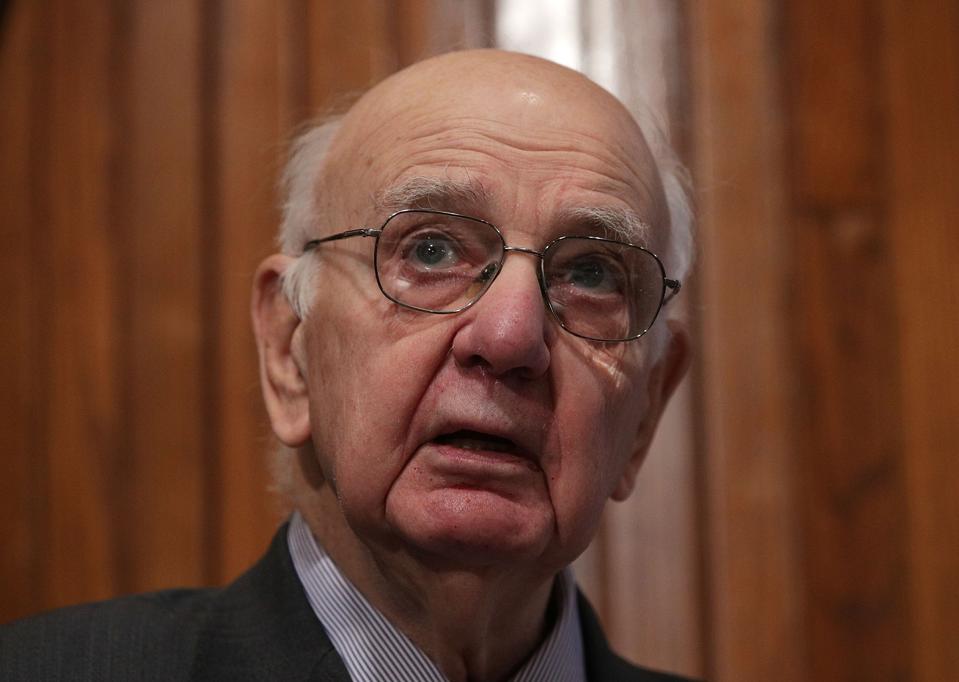
It was the late Paul Volcker, one-time head of the Federal Reserve and a near-fixture of the economics establishment for the past few decades.
The main problem with economists, Volcker said, was their inability to make accurate forecasts, according to an interview he gave to Simon Bowmaker, author of the recently published book, "When the President Calls: Conversations With Economic Policymakers."

"During my lifetime, the subject has become much more mathematical, much more abstract, and much more useless in terms of contributing to effective public policy," Volcker told Bowmaker in an interview for the book.
...the subject has become much more mathematical, much more abstract, and much more useless...
Paul Volcker, fmr Fed Chief
The former Fed chief thought the overarching reliance on math had been "overdone in many cases."
A big part of his beef wasn't the focus on number crunching itself, but rather that the numerical analysis wasn't any good for making predictions about the economy. At least the people he worked with weren't any good at it.

"There are some horrendous examples [of forecasting failure], with the recent financial crisis being the most obvious one," Volcker said. "There are hundreds of economists poring over their computers, but I think they have just demonstrated their inability to be forecasters."
That was true in the run up to the financial crisis a little over a decade ago, and it was in the late 1970s.

False Recession Alarm in 1979

The former Fed chief noted the bizarre time when in 1979, economists repeatedly told him that the U.S. was either headed for a recession or was actually in one.
"There was no recession," he said. "But when you receive those forecasts from your staff, what do you do?"
Such scares put him in a tough spot when deciding on monetary policy.
"I resent it," he said.

Volcker noted that there was a "phony recession" a year later in February 1980. The fake slump got caused by government-imposed credit controls, and the pullback reversed immediately when the constraint got lifted.
In the interview with Bowmaker, Volcker seemed to call on academic economics wizards to get out of their ivory towers and learn about the real world.
"Economists who have been in government should become better economists," Volcker said. "They now have a feel for the real world."

Or put another way, practical knowledge of how economic policy gets made could go a long way to make the profession better.
Follow me on Twitter or LinkedIn. Check out my website or some of my other work here. 
 
Simon Constable | Author | Broadcaster | Journalist | Commentator | Speaker. Author of The Wall Street Journal's 'In Translation' column. Fellow at the Johns Hopkins Institute for Applied Economics, Global Health and the Study of Business Enterprise. Former staffer for General Motors Treasurer's Office. MBA from Darden Graduate School of Business at The University of Virginia. MA New York University. MA (Hons) University of St. Andrews, Scotland. Co-author of the award-winning book The WSJ Guide to the 50 Economic Indicators that Really Matter. Have written for Middle East Eye, TheStreet.com, The South China Morning Post, Barron's, Dow Jones Newswires, MarketWatch.

martedì 10 dicembre 2019

The Taxonomy of Collapse

December 09, 2019

The Taxonomy of Collapse

Source: https://charleshughsmith.blogspot.com/2019/12/the-taxonomy-of-collapse.html

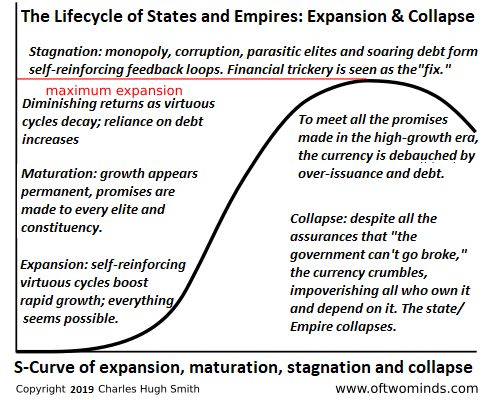
The higher up the wealth-power pyramid the observer is, the more prone they are to a magical-thinking belief that the empire is forever, even as it is crumbling around them.
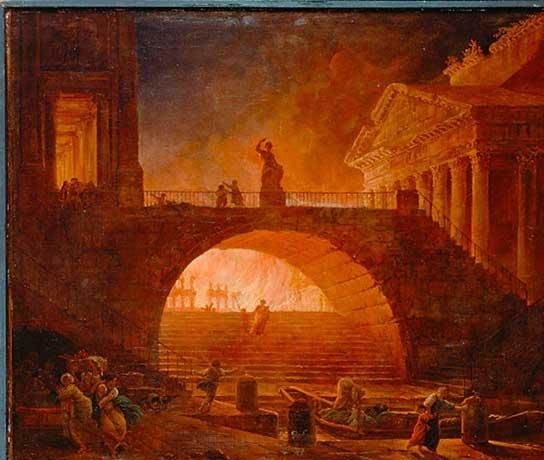
How great nations and empires arise, mature, decay and collapse has long been of interest for a self-evident reason: if we can discern a template or process, we can predict when the great nations and empires of today will slide into the dustbin of history.
One of the justly famous attempts to lay out the stages of expansion, zenith, decline and collapse is Sir John Glubb's 1978 The Fate of Empires. Succinct and deeply informed, Glubb's essay lists these stages:
The Age of Pioneers (outburst or Boost Phase)
The Age of Conquests
The Age of Commerce
The Age of Affluence
The Age of Intellect
The Age of Decadence
The slippery slope to collapse--decadence--is characterized by greed, corruption, irreconcilable internal political rifts, moral decay, frivolity, materialism--hmm, sound familiar?
All of this fits the S-Curve model which I've described here many times, for example:
But what triggers the collapse of a weakening but still functioning empire? For that, I propose a taxonomy of collapse. A taxonomy is a system of classification that groups organisms or types that share characteristics and origins.
What taxonomy of collapse does history suggest? I would start with:
1. Bolt from the blue: a fast-moving, unexpected crisis that overwhelms the usual defenses and responses of the empire. An invasion by previously unknown forces with superior technology and/or organization fits the bill: the Mongols in Eurasia, the Spanish in the New World, etc.
Extremely contagious and previously unknown infectious diseases like plague and smallpox are also bolts from the blue, devastating populations with no immunity. It is estimated that 80% or more of the population of North America died from exposure to smallpox and other European diseases, in many cases long before the victims had ever seen a European, as the diseases spread much faster than the invaders themselves.
A drought that never ends is another unexpected catastrophe that quickly depletes food stores.
These bolts from the blue can strike at the same time: one reason why the small-in-number Spanish forces conquered vast empires in the New World was the empires had already been fatally weakened by diseases introduced by Columbus decades earlier.
2. Irreplaceable declines in essential resources. Food tops the list, as a decline in calories leads to weakened immune systems and heightened odds of pandemics spreading and a subsequent drop in the number of workers needed to support the empire's vast infrastructure.
The book The Fate of Rome: Climate, Disease, and the End of an Empire makes a compelling case that the Western Roman Empire centered around the Mediterranean suffered from a slow environmental transition from an unusually wet era that enabled grain to be grown in previously marginal areas to a drier era that no longer supported the immense grain harvests needed to feed the empire.
Other forms of depletion can also sap the empire of essentials: forests are cut down, silver mines are tapped out, nearby sources of slaves (labor) are no longer available, and so on.
The imperial machinery that is accustomed to there's always more somewhere refuses to trim its expenses, elites refuse to lessen their skim, and since the fat of elite excess is retained, eventually the muscle of military power and trade decay, leaving a hollowed out empire on the edge of a precipice awaiting one final kick into the abyss.
3. Reversal of fortune. Military misadventures top the list, as invasions of nearby competing powers are in effect last-ditch gambles to acquire desperately needed wealth and resources to prop up the status quo. When the imperial army is defeated and destroyed, there are no longer sufficient resources and recruits to rebuild the army.
4. Internal civil conflict: civil wars and political conflicts that break out into society and the economy end up consuming the last of the empire's seed corn, just like an invasion of a bordering empire that fails. Once the conflict is resolved, there are no longer enough resources left to support the imperial infrastructure.
Like Nature, History offers a near-infinite variety, but just as Nature fits into taxonomies of organisms, history can be shuffled into its own taxonomy, however messy and imperfect it might be.
These triggers of collapse can overlap, of course, accelerating the final decline. All complex hierarchical systems are intrinsically fragile and prone to disruption; we don't see the fragility or vulnerabilities until the decline has reached the terminal phase. The higher up the wealth-power pyramid the observer is, the more prone they are to a magical-thinking belief that the empire is forever, even as it is crumbling around them.


My recent books:

giovedì 5 dicembre 2019

Bean Counters: PwC DOUBLE STANDARDS


Extracted from:

Bean Counters: The Triumph of the Accountants and How They Broke Capitalism

 Pag. 122

DOUBLE STANDARDS

Within a day of Lehman’s downfall, insurance giant American International Group (AIG) received the first taxpayer-funded bailout. Its AIG-FP financial products unit had badly misjudged the market by taking on huge exposures to the subprime market. Through the boom years it had been writing credit default swaps, insuring banks against losses on their holdings of subprime-laden collateralized debt obligations. When the CDOs began to falter and AIG’s own credit rating was marked down, it was forced to hand over increasing amounts of collateral, or upfront cash on account of any final payouts, to the banks on the other end of the credit default swaps.


After another rating downgrade on the day of Lehman’s collapse, AIG’s collateral needs rose to the point where it could no longer raise the cash demanded of it. To avoid another Lehman – with far-reaching consequences for all AIG-FP’s other counterparties – the Federal Reserve stepped in with an $85bn bailout.

How had a once solid insurance company come to this? Hadn’t the whole
point of AIG and its financial products arm been that it could shoulder and
manage risk? The US government’s later Financial Crisis Inquiry Commission would pin the blame on ‘its enormous sales of credit default swaps [which] were made without putting up the initial collateral, setting aside capital reserves, or hedging its exposure’. 43

In other words, AIG-FP had drastically underestimated its potential losses.


Details that would later emerge of its dealings with its largest credit default swap counterparty, Goldman Sachs, revealed the helpful role of its auditor, PwC, in the under-reporting.

When the events of 2007 hit the value of Goldman’s CDO portfolio, the bank
had reckoned that the credit default swaps it had entered into with AIG-FP as
insurance against such losses were going to have to pay out. It had therefore
demanded that AIG-FP hand over more than $1bn of collateral on account of the eventual outcome. AIG-FP had taken a different view, insisting the contracts wouldn’t have to pay out.

As the dispute rumbled on, in several quarterly and annual reports to the markets AIG and Goldman gave widely divergent values to the swaps – which could really only have one value – and thus the collateral that ought to be handed over. Goldman was using a model that marked the contracts down by as much as 40% of their full value as it now expected to receive payments to offset the premiums it was paying. Which was fine with its auditors from PwC. AIG-FP, on the other hand, had no model at all with which to value the contracts and gave them full value with no discount. Its auditors, who also happened to be from PwC and were led by the firm’s US financial services boss Tim Ryan, were fine with that, too. The world’s largest accountancy firm thus sat back as two of its biggest and most systemically important clients, with its full knowledge, valued the same assets wildly differently.

If this could happen with the same auditor on both ends of one deal, the mind
boggled at what contradictory accounting involving different auditors might be
out there. Warren Buffett’s long-standing vice chairman at Berkshire Hathaway,
Charlie Munger, voiced his exasperation in a 2009 interview: ‘Two firms make a big derivative trade. The accountants on both sides show a large profit from the same trade [when the profit on one side must equal the loss on the other] . . . and nobody’s even bothered by the fact that this is happening.’ By way of explanation for a scenario that ‘violates the most elemental principles of common sense’, he offered: ‘There’s a demand for it from the financial promoters.’ And they generally got what they wanted from the bean counters. The accounting profession, concluded Munger, ‘is a sewer’. 44

PwC did eventually prompt AIG to try to value the relevant swaps properly.
But when the model it used to do so produced an unhelpful $5.1bn loss at the
end of 2007, the company arbitrarily slashed the figure to $1.5bn. PwC nodded
its approval. More flattering results duly appeased the none-the-wiser stock
market analysts. Four months later, in February 2008, PwC told AIG that the move had been ‘improper and unsupported’, and that ‘this deficiency was a
material weakness’. The books had to be rewritten. ‘Why the auditors waited so long to make this pronouncement is unclear,’ the Financial Crisis Inquiry Commission would comment three years later, ‘particularly given that PwC had known about the adjustment in November.’ 45

Why the auditors played along with false accounting at key moments was in
fact becoming obvious. Inflated profits and hidden losses were now the life support system for the financial system, from which the bean counters were profiting just like the bankers they were serving. In 2007, PwC worldwide
earned $7bn of its $25bn revenues from financial services. 46
Hanging onto the major payers of these fees like AIG and Goldman Sachs was worth a little duplicity.

Notes:

43. Final Report of the National Commission on the Causes of the Financial and Economic Crisis in the United States, January 2011, p.273

44. Interview with Stanford University professor Joseph A. Grundfest, 2009. Available on the website of Ian Fraser, http://www.ianfraser.org/charlie-munger-getting-accounting-integrity-right-has-enormous-implications-for-future-of-mankind/

45. Final Report of the National Commission on the Causes of the Financial and Economic Crisis in the United States, January 2011, p.273.

46. PwC worldwide annual report, 2007. Income includes banking and capital markets, investment management and insurance.
https://www.pwc.co.uk/assets/pdf/annual-report07.pdf

Post in evidenza

The Great Taking - The Movie

David Webb exposes the system Central Bankers have in place to take everything from everyone Webb takes us on a 50-year journey of how the C...