To: the secretary of Hon. Bill English, NZ Deputy Prime Minister
Dear Gabrielle,
thank
You for the forwarded answer of the Minister English. The fact that NZ
banknotes are repayable-on-demand is somehow surprising and make me
think if those are legal tender or something else, like chips in a
Casino.
Another question arise: with what can the Reserve
Bank "repay" for banknotes ? Here is an insight from Wilelm Buiter:
"...fiat money is an asset of the holder but not a liability of the
issuer." and "...base money does not have to be redeemed ever, it
does not constitute an effective liability...". More from him: " [The
bank's] monetary liabilities are liabilities only in name, as they are
irredeemable: the holder of base money cannot insist at any time on
the redemption of a given amount of base money into anything
else other than the same amount of itself (base money). " http://www.economics-ejournal.org/economics/discussionpapers/2007-8/file
Now,
something fishy is going on, don't You think ? Else the liability is
consolidated in the Treasury asset side of the balance or... the real
profits of the Reserve Bank are masked by an accounting trick and there
is an ongoing gigantic fraud against the NZ people.
Court of Genoa: technical assessment on the creation of bank money
The plaintiff's lawyer.Marco DELLA LUNA
In the Italian Civil Court of Genoa, on August 18, 2016, there was a hearing in the case on the
failure to take account of the creation of money by Banca Carige.
The Carige attorney is Paolo CANEPA (brother of the magistrate Anna
CANEPA, the "Magistratura Democratica" union secretary), from the law firm ROPPO & CANEPA, who had attended DE BENEDETTI in the case of the LODO MONDADORI
against Silvio BERLUSCONI, the former Italian PM.
The lawyer asked that the case be estopped for total groundlessness, invoking the temerity of the counterparty.The
Court refers to the next hearing, October 4, 2016 at 10.15 AM, ahead of Hon. Luigi COSTANZO, President of the Chamber as well as Deputy
Chairman of the Court, to decide on the appointment of a forensic accounting expert.
The
lawyer Marco DELLA LUNA, representing the plaintiff, constituted by a
British financial company and Marco SABA, argues that the emergence of
the revenues from the creation of money by commercial banks, in the case
of CARIGE more than euro 25 billion, as well as to rehabilitation of the
Italian banking system, would lead - through subsequent taxation - to the
safety of the Italian state budget. A question arises: if everything is in order, why the management of the Genoa bank CARIGE is opposed to the inquiry ?
Deutsche Bank whistleblower rejects award because SEC 'went easy' on execs
Eric Ben-Artzi, a former risk officer, told the agency to give his
share of $16.5m award to Deutsche and its shareholders after
‘disappointing’ investigation of bank
Ben-Artzi blamed the result of the SEC’s investigation on what he says
is a cozy relationship between Deutsche Bank and the regulatory body.
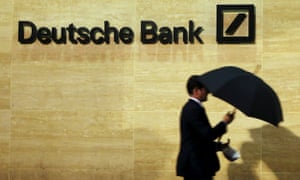
Photograph: Luke Macgregor/Reuters
Jana Kasperkevic
in New York
A Deutsche Bank
whistleblower has turned down his share of the $16.5m whistleblower
award, stating that the Security Exchange Commission (SEC) did not do
enough to punish the executives responsible for the bank’s wrongdoing.
Eric Ben-Artzi, a former risk officer, went to the regulators after
he was fired by Deutsche Bank for raising alarm over the bank’s inflated
valuation of its portfolio of credit derivatives. According to him, by
imposing a $55m fine on the bank but letting the executives off
scot-free, the SEC has instead punished the bank’s “rank-and-file”
employees and shareholders.
“I request that my share of the award be given to Deutsche and its stakeholders,” he wrote on Thursday in an opinion piece published by the Financial Times. (Ben-Artzi was eligible to receive $8.25m, according to the FT.)
He noted that financial award was a “powerful incentive” when he first
decided to help SEC and that he is not “at liberty to reject” the award
since portion of it belongs to his lawyers and his ex-wife.
Ben-Artzi said that the result of SEC’s lengthy investigation was
“disappointing” and that “top executives retired with
multimillion-dollar bonuses based on the misrepresentation of the bank’s
balance sheet”.
The reason why Deutsche Bank was only subject to a $55m fine is that
its top lawyers have long been “revolved” in and out of the SEC,
according to Ben-Artzi.
“Robert Rice, the chief lawyer in charge of the internal
investigation at Deutsche in 2011, became the SEC’s chief counsel in
2013,” he wrote. “Robert Khuzami, Deutsche’s top lawyer in North
America, became head of the SEC’s enforcement division after the
financial crisis. Their boss, Richard Walker, the bank’s longtime
general counsel (he left the bank this year) was once head of
enforcement at the SEC.”
Ben-Artzi added that Mary Jo White, the current chair of the SEC, has
known both Rice and Khuzami for as long as 20 years. She “bears the
ultimate responsibility for the Deutsche fine”, he wrote.
“We brought all of the charges supported by the evidence and the law,
which were unanimously approved by the Commission,” Andrew Ceresney,
director of the division of enforcement, said in a statement provided to
the Guardian.
White’s ties to the banking industry had previously drawn ire from
Massachusetts senator Elizabeth Warren. Last year, Warren sent White a
13-page letter telling her that she found her performance as Wall Street’s top cop “disappointing”.
Ben-Artzi,
who was fired by Rice, said that being let go ruined his Wall Street
career. He now works as vice-president of risk analytics at BondIT, a fixed-income portfolio management company.
Sherron Watkins, who blew the whistle on accounting irregularities at
Enron, previously said that more than a decade later she was unable to
get a job in corporate America.
“I have this label ‘whistleblower’ which is synonymous with troublemaker,” she said in 2014,
before praising SEC’s whistleblower program. “That’s sort of the story
of even the most well-known whistleblowers ... You are out of your
industry. That’s why I welcome this program, because you have to
reinvent yourself and it’s not always easy. Rarely do people have the
notoriety that I have, where I am on the lecture circuit. It’s a
problem.”
In his op-ed, Ben-Artzi said that while he needs the award money “now
more than ever”, he will “not join the looting” of the Deutsche Bank
shareholders.
“I never intended to turn a job in risk management into a crusade,
but after suffering at the hands of the Deutsche executives I will not
join them simply because I cannot beat them,” he wrote. He added that he would happily collect the award if the money was
“clawed back from the bonuses paid to the Deutsche executives,
especially the former top SEC attorneys”.
Earlier this year, while awarding its second largest whistleblower
award at $17m, SEC noted that the award program is instrumental in
encouraging people with insider knowledge to come forward. By June,
the SEC whistleblower program had awarded more than $85m to 32
whistleblowers. According to an analysis by the Wall Street Journal,
more awards are coming. SEC settlements with State Street Corp and Bank
of New York Mellon Corp could lead to a number of whistleblower awards
totaling $100m, according to WSJ.
Public coverage of the award announcement often leads to more tips
being sent to the SEC. Yet as Ben-Artzi’s op-ed shows, the results are
not always to the whistleblower’s liking. According to the Financial Times, Ben-Artzi is the first whistleblower to refuse an award since the program was launched in 2011.
At the end of the first quarter of this year, Switzerland’s central bank held $119.7 billion in publicly traded stocks. The Swiss National Bank’s (SNB) web site
indicates that it is now allocating 20 percent of its foreign currency
reserves to stock investing. Twelve days ago, SNB made its quarterly
filing with the U.S. Securities and Exchange Commission showing large
positions in individual U.S. stocks.
In just five tech names, SNB held over $5.3 billion with $1.489
billion invested in Apple; $1.2 billion invested in Alphabet, parent of
Google; $1 billion in Microsoft; $803 million in Amazon and $741.5
million in Facebook.
Both Apple and Microsoft are among the 30 stocks that make up the Dow
Jones Industrial Average (DJIA), a heavily watched gauge of the U.S.
economy’s health. The Swiss National Bank owns over $1 billion in two
other names in the DJIA: $1.17 billion in Exxon Mobil and $1.032 billion
in Johnson & Johnson.
Swiss National Bank positions of $500 million or more that are
components of the DJIA include: AT&T ($862 million); General
Electric ($823 million); Verizon ($739.6 million); Procter & Gamble
($718 million); Pfizer ($644 million); Coca Cola ($582 million); and
Chevron ($557 million).
Switzerland’s central bank has invested zero dollars in two DJIA
components — the two big Wall Street banks, Goldman Sachs and JPMorgan
Chase.
The Swiss National Bank is just one of more than a dozen central
banks that are now investing in publicly traded stocks – a policy that
looks like a train wreck in motion to quite a number of Wall Street
veterans.
We checked SEC filings for other central banks that are known to be
buying stocks but could find only one other listing: the Bank of Israel.
Instead of breaking down the names of the stocks, number of shares, and
dollar value of the individual position held as done by the Swiss
National Bank, the only public filing from the Bank of Israel tells us
simply that it is using three money managers to make its U.S. stock
investments. Those money managers are: UBS Asset Management Americas
Inc.; BlackRock Investment Management (UK) Ltd.; and State Street Global
Advisors Ltd.
We could find no total dollar amount indicated for the Bank of
Israel’s investments in U.S. stocks in its SEC filings but in 2013
Bloomberg News reported that the Israeli central bank had spent “about 3
percent of its $77 billion reserves on U.S. stocks,” or approximately
$2.3 billion. On June 27 of this year, Reuters reported that Israel’s
Monetary Policy Committee had approved investing as much as 10 percent
of Israel’s foreign currency reserves in stocks.
Another major central bank plowing into stocks is the Bank of Japan.
On April 24 of this year, Bloomberg News reported that the Bank of Japan
“ranks as a top 10 holder in more than 200 of the Nikkei gauge’s 225
companies…”
If one adds the stock holdings of massive sovereign wealth funds,
which are also deploying government money, to the growing stock market
participation of central banks, alarm bells start to go off. Forbes
contributor Adam Sarhan wrote the following earlier this year:
“Over the past 7 years, we have seen
unprecedented action from global central banks all aimed at keeping
stock prices up. It’s normal to see global central banks adjust monetary
policy, up or down, based on economic conditions. But it is not normal
to see global central banks print gobs of money every day to stimulate
markets and it is definitely not normal to see them buy stocks outright.
I’m not a lawyer but it raises the question: Is it even legal? I’m sure
the BOJ is not alone in this questionable activity. The U.S. Fed
refuses to be audited. One is compelled to ask: Why?”
Economist Ed Yardeni also voiced concerns on his web site in April, writing:
“In the long run, it’s hard to imagine
that having the central monetary planners buy corporate bonds and stocks
with the money they print can end well. In effect, the central banks
are turning into the world’s biggest hedge funds, financed by their own
internal primary (money-printing) dealers and backstopped by the
government — which can always borrow more from the central bank or force
taxpayers to make good on this Ponzi scheme…”
Wall Street On Parade has written a great deal about “dark pools,”
those regulator-lite trading venues that are operated by the big Wall
Street banks and function as in-house stock exchanges.
Until we start to see more granular data at the SEC on exactly what
central banks are buying and selling on U.S. stock exchanges, consider
it just more “dark pool” activity and one more reason for the public to
view these markets with a cynical eye.
In one of the few cases of insider trading
leading to an actual conviction, earlier today, a former Wall Street
investment banker was found guilty for engaging in insider trading by
tipping his father off to unannounced healthcare mergers, a victory for
prosecutors after an appellate ruling made pursuing such cases harder.
Sean Stewart, who previously worked at JPMorgan and Perella Weinberg was
found guilty by a federal jury in Manhattan on all nine counts he
faced, including securities fraud.
Stewart, 35, a Yale University graduate, was one of 107 people
accused of insider trading since 2009 by prosecutors under Manhattan
U.S. Attorney Preet Bharara. His trial was Bharara's first since a 2014
appellate ruling narrowed the scope of insider trading laws.
Stewart is scheduled to be sentenced by U.S. District Judge Laura Taylor Swain on February 17.
In a case profiled previously, prosecutors said from 2011 to 2014
Stewart provided his father Robert tips about five mergers, including
INC Research's acquisition of Kendle International Inc, so his father
could make lucrative trades before the deals' were announced. According to Reuters,
Robert Stewart, 61, in some instances had a friend he met working at a
real estate firm, Richard Cunniffe, conduct trades in his own accounts,
because of concern he was too close to the source. The trading enabled the elder Stewart and Cunniffe, 62, to make $1.16 million, prosecutors said.
Sean Stewart testified in his
own defense. He displayed no emotion as the forewoman read the verdict,
which came after more than a week of deliberation.
Robert Stewart, Sean's father, previously avoided prison for his role in the insider-trading conspiracy. In May, he was sentenced to
four years’ probation, including one year of home detention and 750
hours of community service. Under a plea agreement with the government,
he’ll forfeit the $150,000 he made from the scheme.
Stewart pleaded guilty in August to insider-trading conspiracy, just
three months after both Stewarts were charged. Prosecutors, with the
support of U.S. probation officials, had asked for a prison sentence of
at least 2 1/2 years. U.S. District Judge Laura Swain in Manhattan,
explaining her rejection of a prison term, cited Stewart’s role as
primary caregiver for his wife, who has an “unusually serious” health
condition that wasn’t discussed publicly.
Cunniffe cooperated with the government and made secret recordings to
implicate the Stewarts. In one recorded meeting, the elder Stewart said
his son once chastised him for failing to trade on a tip, quoting him
as saying, “I can’t believe I handed you this on a silver platter and
you didn’t invest in it,” prosecutors said.
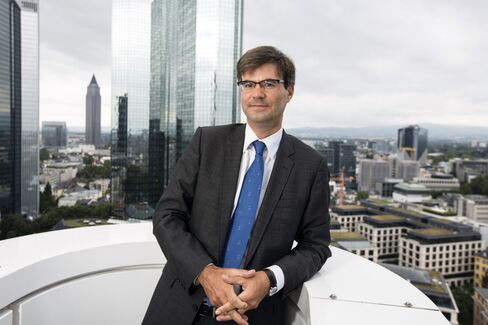
Frank Breitenbach would like to pull apart the global financial system, while he’s still in it.
And then put it back together again, only this time without credit bubbles, crises and bailouts.
It’s
an old idea that’s receiving fresh impetus in Europe as populism makes
political gains and concern grows about the stability of financial
institutions: Remove from banks the power to create money, and give it
back to the state. Exclusively.
The
proposal has appeal even among some insiders, like Breitenbach. He
couples his day job as a vice president at KfW IPEX in Frankfurt, a
state-owned provider of export financing, with his role as a member of
Monetative, an initiative to return the system to what’s known in German
as Vollgeld, which roughly translates as "whole money."
“There is
too much liquidity in the market now and it’s more or less the same
situation we had right before the 2008 crisis,” Breitenbach said in an
interview on Aug. 12, noting that he was giving his personal views, not
those of KfW. “I have the feeling that another financial crisis will
happen.”
Vollgeld’s solution would be to hand central banks
complete control of the money supply. Commercial banks would be required
to back their loans 100 percent with deposits -- whether they come from
savings, capital or their own borrowings.
In other words, lenders
would be barred from creating money out of nothing -- an inherent
attribute of the fractional-reserve banking model that’s been dominant
since the Middle Ages.
Advocates
of Vollgeld say the change is necessary to prevent the credit booms
that helped cause the last financial bust, and possibly the next.
Central banks would be able to ensure the real economy has the liquidity
it needs, and no more.
“The
amount of money that the central bank will pump into the system should
be in line with economic growth,” Breitenbach said. “It’s the central
bank’s task to take control over the amount of money” in the system, he
said.
While Vollgeld has only a handful of supporters in Germany
-- Breitenbach says his organization has about 100 members -- elsewhere
it’s gathering more steam. A Swiss version has succeeded in gathering
the 100,000 signatures needed to hold a plebiscite on the subject, and a
vote is expected around 2018.
Chicago Plan
That would be
85 years after the first version of Vollgeld was floated, as part of the
Chicago Plan of banking reforms by leading U.S. economists including
Irving Fisher in the wake of the Great Depression. Those ideas were
never implemented, but the continued drag on growth and prosperity from
the 2008 financial crisis is feeding new interest.
Vollgeld’s
counterpart in the U.K. is Positive Money, a group that also advocates
central-bank financing of government expenditure known as “People’s QE.”
A version of that has been backed by Jeremy Corbyn, the leader of the
opposition Labour party.
Adair Turner, former chairman of the
U.K.’s Financial Services Authority, and former Deutsche Bank Chief
Economist Thomas Mayer, have discussed similar ideas.
That’s
not to say Vollgeld will arrive any time soon. For a start, Breitenbach
acknowledges that either it would have to be introduced in the entire
19-nation euro area or a decision taken to break up the single-currency
bloc. Aside from the stability concerns over implementing a new system,
there’s no guarantee that the region’s citizens would trust unelected
monetary officials any more than their commercial counterparts. That’s
especially true in Germany, where the European Central Bank is viewed
with particular skepticism.
Confidence Question
There are other snags. Responding
to the Swiss initiative, the government said Vollgeld wouldn’t prevent
liquidity or solvency problems emerging at lenders. It also pointed out
that allowing the central bank to issue money without a corresponding
rise in assets might undermine public confidence in the central bank, or
in money itself.
For Breitenbach, keeping depositors’ money safe
and stemming a source of bank runs will nevertheless be a huge advance
in stability. And it doesn’t mean destroying the financial system as we
know it.
“I don’t see the contradiction between the Vollgeld
system and being a banker,” he said. “The only difference is that the
banks have to collect savings before lending. ”
That’s a critical
difference, and one Breitenbach argues the general public will find
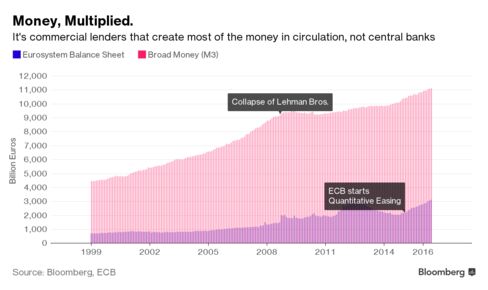
surprising. He says few are aware that it’s actually the commercial
banks that have the largest role in money creation, not the central
bank. Reverse that, and greater stability ensues, goes the thinking.
“The
Vollgeld system is actually much easier to manage than the system we
have right now,” Breitenbach said. “Most people think we already have
this system.”
To: Hon Bill English, Minister of Finance of New Zealand
On seigniorage as liability of the Reserve Bank to the Treasury
Dear Hon Bill English,
the NZ Reserve Bank buys banknotes and pays the production cost
(including a margin) for each order of notes. Banknotes are
later sold to trading banks at their face value and in turn the
face value of currency in circulation becomes a liability of the
Reserve Bank toward the NZ Treasury (seigniorage on the principal).
In fact, the correct definition of seigniorage is the difference in
value from the cost of production of the monetary medium (coins,
banknotes, electronic currency a.k.a. deposits) and is face value. In
countries where banks are NOT sovereign, the seigniorage must be
returned to the body sovereign (local Treasury Department).
Questions:
- Do you have a recorded asset in the Treasury books matching the
Reserve Bank liability over currency in circulation ?
- If not, why ?
- If it is not the Treasury, who is the current net beneficiary of
this Reserve Bank's liability ?
- Is it a NZ entity or an alien body ?
- Do you believe in aliens ?
Thank You for Your kind attention and I look forward for Your answers.