The finance curse: how the outsized power of the City of London makes Britain poorer
The finance curse: how the outsized power of the City of London makes Britain poorer
The financial sector is hailed as the crowning glory of the UK economy. But as it blooms, everything else withers. By Nicholas Shaxson
Main image:
Illustration: Katie Edwards
In
the 1990s, I was a correspondent for Reuters and the Financial Times in
Angola, a country rich with oil and diamonds that was being torn apart
by a murderous civil war. Every western visitor asked me a version of
the same question: how could the citizens of a country with vast mineral
wealth be so shockingly destitute?
One answer was corruption: a lobster-eating, champagne-drinking elite
was getting very rich in the capital while their impoverished
compatriots slaughtered each other out in the dusty provinces. Another
answer was that the oil and diamond industries were financing the war.
But neither of these facts told the whole story.
There was something else going on. Around this same time,
economists were beginning to put together a new theory about what was
troubling countries like Angola. They called it the resource curse.
Academics had worked out that many countries with abundant natural
resources seemed to suffer from slower economic growth, more corruption,
more conflict, more authoritarian politics and more poverty than their
peers with fewer resources. (Some mineral-rich countries, including
Norway, admittedly seem to have escaped the curse.) Crucially, this poor
performance wasn’t only because powerful crooks stole the money and
stashed it offshore, though that was also true. The startling idea was
that all this money flowing from natural resources could make their
people even worse off than if the riches had never been discovered. More
money can make you poorer: that is why the resource curse is also
sometimes known as the Paradox of Poverty from Plenty.
Back in the 1990s, John Christensen was the official economic adviser
to the British tax haven of Jersey. While I was writing about the
resource curse in Angola, he was reading about it, and noticing more and
more parallels with what he was seeing in Jersey. A massive financial
sector on the tiny island was making a visible minority filthy rich,
while many Jerseyfolk were suffering extreme hardship. But he could see
an even more powerful parallel: the same thing was happening in Britain.
Christensen left Jersey and helped set up the Tax Justice Network, an
organisation that fights against tax havens. In 2007, he contacted me,
and we began to study what we called the finance curse.
It
may seem bizarre to compare wartorn Angola with contemporary Britain,
but it turned out that the finance curse had more parallels with the
resource curse than we had first imagined. For one thing, in both cases
the dominant sector sucks the best-educated people out of other economic
sectors, government, civil society and the media, and into
high-salaried oil or finance jobs. “Finance literally bids rocket
scientists away from the satellite industry,” in the words of a landmark academic study
of how finance can damage growth. “People who might have become
scientists, who in another age dreamt of curing cancer or flying people
to Mars, today dream of becoming hedge-fund managers.”
In Angola, the cascading inflows of oil wealth raised the local price
levels of goods and services, from housing to haircuts. This high-price
environment caused another wave of destruction to local industry and
agriculture, which found it ever harder to compete with imported goods.
Likewise, inflows of money into the City of London (and money created in
the City of London) have had a similar effect on house prices and on
local price levels, making it harder for British exporters to compete
with foreign competitors.
Oil booms and busts also had a disastrous effect in Angola. Cranes
would festoon the Luanda skyline in good times, then would leave a
residue of half-finished concrete hulks when the bust came. Massive
borrowing in the good times and a buildup of debt arrears in the bad
times magnified the problem. In Britain’s case, the booms and busts of
finance are differently timed and mostly caused by different things. But
just as with oil booms, in good times the dominant sector damages
alternative economic sectors, but when the bust comes, the destroyed
sectors are not easily rebuilt.
Of course, the City proudly trumpets its contribution to Britain’s
economy: 360,000 banking jobs, £31bn in direct tax revenues last year
and a £60bn financial services trade surplus to boot. Official data in
2017 showed that the average Londoner paid £3,070 more in tax than they
received in public spending, while in the country’s poorer hinterlands,
it was the other way around. In fact, if London was a nation state,
explained Chris Giles in the Financial Times, it would have a budget
surplus of 7% of gross domestic product, better than Norway. “London is
the UK’s cash cow,” he said. “Endanger its economy and it damages UK
public finances.”
To
argue that the City hurts Britain’s economy might seem crazy. But
research increasingly shows that all the money swirling around our
oversized financial sector may actually be making us collectively
poorer. As Britain’s economy has steadily become re-engineered towards
serving finance, other parts of the economy have struggled to survive in
its shadow, like seedlings starved of light and water under the canopy
of a giant, deep-rooted and invasive tree. Generations of leaders from
Margaret Thatcher to Tony Blair to Theresa May have believed that the
City is the goose that lays Britain’s golden eggs, to be prioritised,
pampered and protected. But the finance curse analysis shows an
oversized City to be a different bird: a cuckoo in the nest, crowding
out other sectors. We
all need finance. We need it to pay our bills, to help us save for
retirement, to redirect our savings to businesses so they can invest, to
insure us against unforeseen calamities, and also sometimes for
speculators to sniff out new investment opportunities in our economy. We
need finance – but this tells us nothing about how big our financial
centre should be or what roles it should serve.
A growing body
of economic research confirms that once a financial sector grows above
an optimal size and beyond its useful roles, it begins to harm the
country that hosts it. The most obvious source of damage comes in the
form of financial crises – including the one we are still recovering
from a decade after the fact. But the problem is in fact older, and
bigger. Long ago, our oversized financial sector began turning away from
supporting the creation of wealth, and towards extracting it from other
parts of the economy. To achieve this, it shapes laws, rules,
thinktanks and even our culture so that they support it. The outcomes
include lower economic growth, steeper inequality, distorted markets,
spreading crime, deeper corruption, the hollowing-out of alternative
economic sectors and more.
Newly published researchmakes a first attempt to assess the scale of the damage to Britain. According to a new paper
by Andrew Baker of the University of Sheffield, Gerald Epstein of the
University of Massachusetts Amherst and Juan Montecino of Columbia
University, an oversized City of London has inflicted a cumulative
£4.5tn hit on the British economy from 1995-2015. That is worth around
two-and-a-half years’ economic output, or £170,000 per British
household. The City’s claims of jobs and tax benefits are washed away by
much, much bigger harms.
This estimate is the sum of two figures. First, £1.8tn in lost
economic output caused by the global financial crisis since 2007 (a
figure quite compatible with a range suggested by the Bank of England’s
Andrew Haldane a few years ago). And second, £2.7tn in “misallocation
costs” – what happens when a powerful finance sector is diverted away
from useful roles (such as converting our savings into business
investment) toward activities that distort the rest of the economy and
siphon wealth from it. The calculation of these costs is based on
established international research showing that a typical finance sector
tends to reach its optimal size when credit to the private sector is
equivalent to 90-100% of gross domestic product, then starts to curb
growth as finance grows. Britain passed its optimal point long ago, averaging around 160% on the relevant measure of credit to GDP from 1995-2016.
This
£2.7tn is added to the £1.8tn, checking carefully for overlap or
double-counting, to make £4.5tn. This is a first rough approximation for
how much additional GDP Britons might have enjoyed if the City had been
smaller, and serving its traditional useful roles. (A third, £700bn
category of “excess profits” and “excess remuneration” accruing to
financial players has been excluded, to be conservative.)
But what exactly are these “misallocation costs?” There are many. For
instance, you might expect the growth in our giant financial sector to
provide a fountain of investment for other sectors in our economy, but
the exact opposite has happened. A century or more ago, 80% of bank lending went to businesses for genuine investment. Now, less than 4%
of financial institutions’ business lending goes to manufacturing –
instead, financial institutions are lending mostly to each other, and
into housing and commercial real estate.
Investment rates in the UK’s non-financial economy since 1997 have been the lowest in the OECD, a club that includes Mexico, Chile and Turkey. And in Britain’s supposedly “competitive” low-tax, high-finance economy, labour productivity is 20-25% lower
than that of higher-tax Germany or France. Resources are being
misallocated as finance has become an end in itself: unmoored,
disconnected from the real economy and from the people and real
businesses it ought to serve. Imagine if telephone companies suddenly
became insanely profitable, and telephony grew to dwarf every other
economic sector – but our phone calls were still crackly, expensive and
unreliable. We would soon see that our oversized telephone sector was a
burden, not a benefit to the economy, and that all those phone
billionaires reflected economic sickness, not dynamism. But with
everyone dazzled by our high-society, world-conquering financial centre,
this glaring problem with the City seems to have been overlooked. Half
a century ago, corporations were not only supposed to make profits, but
also to serve employees, communities and society. Overall taxes were
high (top income tax rates were more than 90% for many years during and
after the second world war) and financial flows across borders were
tightly constrained, under the understanding that while trade was
generally a good thing, speculative cross-border finance was dangerous.
The economist John Maynard Keynes, who helped construct the global
financial system known as Bretton Woods, which kept cross-border finance
tightly constrained, knew this was necessary if governments were to act
in their citizens’ interest. “Let goods be homespun whenever it is
reasonably and conveniently possible,” he famously said. “Above all, let
finance be primarily national.” The fastest economic growth in world
history came in the roughly quarter of a century after the Second World
War, when finance was savagely suppressed.
From
the 1970s onwards, finance broke decisively free of these controls,
taxes were slashed and swathes of our economies were privatised. And our
businesses began to undergo a dramatic transformation: their core
purposes were whittled down, through ideological shifts and changes in
laws and rules, to little more than a single-minded focus on maximising
the wealth of shareholders, the owners of those companies. Managers
often found that the best way to maximise the owners’ wealth was not to
make better widgets and sprockets or to find new cures for malaria, but
to indulge in the sugar rush of financial engineering, to tease out more
profits from businesses that are already doing well. Social purpose be
damned. As all this happened, inequality rose, financial crises became
more common and economic growth fell, as managers started focusing their
attentions in all the wrong places. This was misallocation, again, but
the more precise term for this transformation of business and the rise
of finance is “financialisation”.
The best-known definition of the term comes from the American
economist Gerald Epstein, a co-author of the new study cited above:
financialisation is “the increasing role of financial motives, financial
markets, financial actors and financial institutions in the operation
of the domestic and international economies”. In other words, it is not
just that financial institutions and credit have puffed up spectacularly
in size since the 1970s, but also that more normal companies such as
beermakers, media groups or online rail ticket services, are being
“financialised”, to extract maximum wealth for their owners.
Take private equity firms, for instance. They typically buy up a
solid company then financially engineer that company to squeeze all its
different stakeholders, one by one. They run the company’s financial
operations through tax havens, fleecing taxpayers. They may squeeze
workers’ pay and pensions pots, or delay paying suppliers. They might
buy up several companies to dominate a market niche, then milk customers
for monopoly profits. They chisel the pension funds that invest
alongside them, with hidden fees. And so on.
Then, armed with the juiced-up cashflows from these tactics, they
borrow more against that company and pay themselves huge “special
dividends” from the proceeds. If the company, newly indebted, now goes
bust, the magic of “limited liability” means the private equity titans
are only liable for the sliver of equity they invested in the first
place – typically just 2% of the value
of the company they have bought up. Private equity investors sometimes
do make the companies they buy more efficient, creating wealth, but that
is a minority sport compared to the financialised wealth extraction.
Or,
consider the financial structure of Trainline, the online rail ticket
seller. When you buy a ticket, you may pay a small booking fee, perhaps
75p. After leaving your bank account, that 75p takes an extraordinary
financial journey. It starts with London-based Trainline.com Limited,
then flows up to another company that owns the first, called Trainline
Holdings Limited. That company is owned by another, which is owned by
another and so on.
Five companies up and your brave little 75p skips off to the tax
haven of Jersey, then back again to London, where it passes through five
more companies, then back to Jersey, then over to Luxembourg, another
tax haven. Higher up still, it passes through three or more impenetrable
companies in the Cayman Islands, then joins a multitude of other
rivulets and streams entering the US, where, 20 or so companies after
starting, it flows to KKR, a giant US investment firm.
It flows onwards, to KKR’s shareholders, including banks, investment
funds and billionaires. KKR owns or part-owns more than 180 real, solid
companies including the car-sharing firm Lyft, Sonos audio systems and
Trainline. But on top of those 180 real firms, KKR has at least 4,000
corporate entities, including more than 800 in the Cayman Islands, links
in snaking chains of entities with peculiar names drawn from finance’s
arcane lingo, like (in Trainline’s case) Trainline Junior Mezz Limited
or Victoria Investments Intermediate Holdco Limited.
This is an invisible financial superstructure, siphoning wealth from
Trainline’s genuinely useful and profitable services, upwards, away and
offshore. None of this is remotely illegal. In our age of
financialisation, this is increasingly how business is done. In
2012, Boris Johnson, then the mayor of London, stood under an umbrella
by a busy road, his blond hair whiffling in the wind. “A pound spent in
Croydon is far more of value to the country from a strict utilitarian
calculus than a pound spent in Strathclyde,” he gushed. “Indeed you will
generate jobs and growth in Strathclyde far more effectively if you
invest in Hackney or Croydon or in other parts of London.”
We are back to the idea of London as the engine of the economy. Is he
right? Will pampering Croydon, London and south-east England generate
wealth that can then be spread out to “Strathclyde”, Scotland and the
regions? Or is London the centre of a financialising machine that sucks
power and money away from the peripheries? Can an oversized City of
London and the rest of Britain prosper alongside each other? Or, for the
regions to prosper, must the City of London be humbled? This is perhaps
the defining economic question of our times. It is a question
ultimately bigger than Brexit.
The newly published research provides part of the answer; it suggests
that the power of London finance is hurting Britain, to the tune of
£4.5tn.
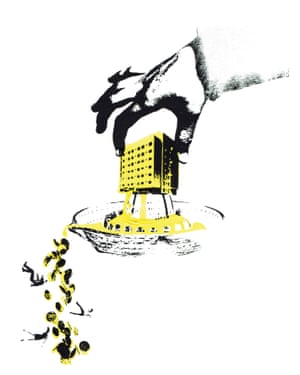
‘Private equity firms typically buy up a solid company
then financially engineer that company to squeeze all its different
stakeholders.’ Illustration: Katie Edwards
But
let’s take a more fine-grained look. If Johnson thinks money flows from
Croydon to “Strathclyde” (a Scottish administrative region, now
abolished) he may wish to ponder the Strathclyde Police Training and
Recruitment Centre, built by the construction firm Balfour Beatty and
opened in 2002 under the now-notorious private finance initiative. Under
PFI, instead of the government building and paying for projects such as
schools or hospitals directly, they get private firms to borrow the
money in the City to finance their construction, under a deal that the
government will pay them back over, say, 25 years, with interest and
extra goodies. (Cynics see PFI as an expensive way for successive
governments to hide their borrowing and spending, by outsourcing it all
to the private sector.)
The training centre (now called simply the Police Scotland Training
Centre) sits underneath a corporate latticework nearly as complex as
Trainline’s. PFI payments flow from the government to a private special
purpose vehicle (SPV) called Strathclyde Limited Partnership then flow
upwards from it through 10 or so companies or partnerships, to a £2bn
Guernsey-based firm called International Public Partnerships Limited
(INPP), then onwards via tangled shareholdings, partnerships, banking
and lending arrangements, and lawyers and accountants clipping fees
along the way, to other people and firms in London, South Africa, New
York, Texas, Jersey, Munich, Ontario and more. The pipework is complex
but the overall pattern is clear. Money flows from police budgets in
Scotland, up through these financialised pipelines and into the City,
posh parts of London and the south-east and offshore. Along the way,
profits are being made and distributed and tax is avoided.
But there is a bigger issue than tax here. Treasury data shows that
while the police training centre cost £17-18m to build, the flow of
payments to the PFI consortium will add up to £112m from 2001 to 2026,
well over six times as much, and vastly more than what the government
would have spent if it had simply borrowed that much itself and paid
Balfour Beatty directly to build it. This fits a wider pattern. The
700-odd PFI schemes in Britain had an estimated capital value of less
than £59.1bn in 2017, yet taxpayers will end up paying out more than
£308bn for them, well over five times that sum. PFI is a gift to the
City which has resulted in, as the PFI expert Allyson Pollock acidly put
it, “one hospital for the price of two”.
I
have looked at several PFI corporate structures: each has a similarly
convoluted financial architecture, and each involves a rain of payments
from British regions (including poorer parts of London) into this
central-London-focused financial nexus, overseas and offshore. And PFI
is just one component of a larger picture. About £240bn, a third of the
UK government’s annual budget, now goes on privately run but
taxpayer-funded public services, most of it run through similarly
financialised, London-focused pipelines.
On this evidence, Johnson’s picture of money flowing from Croydon to
Strathclyde has it exactly back to front. These are examples of what the
late geographer Doreen Massey called the “colonial relationship”
between parts of London and the rest of the country. To visualise what
is going on, I like to imagine old white men in top hats manipulating a
Heath-Robinson-like contraption of spindly pipework perched on top of
the economy, vacuuming up coins and notes and IOUs from the pockets of
those underneath: the workers and users of private care homes, sexual
abuse referral centres, schools, hospitals, prisons – and, of course,
those of us paying mortgages on expensive homes. All are unconsciously
paying tribute into this great invisible extractive machinery.
It is true, of course, that a chunk of the City’s money comes from
overseas, so is not extracted from Britain. That at least must be a net
benefit, surely? Not so. The core value of finance to our economy comes
not from the jobs and billionaires it creates, but from the services it
provides. Bringing in enormous quantities of overseas wealth doesn’t
provide useful services for the British economy – but it does increase
the power and wealth of the finance sector, contributing to the brain
drain, the economic crises, the crashing productivity, the predatory
attitudes, the misdirected lending and the subsequent inequality. Our
open arms to the world’s dirty money is corrupting our politics, and it
is puffing up our housing markets, penalising the young, the poor and
the weak. It is all deepening the finance curse.
Finance is a great geographical sorting machine, dividing us into
offshore winners and onshore losers. But it is also a sorting machine
for race, gender, disability and vulnerability – taking value from those
suffering reduced public services or wage cuts, and from groups made up
disproportionately of women, non-white people, the elderly and the
vulnerable – and delivering it to the City. It is a generational sorting
machine too, as PFI, risky shadow banking profits and financialised
games help the winners to jam today, with the bills sent to our kids.
This hidden tide of money flows constantly from the tired, the weak,
the vulnerable huddled masses across Britain, up through these invisible
filigree pipelines to a relatively small number of white European or
North American men in Mayfair, Chelsea, Jersey, Geneva, the Caymans or
New York. This is the finance curse in action. And it’s nice work if you
can get it.
Why
can’t we do something about the overwhelming power of finance? Why are
the protests so muted? Why can’t we tax, regulate or police City
institutions properly?
We can’t, and we don’t, not just because the City’s money talks so
loudly, but also because of an ideology that has bamboozled us into
thinking that we must be “competitive”. The City is going head to head
with other financial centres around the world, they cry, and if we are
to stay ahead in this race, we cannot hold it back with tough
regulations, clod-hopping police snooping around, or “uncompetitive” tax
rates. Otherwise, all that money will whoosh off to Geneva or Hong
Kong. After Brexit, it will be even more urgent to stay competitive.
“We must be competitive” – it sounds great, right? Tony Blair
embraced this concept, even before he slammed the Financial Services
Authority in 2005, saying it was seen as “hugely inhibiting of efficient
business by perfectly respectable companies that have never defrauded
anyone”. David Cameron bowed down to this competitiveness agenda when he
declared that “We are in a global race today... Sink or swim. Do or
decline.” Theresa May reiterated the idea last month when she declared
that Britain would be “unequivocally pro-business” with the lowest
corporate tax rate among G20 countries.
Many people in Britain, it is true, are ambivalent about all this.
They rightly fret that the City is a global money-laundering paradise,
harming other nations, but (whisper it quietly) they like the hot money
and oligarchs it attracts to our shores. There is a trade-off, they
think, between doing the right thing and preserving our prosperity. Some
do understand that if other countries follow suit with this
competitiveness agenda, a race to the bottom ensues, leading to
ever-lower corporate taxes, laxer financial regulation, greater secrecy,
looser controls on financial crime and so on. The only answer to a race
to the bottom, they gloomily conclude, is to agree some sort of
multilateral armistice to get countries to co-operate and collaborate in
not doing this stuff. But that is like herding squirrels on a
trampoline: each country wants to out-compete the others, so there will
be cheating on any deal. And it is hard to mobilise voters on this
complex, distant global stuff. So, they sigh, we are stuck in this ugly
race to the bottom.
But there is some tremendous good news here: these people are all
flat wrong. The competitiveness agenda, driving us into this race, is
intellectual nonsense resting on elementary fallacies, lazy assumptions
and confusions. And this is for a few simple reasons. For one thing,
economies, tax systems and cities are nothing like companies, and don’t
compete like we might think. To get a taste of this, ponder the
difference between a failed company, such as Carillion, and a failed
state, such as Syria. Even more to the point, the finance curse shows us
that if too much finance harms your economy, then pursuing more finance through the competitiveness agenda will make things worse.
Underpinning
all this is the fallacy of composition, whereby the fortunes of our big
businesses and big banks are conflated with the fortunes of our whole
economy. Making HSBC or RBS more globally competitive, the thinking
goes, will make Britain more competitive. But to the extent that their
profits are extracted from other parts of the British economy, their
success hurts Britain more than it helps.
To see this more clearly, consider corporate tax cuts, for instance.
In the last eight years, Britain has slashed its main corporate tax rate
from 28% to 20%, cutting tax revenues by more than £16bn. Theresa May
now wants to go further, as a magic open-for-business elixir to address
the Brexit mayhem.
What could Britain do with that £16bn? We could simultaneously run
nine Oxford Universities, double the resources of Britain’s Financial
Conduct Authority, treble government cybersecurity resources, and double
staff numbers at HMRC, the tax authorities. Or we could send nearly
half a million kids to Eton each year, if you could fit them all in.
Does this trade-off somehow make Britain’s tax system, or Britain
itself, more competitive? Of course not.
Corporate tax cuts are in fact just one of many varieties of goodies
that we shower on the mobile financiers and multinationals. The same
basic arguments hold in other areas, too. Better financial regulation
brings benefits, while also scaring away the wealth-extracting
predators. It is a win-win. There is no trade-off.
Words such as competitiveness and related terms (such as the even
more fatuous UK Plc) are wielded to trick millions of taxpayers into
thinking that it is in their own self-interest to hand over goodies –
tax cuts, financial deregulation, tolerance for monopolies, turning a
blind eye to crime and more – to large multinationals and financial
institutions. We are permanently at a tipping point, we are told: all
that investment is about to disappear down a gurgling global plughole
unless we cut taxes and deregulate, NOW, I tell you.
But this is not how investment works. Big banks and financialised
multinationals say they need corporate tax cuts: of course they do, just
as my children say they need ice-cream. But in survey after survey,
business officials say that when they are deciding where to invest, they
want the rule of law, a healthy and educated workforce, good
infrastructure, access to prosperous, thirsty markets, good inputs and
supply chains and economic stability. All these require tax revenues.
Low taxes usually come a distant fifth, sixth or seventh in their
wish-lists. As the US investor Warren Buffett put it: “I have worked
with investors for 60 years and I have yet to see anyone [...] shy away
from a sensible investment because of the tax rate on the potential
gain.”
We need investment that is embedded in the local economy, bringing
jobs, skills and long-term engagement, where managers send their kids to
local schools and the business supports an ecosystem of local supply
chains. This is the golden stuff, and if an investment is nicely
embedded, a whiff of tax won’t scare it away (even if Brexit might). Any
investor who is more sensitive to tax has, almost by definition,
shallower roots. So taxes will tend to discourage the flightier, more
predatory, more financialised investors, who bring fewer jobs and local
linkages, and higher corporate tax revenues pay for ingredients that
attract investors: roads, police forces, courts, and the educated and
healthy workers. To prosper, Britain should increase its effective
corporate tax rates, at least for financiers and large multinationals.
Of
course, you could also argue that the best way to become more
competitive would be for a country to invest in and upgrade education or
infrastructure, control dangerous capital flows across borders, manage
the exchange rate, or carefully target industrial policies to nurture
productive domestic economic ecosystems. You could insist that something
called “national competitiveness” must meet the test of productivity,
good jobs and a broad-based rise in living standards. There are
respectable arguments along all these lines.
But these are not the visions that Blair, Cameron, May, Trump and
other finance-captured leaders have been pushing. Their competitiveness
agenda is about pursuing rootless global capital in a dog-eat-dog world.
Give big banks and multinationals the goodies, and look the other way
when they behave badly, in the craven and pathetic hope that they won’t
run away.
Any country engaging in a race to the bottom on this stuff also needs
to understand that the race does not stop when tax rates reach zero.
There is literally no limit to the extent to which corporate players and
the wealthy wish to free-ride off the taxes paid by the rest of us.
Eliminate their taxes, appease them, and they will demand other
subsidies, like the playground bully. Why wouldn’t they?
And yet your local car wash, your barber, or your last surviving
neighbourhood fruit-and-veg merchant can’t credibly threaten to jump to
Monaco if they don’t like their tax rates or fruit hygiene regulations.
The agenda favours the mobile big players with handouts, leaving the
domestic small fry to pay the full price of civilisation – plus a
surcharge to cover the roaming members of the billionaire classes who
won’t. The agenda systematically shifts wealth upwards from poor to
rich, distorting our economies, reducing growth and undermining our
democracies. It is always harmful.
The competitiveness agenda is a billionaire-friendly hoax. Most
competent economists know this already. “If we can teach undergraduates
to wince when they hear someone talk about competitiveness, we will have
done our nation a great service,” the US economist Paul Krugman explained in a 1993 paper. “A government wedded to the ideology of competitiveness,” he later added, “is as unlikely to make good economic policy as a government committed to creationism is to make good science policy.” So
the competitiveness agenda is an intellectual house of cards, ready to
fall. If we can topple it, we can tackle the finance curse. It is pretty
straightforward, in fact. In the 1983 movie War Games, a computer geek
hacks into the US Department of Defense’s supercomputer and gets dragged
into a game of strategy called Global Thermonuclear War. As the game
merges with reality, the machine races through thousands of scenarios
before concluding: “A strange game. The only winning move is not to
play.” Britain is in the same position. By joining this “competitive”
global race we have not only been beggaring others – we have been
beggaring ourselves, too. We can, and we must, simply step out of the
race, unilaterally. That last word, unilaterally, is key. We can just
stop it. This is a race for losers.
We need not bow down to the demands of monopolists, foreign
oligarchs, tax-haven operators, wealth-extracting private equity moguls,
too-big-to-jail banks, or PFI milkers. We can tax, regulate and police
our financial sector as we ought to. Global coordination and cooperation
are worth doing where possible, but we need not wait for it. And by
appealing to national self-interest, we can mobilise the biggest
constituency of all, and put finance back in its rightful place: serving
Britain’s people, not served by them.
Adapted from The Finance Curse: How Global Finance Is Making Us
All Poorer by Nicholas Shaxson, published by Vintage on 11 October and
available from guardianbookshop.com • Follow the Long Read on Twitter at @gdnlongread, or sign up to the long read weekly email here.
 ‘The competitiveness agenda is an intellectual house of cards, ready to fall.’ Illustration: Katie Edwards




Nessun commento:
Posta un commento