venerdì 8 gennaio 2021

Janet Yellen’s Cash Haul of $7 Million Is Just the Tip of the Iceberg

Janet Yellen’s Cash Haul of $7 Million Is Just the Tip of the Iceberg; She Failed to Report Her Wall Street Speaking Fees from JPMorgan and Others in 2018

David Zervos of the Jefferies Group on April 2, 2018 with Janet Yellen at a Speaking Engagement for Which She Was Paid Lavishly

David Zervos of the Jefferies Group on April 2, 2018 with Janet Yellen at a Speaking Engagement for Which She Was Paid Lavishly, But Has Failed to Say How Much

By Pam Martens and Russ Martens: January 6, 2021 ~

Source:  https://wallstreetonparade.com/2021/01/janet-yellens-cash-haul-of-7-million-is-just-the-tip-of-the-iceberg-she-failed-to-report-her-wall-street-speaking-fees-from-jpmorgan-and-others-in-2018/

On December 29 we needed a clarification from former Treasury Secretary Larry Summers about his opinion column against Congress issuing $2,000 stimulus checks. We sent him an email at 10:13 a.m. and received a very clear response from him directly at 12:51 p.m. that day — a span of a few hours.

Compare that timely response to Janet Yellen’s respect for the media’s obligation to report a full set of facts to the American people. Three days ago, we contacted Yellen at four different entities with which she is affiliated. Only the Brookings Institution responded, saying she was on leave. President-elect Joe Biden’s media team did not respond at all, nor did the Washington Speakers Bureau and University of California, Berkeley.

Yellen is Biden’s nominee for U.S. Treasury Secretary. In anticipation of her Senate confirmation hearing, she has released her financial disclosure forms which showed a windfall of more than $7 million in speaking fees since she left her position with the Federal Reserve. The bulk of that money came from Wall Street firms, which are variously regulated and bailed out by the Fed.

Our question for Yellen is an uncomfortable one: why did her financial disclosure form report her cash haul from Wall Street’s serially charged trading houses for just the years 2019 and 2020 when common sense suggests her biggest haul would have been in 2018, when her knowledge of the thinking at the Fed was most timely.

Yellen stepped down as Chair of the Federal Reserve on February 3, 2018 when President Trump failed to renominate her for the position of Chair. Yellen was a Fed Governor before becoming its Chair and that term didn’t expire until 2024. Yellen could have remained at the Fed and functioned as a public servant. Instead, in the very same month that she stepped down at the Fed, she signed an exclusive contract with the Washington Speakers Bureau.

Less than two months after stepping down from the Fed, Yellen was raking in huge fees for chumming around with, and delivering her bits of wisdom to, the mega trading houses on Wall Street: the very same folks who blew up the U.S. financial system in 2008 and received a super-secret $29 trillion bailout from the Fed. The details of the Fed’s obscene bailout were made public three years after the fact under a federal court decision and government audit.

Yellen’s first event on April 2, 2018 was reported by Reuters. Yellen was hosted by Jefferies Group LLC where she first answered questions from 100 of its top clients – such as hedge funds. That same evening, she dined at the penthouse of Jefferies’ CEO with 40 of his chosen guests at a sit-down dinner. Yellen declined to tell Reuters what she was paid for the event.

David Zervos, Chief Strategist for Jefferies, Tweeted a photo of himself with Yellen from the event, stating: “An amazing evening last night hosting Janet Yellen for our clients in NY.”

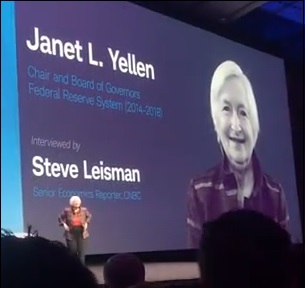
Janet Yellen Appears on Stage at the Schwab IMPACT Conference in Washington, D.C. in October 2018

Janet Yellen Appears on Stage at the Schwab IMPACT Conference in Washington, D.C. in October 2018

We also know from this YouTube video and press release that Yellen was a speaker during the October 28-31, 2018 Charles Schwab IMPACT conference, held at the Walter E. Washington Convention Center in Washington, D.C. We have yet to learn what she was paid for that event.

Bloomberg News also reported Yellen’s presence at their November 6-7, 2018 New Economic Forum in Singapore, writing that Yellen said it was “unclear whether the U.S. has the appropriate tools to deal with some of the new, emerging risks.” The public has no knowledge of what Yellen charged to speak in Singapore.

And we know from a press release from the CME Group, owner of futures exchanges, that Yellen spoke at its annual Global Financial Leadership Conference at the Ritz-Carlton beach resort, held November 12-14, 2018 in Naples, Florida. Again, the specific amount she was paid for this event has been withheld by Yellen.

According to Yellen’s financial disclosure form, she was speaking as many as four or more times a month during 2019. For example, in just the month of March, 2019, Yellen raked in the following from the finance sector in speaking fees:

March 3, 2019: Standard Chartered Bank, $270,000

March 6, March 11, and March 12, 2019: three speaking events at Citigroup for $217,200 each for a total of $651,600

Citigroup received the largest secret bailout from the Fed in global banking history, representing more than $2.5 trillion in cumulative, below-market rate loans from December 2007 through at least the middle of 2010, according to the audit released in 2011 by the Government Accountability Office (GAO).

We know that Yellen has not fully disclosed her financial entanglements with Wall Street because page 8 of her financial disclosure form asks her to list her “sources of compensation exceeding $5,000 in a year.” Under that heading, Yellen lists JPMorgan Chase, Morgan Stanley, Carlyle Investment Management. And she states the source of the income from those firms resulted from her being a “speaker.” But Yellen has not included those firms and others in her details of income for 2019 or 2020, leaving the reader to assume that she was paid for speaking events at these firms in 2018, while failing to report the specific amounts of income from each.

How much Yellen was paid by the five-count felony firm of JPMorgan Chase is a matter of national interest (and potentially national security), considering that the Fed did not force out the bank’s CEO, Jamie Dimon, as he presided over all five of those felony counts in a six-year span. The bank admitted guilt to all five felonies.

Yellen needs to immediately come clean with the American people as to just what happened in 2018 after she left the Fed. As Treasury Secretary, Yellen would not only have control over the slush fund called the Exchange Stabilization Fund, which the New York Fed can use to trade in gold, stocks and currencies, but Yellen will also Chair the Financial Stability Oversight Council (F-SOC), which makes decisions on threats posed to the U.S. financial system by those very same banks that have provided millions to enrich Yellen.

As Senior Reporter Jesse Eisinger of ProPublica Tweeted: “Deeply troubling two-fisted money grab from banks by Janet Yellen. This is corruption, but isn’t called that because it’s so quotidian.” Eisinger also noted: “Sure, Yellen might think she can make independent decisions once in office. But how arrogant is it to imagine that money corrupts everyone but you?”

sabato 26 dicembre 2020

Lebanon to ask consultants A&M to resume central bank audit


Lebanon to ask consultants A&M to resume central bank audit

Lebanon to ask consultants A&M to resume central bank audit
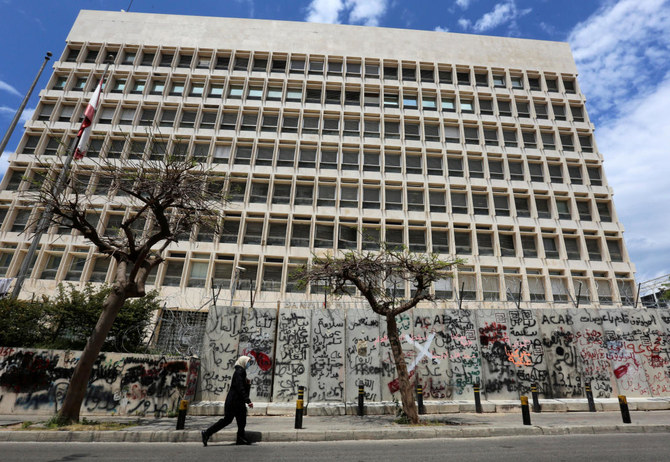
A woman wearing a protective mask walks past Central Bank building as Lebanon extends a shutdown to curb the spread of the COVID-19 in Beirut, Lebanon, May 5, 2020. (File/Reuters)
Updated 23 December 2020
930
  • Parliament agreed this week to lift banking secrecy for one year, after the restructuring consultancy pulled out of the audit

BEIRUT: Lebanon’s finance minister said on Wednesday the country would contact Alvarez & Marsal to resume a forensic audit of the central bank, a key condition for foreign aid that has hit a roadblock.
Parliament agreed this week to lift banking secrecy for one year, after the restructuring consultancy pulled out of the audit, saying it had not received information it required.
“It was decided based on the law from parliament and government decisions to contact the firm A&M to resume the forensic audit,” the minister’s office cited him as saying after meeting with the president.

venerdì 18 dicembre 2020

Former Goldman CFO Calls For Universal Basic Income "To Stave Off Revolution"

 Former Goldman CFO Calls For Universal Basic Income "To Stave Off Revolution"

Former Goldman Sachs CFO Marty Chavez thinks that income redistribution via Universal Basic Income (UBI) is the only way to stave off revolution as the wealth gap continues to increase.

In an interview with The Business of Business, host Gregory Ugwi asked Chavez if he agrees with Rep. Alexandria Ocasio-Cortez (D-NY), who says "there should be no billionaires in the US as long as there are poor families," adding that venture capitalist Paul Graham says that income inequality is a "natural part of capitalism, and a sign that the process is working."

Chavez, a Democrat donor (most recently Pete Buttigieg's presidential bid), agreed that the income gap is a consequence of capitalism, but said "at the same time, it isn't an inevitable feature of capitalism that the inequality be as extreme as it's getting. There have been long periods in American history where there was always inequality - but it wasn't this kind of inequality."

He also isn't a fan of AOC, saying "I am not in AOC's camp - at all. I didn't vote for her, I wouldn't vote for her. I hear her, and she's just not saying anything that makes any sense to me."

"At the same time, I'm a big proponent of a universal basic income.

My personal view is that if you're just being pragmatic and looking at inequality - and not thinking about some abstract concept of justice - you don't want the inequality to be so extreme that it leads to revolution. So you ought to be prepared to pay to decrease that probability.

This is what I say to, you know, friends who you might call 'oligarchs,' right? Why it would make sense for everybody to have some baseline income and why we should all pay for it."

Watch:


martedì 15 dicembre 2020

Essential step: the adoption of forensic audit in Central Bank accounts

President Aoun Highlights Lebanon’s Desire to Reinforce Relations with EU

Source: https://english.almanar.com.lb/1216096


President of the Republic, General Michel Aoun, asserted Lebanon’s desire to strengthen relations with the European Union, which stood by the Lebanese in the recent Beirut Port explosion ordeal. President Aoun welcomed any assistance which the EU could provide to Lebanon to help it in the economic recovery plan, “Whose implementation would be among the priorities of the future Government”, indicating that “The adoption of forensic audit in Central Bank accounts and official institutions and departments is an important and essential step on the path of reform that the Lebanese and international community are demanding, in order to combat corruption”.

Stances of the President came while meeting a delegation from the European Parliament, today at the Presidential Palace, which included MPs, Terry Mariani, and Jean-Lynn Lacappel, who is in Lebanon on an exploratory visit.

Discussions tackled Lebanon’s relationship with the European Union and the Parliament, in addition to political positions related to the current crises, in Lebanon and the region. The aid provided by the EU to Lebanon, method of its disbursement, and the bodies which followed it up, were also deliberated during the meeting, where the European Parliamentary delegation affirmed desire to help Lebanon in all fields, especially after recent developments.


Lebanon: The forensic audit donors demand is dead. Who killed it?

Economy|Business and Economy

Lebanon: The forensic audit donors demand is dead. Who killed it?

An audit of Lebanon’s central bank is a key condition for international aid, but special interests have torpedoed it. 

The country's central bank has been a focal point for protesters to voice anger over the Lebanese pound which has lost 80 percent of its value against the US dollar since last year [File: Mohamed Azakir/Reuters]

Lebanon is seeking tens of billions of dollars in aid from donor nations and the International Monetary Fund (IMF) to help resolve a crushing financial crisis. But they said aid would only flow following a forensic audit of the central bank, known as the Banque du Liban (BDL).

“I am personally completely shocked,” a Western diplomat told Al Jazeera on Friday.

In a phone interview with Al Jazeera, Wazni said A&M informed him on Friday that it had lost confidence it would ever receive the documents it needed from the central bank some two and a half months after it signed a contract to begin the audit.

Two weeks earlier, Wazni had announced a three-month extension to a deadline for BDL to provide A&M with all the information it needed. BDL had provided answers to fewer than half of A&M’s questions, citing Lebanon’s banking secrecy laws.

I’m surprised by their decision

Lebanon's Caretaker Finance Minister Ghazi Wazni

“[A&M] said they were sure that in these three months they won’t get the documents to do their work and asked for the termination of the contract,” Wazni told Al Jazeera. “They should have waited because there were proposals in the works to lift the banking secrecy laws. I’m surprised by their decision.”

Nasser Saidi, a former vice governor at the central bank, said the decision likely came down to considerations over A&M’s image.

“Incredibly, this company cares more about its own reputation than Lebanon cares about its reputation,” Saidi told Al Jazeera. “They are professionals, they wanted to do a professional job, they were prevented from doing so and now we’re back to square one.”

He said BDL’s reliance on banking secrecy laws to withhold information was “a pretence” and that neither the central bank nor the finance ministry had “any willingness to undertake the forensic audit”.

now we’re back to square one

Nasser Saidi, fmr vice governor, Banque du Liban

BDL’s claims have also been discredited by top political and judicial officials including the prime minister, justice minister and the prestigious Beirut Bar Association.

“I think the laws are fine,” Caretaker Justice Minister Marie-Claude Najm told Al Jazeera in late October. “We are talking about money of the people and the state – if you can’t investigate that, what can you do in a country? This would mean there are institutions above law and accountability.”

Najm and caretaker Prime Minister Hassan Diab have accused the central bank’s governor, Riad Salameh, who has held the office since 1993, of obstructing the audit to protect the interests of the country’s financial-political elite.

“Riad and the big boys behind him [killed the forensic audit]. As long as he’s there he’s protecting the system,” a financial source with first-hand knowledge of the process told Al Jazeera.

Too big to care

Lebanon’s deep financial crisis has its roots in decades of alleged corruption and mismanagement by a group of businessmen and armed faction leaders who entered government after the end of the country’s civil war in 1990.

In October 2019, the country was swept by massive protests calling for the removal of that ruling class, fuelled by the collapse of the country’s economy which led the currency to decouple from a two-decade-old US dollar peg.

The Lebanese pound has since lost more than 80 percent of its value against the greenback. Half of the population has fallen below the poverty line.

Yet despite this downward spiral, repeated attempts by Diab’s government to meet the conditions set by the international community have been trounced.

An attempt to endorse capital controls limiting transfers of money abroad – effectively an attempt to legalise measures already implemented by private banks at their own discretion – failed when Wazni withdrew the bill under directives from Speaker Nabih Berri, who appointed him.

Berri, who heads the Amal Movement, which holds the most Shia seats in the parliament, is a figurehead of the country’s old guard who has held his post since 1992.

The cabinet’s financial rescue plan – which sought to have banks and big depositors bear the brunt of the losses in the financial system, rather than small depositors – was held up by a so-called parliamentary “fact-finding” committee made up of MPs representing the elite, many of whom stood to lose from the plan themselves.

The plan was never implemented.

Now, it looks like the forensic audit is taking a similar path.

Twitter: @UNJanKubis
·
Nov 20
Why it seems that foreigners are more concerned about the well-being and fate of #Lebanon  and its people, more alarmed by lack of action and procrastination than the country’s political elites?

It has faced obstruction since April, when it was approved by the cabinet. By July, no contract had been signed, at which point Wazni admitted that his backers – a reference to Berri – were against the audit.

Wazni then said that the issue was the alleged Israeli ties of Kroll, the renowned forensic auditing firm the cabinet had decided to retain for the job. So Kroll was tossed out, and in late July, the cabinet agreed once again to carry out the audit, this time with A&M, a firm not specialised in forensic auditing.

Wazni then signed the contract with A&M in September.

The outgoing finance minister told Al Jazeera that he believed “70 percent” of the contract could be implemented without an amendment to Lebanon’s banking secrecy laws – a stunning admission.

The company will now be paid $150,000 for services rendered. Wazni said he would be meeting with the president and prime minister on Saturday to decide the path forward.

Mike Azar, a senior financial adviser and expert on the Lebanese financial crisis, believes the audit not only would have uncovered potential crimes and fraud committed over decades, but allowed for a detailed diagnosis of what went wrong in Lebanon’s financial system.

“Losing the audit is a loss not just in terms of fighting corruption and potential crimes people deserve to know about … but also a very important part of any effective and optimal financial recovery plan to make sure the problems of the past are not repeated again, and to strengthen institutions,” Azar told Al Jazeera.

Saidi said: “We can still rescue Lebanon, but what’s incredible is that despite the willingness of the international community to help, and despite the IMF and the World Bank’s willingness to help, the leadership in Lebanon has effectively refused that help.”

The United Nations Special Coordinator for Lebanon, Jan Kubis, said as much in a tweet on Friday: “Why it seems [sic] that foreigners are more concerned about the wellbeing and fate of Lebanon and its people, more alarmed by lack of action and procrastination than the country’s political elites?”

sabato 12 dicembre 2020

The ECB digital Euro: the good and bad things it can do

real-world economics review, issue no. 94
All the good things a digital euro could do – and all the bad things it will

Norbert Häring [Germany]

You may post comments on this paper at https://rwer.wordpress.com/comments-on-rwer-issue-no-94/


“What would happen if we gave the Earthlings our technological knowledge and methods? The first to seize upon them and use them to increase their own power would be the ruling class in all countries. This would be inevitable, because they already control the means of production and control the loyalty of 99% of all the scientists and engineers. In other words, they are the only ones who can apply the new technology, and they will use it to the exact extent that it can help them increase their power over the masses” - (Alexander Bogdanov, Red Star, 1908).

On 2 October, the European Central Bank (ECB) announced in a press release that it intends to intensify its work on a digital euro. The ECB enumerated three scenarios under which it might want to issue a digital euro: (i) a sharp decline in the use of cash, (ii) “the launch of global private means of payment that might raise regulatory concerns and pose risks for financial stability and consumer protection” (read: Libra), and (iii) a broad take-up of central bank digital currencies (CBDC) issued by foreign central banks (read: digital yuan).

With a digital euro one could, if one wanted and was allowed to, actually do some good, namely:

- create a supplement for cash that protects privacy better than other digital means of payment,

- give citizens and companies an alternative to bank money which always carries the risk of bankruptcy,  

- curtail the power of banks, by taking away or limiting their power to create money,

- help prevent a private company such as Facebook, with its own globally accepted currency, from crowding out the euro in payment transactions,

- prevent China from using its digital yuan to replace the euro (or the dollar) as a transaction currency.

On the other hand, however, it is also possible to do rather underhanded things with it, especially:

- facilitate and accelerate the abolition of cash in order to perfect financial control over citizens,

- defend and expand the sanctioning power of the U.S. government, with which it enforces its own law worldwide, including in Europe, in violation of international law.

I will briefly explain what a digital euro is and how it works. Then I will deal with the all-important questions of who controls it and to what end.


What is a digital euro?

Deposits at banks that are denominated in euro and can be used for all sorts of digital payments are already in existence. However, these deposits legally are only loans from the depositors to the banks which confer the right to be paid back with real money, i.e. physical euros issued by the central bank. A genuine digital euro would be digital money from the central bank.

So far, only banks have access to digital central bank money. They have account balances at the central bank through which they effect payment transactions among themselves. The main innovation of digital central bank money (for everyone) would be that everyone would have direct or indirect access to such central bank money, and could use it for digital payment transactions. There are two ways to achieve this:

1. Everyone gets an account at the central bank for payment transactions. The balances on this account are exchangeable on a one-to-one basis with balances at commercial banks or cash. Like cash, these balances are not at risk of insolvency because the central bank is behind them.

2. Alternatively, citizens would have special accounts at commercial banks for digital central bank money. Unlike normal bank deposits, the balance on these accounts is not a loan to the bank, but an escrow account. The account holder is the owner of the money on it, the bank only manages it as a service provider. If these accounts exist, the digital central bank money can be transfered from some commercial bank’s central bank account to a private CBDC-account at a commercial bank.

If the central bank would want to protect financial privacy of citizens, it could offer the possibility to load the digital euros onto anonymous electronic wallets or cards that can be used to make anonymous payments. That sounds good and it could be. But there is a big downside. It will not happen.


The real agenda

Anyone who believes that those same central bankers, which have been working together for ten years under US leadership to push back cash, would design central bank digital currencies in such a way that more than small amounts can be paid anonymously, is highly naive. A case in point is the treatment of rechargeable credit cards, which one could use to shop on the Internet while maintaining privacy.

The EU Commission and central bankers have acted to restrict the possibilities of use and the permitted amounts more and more, to the point that the option is hardly relevant any more. Why should those same people and working groups, who have done this, suddenly rediscover their respect for the value of people’s financial privacy when it comes to central bank digital money?

And indeed, where the central bank’s plans are already well advanced, in Sweden, there is only talk of small amounts of CBDC which might be allowed to be spent anonymously. And even that could be stopped at any time.

In Sweden, central bank digital money is recognizably intended to mitigate the disadvantages associated with the impending and intended complete elimination of cash. One of these disadvantages is that, without cash as the only central bank money, there is no longer a clear legal anchor for the monetary system. If bank money represents a legal claim to the legal tender cash, what is bank money when there is no more cash?

The Swedish central bank has already written a paper on this, in which it concluded that it would be quite complicated. If you declare central bank digital money another form of legal tender, this problem is solved.

Also, the problem of people without a bank account, which is currently impeding the removal of cash for legal reasons, can be solved more easily if the state can simply issue payment cards to everybody which can be loaded with central bank money.


Privacy and cash to be abolished

Just how much respect for privacy can be expected is shown by the fact that only a small paragraph in the long report of a working group of major central banks, including the ECB, together with the Bank for International Settlements (BIS), which was presented at the beginning of October, is devoted tothis topic. It just summarily proclaims that a balance will have to be struck between privacy and governments’ interest in monitoring citizens, and that it is not about the if of surveillance, but only about how much and by whom:

“For a CBDC and its payment system, payments data will exist, and a key national policy question will be deciding who can access which parts of it and under what circumstances.”


The central banks proclaim that they will continue to offer cash as long as the citizens want it, but nothing more than that. There is no joint commitment to preserve the availability and usability of cash, so that citizens retain an interest in using it. There are recent commitments to that effect by individual central banks, including the ECB. We will have to see if they are meaning it or just paying lip service.

In the higher echelons of the Bank for International Settlements (BIS), which coordinated the group, the intention to get rid of cash is clear enough. Here is a quote from the secretary general of the BIS, Augustin Carstens, from a 2019 speech entitled “The future of money and payments”. The former head of the Mexican central bank and a graduate of Chicago University is Washington’s man at the head of the BIS and a proven fighter against cash.

“Like cash, a CBDC could and would be available 24/7, 365 days a year. At first glance, not much changes for someone, say, stopping off at the supermarket on the way home from work. He or she would no longer have the option of paying cash. All purchases would be electronic. But from here, differences start to emerge. A CBDC is not necessarily anonymous, like cash. And unlike cash, it could pay or charge interest. ”


The ambiguous attitude of the ECB

I do think, that the ECB or at least many at the ECB mean it when they say they want to support the use of cash. I doubt, though, that they will prevail against the powerful interests who want to see cash gone. The report of the ECB working group published in October is quite clear with regard to the chances of getting a digital Euro which would preserve privacy:

“Regulations do not allow anonymity in electronic payments and the digital euro must in principle comply with such regulations. Anonymity may have to be ruled out, not only because of legal obligations related to money laundering and terrorist financing, but also in order to limit the scope of users of the digital euro when necessary –for example to exclude some non-euro area users and prevent excessive capital flows.”

The users from outside the euro area who could be blocked are, of course, only one example. Anyone can be blocked and the money flows of the whole population can be controlled and limited if, thanks also to the digital euro, there is no more cash anymore.

A recent survey of the ECB to find out about the opinions of citizens and practitioners with regard to a digital Euro contains reasons for suspicion with regard to the goals of such a project. One of the options the ECB is focussing on consists in providing a device that allows to store digital euros and to transfer them anonymously in analogue face to face settings, in which they are a direct alternative to cash.

It is hard to see, how the introduction of such a device would not be a competition to the use of cash and would thus not lead to a further decline in cash-use. This in turn would increase the cost per-transaction of keeping in place an extensive infrastructure for the provision and handling of cash.

Even the Eurosystem cash strategy, published (quietly) on 2 October 2020, in which it commits to ensuring the continued wide availability to pay with cash, cannot really dispel the suspicion that the commitment is only half-hearted.

One paragraph is titled “We make sure that cash is accepted everywhere”. However, there is no mention in the text of what the ECB is doing or plans to be doing to support general acceptance of cash. All they do is stating the law and even implicitly implying that all restrictions on the use or acceptance of cash based on a law willbe fine. They write: “Public service providers, traders and other businesses cannot refuse cash payments, unless explicitly required by law or where all parties have previously agreed on other means of payment.”

As I understand it, the ECB would need to come to an agreement with the EU-commission, to ensure that businesses are, as a rule, required to accept cash. This will be an uphill battle, given the traditional attitude of the commission, which is quite hostile to cash.

In the section on access to cash-services the ECB states:

“Credit institutions therefore have a social responsibility to provide cash services to citizens and businesses.”


This sounds good and it is certainly a welcome turnaround to past years, in which regulators have encouraged banks to raise their fees to improve their bottom lines. Banks have done that, and they have raised cash handling charges more than any. However, the change in attitude seems to not have taken root everywhere in the Eurosystem, yet. Very recently, I asked the Bundesbank, which is part of the Eurosystem, about their attitude vis-a-vis banks which stop the provision of coin-handling services to citizens or make them very expensive. They responded that banks have no legal obligation to provide these services. There was no mention of a “social obligation of credit institutions”, even though the governing council of the ECB, of which the Bundesbank-president is a member, had adopted the new cash strategy weeks earlier. See (in German): Was Bafin und Bundesbank dazu sagen, dass man überschüssiges Münzgeld bei Banken immer schwerer los wird.


The ECB seems mostly concerned about the banks


From the ranks of the ECB, the Director General for Payments, Ulrich Bindseil, presented a concept for a digital euro, which makes it quite clear that citizens should expect little good from it. His proposal is primarily aimed at ensuring that the banks can continue to play their old game, in which they create money by buying securities and granting loans, thereby boosting the economy, enabling them to put even more money into circulation, and so on until the whole thing collapses at some point and the banks are then rescued by governments and central banks.

To this end, Bindseil wants to discourage high CBDC-balances at the ECB by charging negative interest rates for CBDC-balances above 3,000 euros. The motto is: just don’t let CBDC compete with the unsound bank money system.

The unfortunate thing is: such a castrated central bank money, which allows no or only small anonymous payments and limits the size of deposits, is quite unattractive, as Peter Bofinger and Thomas Haas point out in a CEPR-discussion paper published in November 2020. They show that the problem is not the lack of the appropriate payment object, but the lack of an independent European payment system, that could compete with Mastercard, Visa and Paypal:

“Our analysis shows that there is no justification for digital cash substitutes from the point of view of the user perspective. Instead, our analysis opens the perspective for a retail payment system organized or orchestrated by the central bank without a new, independent payment object.”


If central bankers are worried about cash disappearing, Bofinger says in a newspaper comment, it would be much better for them to ensure that the nationwide supply of cash remains guaranteed and that you can pay with it everywhere. After all, the digital euro cannot satisfy the growing demand for a secure and anonymous means of payment, which is evidenced by the increasing amount of cash in circulation in all major currencies, at least not in the expected and envisaged concept.


Fighting back against Libra and digital yuan

If it is not about the interests of the citizens, what is it all about? It’s about what monetary policy and geopolitics are always about: power. It was the announcement of Facebook to issue a global money called Libra that scared the central bankers into action. A platform like Facebook, with over two billion users around the world, which issues its own money, could potentially undermine the power of central banks. US Treasury Secretary Mnukhin therefore described Libra as a threat to US national security.

What a private currency has to do with the national security of the USA is explained in the text of the tender of the Office of the Director of National Intelligence for a research project on the dangers for the global dollar dominance. It says:

“There are many advantages for U.S. national security to have the U.S. dollar as the world reserve currency. Any international transaction settled in US dollars, gives the U.S. jurisdiction over financial crimes associated with those transactions, to include support to terrorism and weapons-of-mass destruction (WMD) proliferation. In addition, the U.S. is able to effectively level sanctions against or designate entities that violate international laws or treaties, or that have the potential to cause financial instability in global markets. The U.S. maintains international dominance in no small part due to its financial power and authorities. However, there are many threats to the U.S. dollar maintaining its status as the world reserve currency. Countries such as China and India have large growing economies that could compete with U.S. economic growth. Many cryptocurrency enthusiasts predict that either a global cryptocurrency or a national digital currency could undermine the U.S. dollar. If either of these scenarios or others come to pass, the U.S. would lose both its status in the world and its global authorities.”

That the U.S. government would have the power to domesticate Facebook and Libra was foreseeable. On May 6, 2020, Stuart Levey, former First Secretary of the Treasury and top financial sanctioner, was appointed head of the Libra Association. This appointment is likely to imply that Libra is destined to become a tool to assure the preservation of dollar domination rather than a potential threat to it.

On 27 November 2020 the Financial Times reported under the headline: “Facebook’s Libra currency to launch next year in limited format”:

The long-awaited Facebook-led digital currency Libra is preparing to launch as early as January, according to three people involved in the initiative, but in an even more limited format than its already downgraded vision. The 27-strong Libra Association (...) would now initially just launch a single coin backed one-for-one by the dollar.

This supports the view that Libra is going to be used as a tool for more intensive and extensive dollarization of other countries. According to the FT-report the plan is to start with “half a dozen high-volume remittance corridors” including the US and some Latin American countries.

Obviously, if it becomes easier for migrant workers to send (Libra-)Dollars home into their countries, rather than exchanging them into local currencies, the respective economies will become more dollarized. If successful, this model can be extended to any US/foreign-country pair and eventually any country pair.

This is not really good news for the central banks of other countries, considering the unscrupulousness with which the US has recently been pursuing its political and economic interests with the sword of sanctions against everyone who is using the dollar. The sanctions against European companies that are involved in the perfectly legal Nordstream2 project and in the perfectly legal trade with Iran, sanctions which are contrary to international law, are only two examples of many.

For the rest of the world threatened by U.S. financial sanctions, a kind of Libra-dollar that could push back their own currency even on their domestic territory is therefore a great threat. It would make the US sanction sword cut even deeper.

If one was stubbornly optimistic, plans by European central banks to introduce digital central bank money could be interpreted as efforts to offer citizens a means of payment that is as attractive as US-based offerings such as Libra.

The fact that the ECB and the central banks of Japan, Sweden, Canada, Great Britain and Switzerland, together with the BIS, formed the above-mentioned working group on DBDC at the beginning of the year, without participation of the US, would seem to support this interpretation.

But that would be naive. As Peter Bofinger writes in his article, payment systems like Paypal’s are much more attractive than an e-Euro castrated for the benefit of the banks - at least as long as the submissive EU Commission refrains from enforcing European data protection rules against large US-based global players like Paypal.

Paypal has recently expanded its offer to include payment transactions in Bitcoin. It will be easy for the company to also process transactions in e-Euro via its own system and thus keep them within the range controllable by the US services.


Teaming up against China

In the meantime, the US Federal Reserve has joined the central bank working group on CBDC as the seventh member. It seems to have succeeded in getting the six others to commit to cooperatively shape the development of digital central bank money, as it says in the report published in October entitled “Central bank digital currencies: foundational principles and core features”.

The report also states that one of the basic principles must be the involvement of the private sector, i.e. de facto the large multinational U.S. corporations that dominate payment systems globally.

“ The payment system upon which a CBDC exists and is transferred must involve the private sector to benefit from innovation and competition and support adoption and use.”

In other words: there must not be a fully (national) government-controlled system that excludes US corporations. Motions to break-free from dollar dominance and the US sanctioning power based on it are thus no longer possible. The only thing left to do now is to jointly avert the other threat to western and dollar dominance, the digital yuan.

China’s central bank is further ahead with its digital currency. Since October, a field test with digital yuan has been underway in Shenzen. The central bank raffled off digital yuan among the people who wanted to participate. At the start of the trial, 3,400 stores accepted the new currency.

To add to western concerns, Chinese smartphone manufacturer Huawei recently equipped its new Mate 40 top model with a pre-installed electronic purse that can be filled with digital yuan or crypto currencies.

It is expected that the same feature will soon be integrated into Huawai’s low-cost models and those of other Chinese manufacturers such as Transsion, which has a large market share in Africa. Africa has close trade relations with China, so the yuan could significantly increase its market share in Africa in this way, at the expense of the dollar.


Conclusions

Anyone who wants to make the monetary system more stable and citizen-friendly, to preserve the privacy of citizens and the sovereignty of their country should oppose central bank digital money in general and a digital euro in particular. A digital euro would most likely be used to speed up the demise of cash. And cash is the only means of payment that can preserve financial privacy and it is the only viable payment technology that can escape surveillance and control by the US-government. A digital euro cannot do this. It would expose citizens and companies of the euro area even more to the ever present threat of US financial sanctions.

Norbert Häring is a financial journalist based in Germany, blogger and author most recently of the book Schönes neues Geld (Brave new money).


Author contact: norbert.haering@posteo.de
___________________________

SUGGESTED CITATION: Häring, Norbert (2020) “All the good things a digital euro could do –and all the bad things it will” real-world economics review, issue no. 94, 9 December, pp.53-60,  

http://www.paecon.net/PAEReview/issue94/Haering94.pdf


Doctor FrankenKLEIN and Miss Hype

354

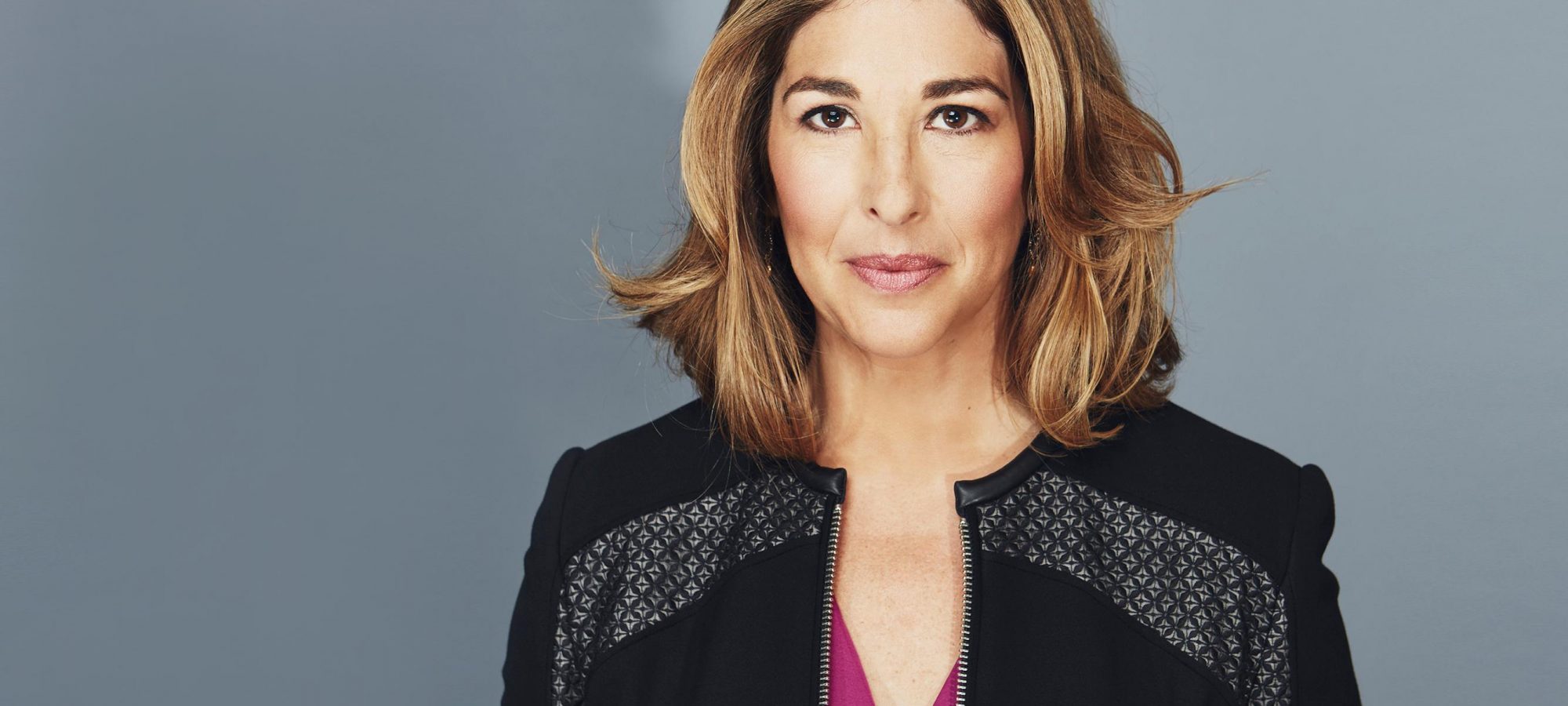
Naomi Klein: Gatekeeper Extraordinaire Veteran journalist lines up alongside the mainstream, attacking “conspiracy theorists” and “covid denialism”.

Cat McGuire & Colleen McGuire - Source: https://off-guardian.org/2020/12/11/naomi-klein-gatekeeper-extraordinaire/


With a title like The Great Reset Conspiracy Smoothie, it appears Naomi Klein is trying too hard to recapture her prowess at defining a meme. Her buzz-concept, “Shock Doctrine,” is spot-on and rightfully successful. But her “Screen New Deal” about Silicon Valley technocrats fizzled.

And now she puts forth “Conspiracy Smoothie,” declaring the multitudinous “conspiracies” out there are just one big bizarro mashup, an “inchoate meta-scream.” The word “smoothie” defeats her purpose, though, because smoothies are healthy, yet she wants to brand alternative thinkers as sinister and unhealthy. Ha! This feckless meme won’t catch on with anybody.

To her credit, Klein offers a very good history and analysis of The Great Reset, as long as she stays within the precincts of critiquing Empire, such as:

…[T]he Great Reset is not a serious effort to actually solve the crises it describes. On the contrary, it is an attempt to create a plausible impression that the huge winners in this system are on the verge of voluntarily setting greed aside to get serious about solving the raging crises that are radically destabilizing our world.

But once she gets near taboo topics, Naomi goes batshit mainstream. Unlike alt “researchers” (her raised-eyebrow quotes), these subjects are “inchoate” for her because, like NIST who doesn’t know there were explosives on 9/11, she hasn’t gone looking. She even admits, “I’ve been doing my best to ignore it [“conspiracies”] for months.”

Rather than go off-reservation and investigate for herself, like a typical conspiracy denier, everything under the hood is automatically deemed “off-the-wall.” Alison McDowall will surely skewer Klein again as seen during this prickly exchange they had about The Great Reset. (See video at 13:25 to 17:00)

Klein’s most damning accusation is her reference to “truly dangerous anti-vaccination fantasies and outright coronavirus denialism.” Is Klein really this naive about the objectives and tactics of the Medical Industrial Complex?

Her anti-vaxx slur is a defamation against vaccine-activists, most of whom actually advocate for safe and effective vaccines — the existence of which, however, are questionable. Vaccine manufacturers have no incentive to make a safe product because they were granted legal immunity in 1986 by Congress.

Proof there exists a serious safety deficit in vaccines is the current running tab of $4.2 billion awarded to victims and their families in “Vaccine Court” from vaccine deaths and injuries.

Klein’s political bifurcation of conspiracy theories telegraphs an utter misreading of allies and issues:

And yet search for the term “global reset” and you will be bombarded with breathless “exposés” of a secret globalist cabal, headed by Schwab and Bill Gates, that is using the state of shock created by the coronavirus (which is probably itself a “hoax”) to turn the world into a high-tech dictatorship that will take away your freedom forever: a green/socialist/Venezuela/Soros/forced vaccine dictatorship if the Reset exposé is coming from the far right, and a Big Pharma/GMO/biometric implants/5G/robot dog/forced vaccine dictatorship if the exposé hails from the far left.

After channeling Cass Sunstein in the above paragraph, she asks readers if they are confused. No, Naomi, you are the one who is confused. You are the one who cannot recognize that most of these issues are not only scientifically legitimate, but many are important to and shared by global activists and professionals across the political spectrum. You are the one who is out of touch for not recognizing how and why these issues unite many diverse communities. Unlike the binary tribalism you attribute to the above players, their unity is transpartisan.

In Klein’s inventory of 2020 shock doctrines, it’s all the fault of the right side of the aisle. There is not an ounce of finger-pointing, for example, that the extreme failures of the lockdowns are almost wholly the result of diktats by petty Democratic tyrants (not to mention their over-the-top hypocrisy).

Shockingly, she fails to comment on the source of the epic silencing of anyone who questions Official Narratives. To wit, Big Tech and Big Media censors are fully aligned with Democratic agendas. As for the Left’s political-identity swamp, there is nary a mention of Mao’s Cultural Revolution USA-style that has ravaged our country.

The World According to Naomi is full of plutocrats, but they’re all right-wing. She goes on and on about workers rights and all the populist issues that Democrats traditionally stood for. Didn’t she get the memo that there’s been a tectonic shift? Doesn’t she realize that the entire force of the 1% has arrayed itself with the Democrats, a party that has now disgracefully abandoned what had been their deplorables base for decades.

If Bernie progressives, we-the-people patriots, the Yellow Vests, indigenous peoples, and all the rest of the world’s 99% would just join hands, we could create a powerful transpartisan movement to abort The Great Reset’s dystopian agenda. But this can’t happen by staying within the Democrats’ Big Tent as Klein does, which likewise ultimately aligns her with the Establishment no matter how much she critiques them from her influential, mainstream-left perch.

Invoking an ever-reliable inference to Trump Derangement Syndrome, she writes:

Is it all a plan, another kind of elaborate conspiracy? Nothing so elegant. As Steve Bannon kindly told us, the informational strategy of the Trump era has always been to “flood the zone with shit.” Four years later, we can see what this looks like in practice. It looks like far-left and far-right conspiracists sitting down over a tray of information-shit sandwiches to talk about how the Great Reset is Gates’s plan to use the DNA from our Covid-19 tests to turn the United States into Venezuela.

“It makes no sense,” she concludes. Yep, Naomi, if you don’t investigate beyond ad hominem analysis and if you seemingly strive for a token social-responsibility seat at the Davos table, your current worldview will only ever perceive genuine opposition to The Great Reset as an indigestible smoothie.

Cat McGuire and Colleen McGuire are twin sisters who are activists and writers. Cat lives in New York City where she works with Break The Spell, a public outreach group raising awareness about the Covid plandemic and the Great Reset. Colleen practiced law in New York City for 16 years and now lives in Greece.

Post in evidenza

The Great Taking - The Movie

David Webb exposes the system Central Bankers have in place to take everything from everyone Webb takes us on a 50-year journey of how the C...