martedì 10 dicembre 2019

The Taxonomy of Collapse

December 09, 2019

The Taxonomy of Collapse

Source: https://charleshughsmith.blogspot.com/2019/12/the-taxonomy-of-collapse.html

The higher up the wealth-power pyramid the observer is, the more prone they are to a magical-thinking belief that the empire is forever, even as it is crumbling around them.
How great nations and empires arise, mature, decay and collapse has long been of interest for a self-evident reason: if we can discern a template or process, we can predict when the great nations and empires of today will slide into the dustbin of history.
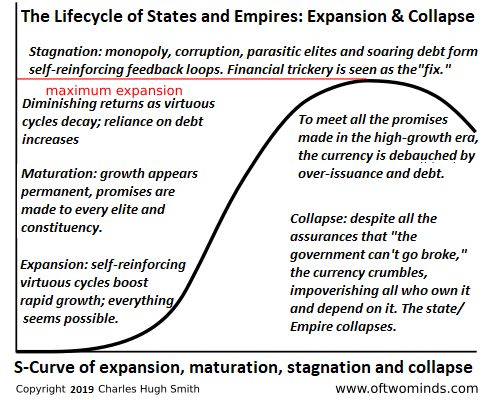
One of the justly famous attempts to lay out the stages of expansion, zenith, decline and collapse is Sir John Glubb's 1978 The Fate of Empires. Succinct and deeply informed, Glubb's essay lists these stages:
The Age of Pioneers (outburst or Boost Phase)
The Age of Conquests
The Age of Commerce
The Age of Affluence
The Age of Intellect
The Age of Decadence
The slippery slope to collapse--decadence--is characterized by greed, corruption, irreconcilable internal political rifts, moral decay, frivolity, materialism--hmm, sound familiar?
All of this fits the S-Curve model which I've described here many times, for example:
But what triggers the collapse of a weakening but still functioning empire? For that, I propose a taxonomy of collapse. A taxonomy is a system of classification that groups organisms or types that share characteristics and origins.
What taxonomy of collapse does history suggest? I would start with:
1. Bolt from the blue: a fast-moving, unexpected crisis that overwhelms the usual defenses and responses of the empire. An invasion by previously unknown forces with superior technology and/or organization fits the bill: the Mongols in Eurasia, the Spanish in the New World, etc.
Extremely contagious and previously unknown infectious diseases like plague and smallpox are also bolts from the blue, devastating populations with no immunity. It is estimated that 80% or more of the population of North America died from exposure to smallpox and other European diseases, in many cases long before the victims had ever seen a European, as the diseases spread much faster than the invaders themselves.
A drought that never ends is another unexpected catastrophe that quickly depletes food stores.
These bolts from the blue can strike at the same time: one reason why the small-in-number Spanish forces conquered vast empires in the New World was the empires had already been fatally weakened by diseases introduced by Columbus decades earlier.
2. Irreplaceable declines in essential resources. Food tops the list, as a decline in calories leads to weakened immune systems and heightened odds of pandemics spreading and a subsequent drop in the number of workers needed to support the empire's vast infrastructure.
The book The Fate of Rome: Climate, Disease, and the End of an Empire makes a compelling case that the Western Roman Empire centered around the Mediterranean suffered from a slow environmental transition from an unusually wet era that enabled grain to be grown in previously marginal areas to a drier era that no longer supported the immense grain harvests needed to feed the empire.
Other forms of depletion can also sap the empire of essentials: forests are cut down, silver mines are tapped out, nearby sources of slaves (labor) are no longer available, and so on.
The imperial machinery that is accustomed to there's always more somewhere refuses to trim its expenses, elites refuse to lessen their skim, and since the fat of elite excess is retained, eventually the muscle of military power and trade decay, leaving a hollowed out empire on the edge of a precipice awaiting one final kick into the abyss.
3. Reversal of fortune. Military misadventures top the list, as invasions of nearby competing powers are in effect last-ditch gambles to acquire desperately needed wealth and resources to prop up the status quo. When the imperial army is defeated and destroyed, there are no longer sufficient resources and recruits to rebuild the army.
4. Internal civil conflict: civil wars and political conflicts that break out into society and the economy end up consuming the last of the empire's seed corn, just like an invasion of a bordering empire that fails. Once the conflict is resolved, there are no longer enough resources left to support the imperial infrastructure.
Like Nature, History offers a near-infinite variety, but just as Nature fits into taxonomies of organisms, history can be shuffled into its own taxonomy, however messy and imperfect it might be.
These triggers of collapse can overlap, of course, accelerating the final decline. All complex hierarchical systems are intrinsically fragile and prone to disruption; we don't see the fragility or vulnerabilities until the decline has reached the terminal phase. The higher up the wealth-power pyramid the observer is, the more prone they are to a magical-thinking belief that the empire is forever, even as it is crumbling around them.


My recent books:

giovedì 5 dicembre 2019

Bean Counters: PwC DOUBLE STANDARDS


Extracted from:

Bean Counters: The Triumph of the Accountants and How They Broke Capitalism

 Pag. 122

DOUBLE STANDARDS

Within a day of Lehman’s downfall, insurance giant American International Group (AIG) received the first taxpayer-funded bailout. Its AIG-FP financial products unit had badly misjudged the market by taking on huge exposures to the subprime market. Through the boom years it had been writing credit default swaps, insuring banks against losses on their holdings of subprime-laden collateralized debt obligations. When the CDOs began to falter and AIG’s own credit rating was marked down, it was forced to hand over increasing amounts of collateral, or upfront cash on account of any final payouts, to the banks on the other end of the credit default swaps.


After another rating downgrade on the day of Lehman’s collapse, AIG’s collateral needs rose to the point where it could no longer raise the cash demanded of it. To avoid another Lehman – with far-reaching consequences for all AIG-FP’s other counterparties – the Federal Reserve stepped in with an $85bn bailout.

How had a once solid insurance company come to this? Hadn’t the whole
point of AIG and its financial products arm been that it could shoulder and
manage risk? The US government’s later Financial Crisis Inquiry Commission would pin the blame on ‘its enormous sales of credit default swaps [which] were made without putting up the initial collateral, setting aside capital reserves, or hedging its exposure’. 43

In other words, AIG-FP had drastically underestimated its potential losses.


Details that would later emerge of its dealings with its largest credit default swap counterparty, Goldman Sachs, revealed the helpful role of its auditor, PwC, in the under-reporting.

When the events of 2007 hit the value of Goldman’s CDO portfolio, the bank
had reckoned that the credit default swaps it had entered into with AIG-FP as
insurance against such losses were going to have to pay out. It had therefore
demanded that AIG-FP hand over more than $1bn of collateral on account of the eventual outcome. AIG-FP had taken a different view, insisting the contracts wouldn’t have to pay out.

As the dispute rumbled on, in several quarterly and annual reports to the markets AIG and Goldman gave widely divergent values to the swaps – which could really only have one value – and thus the collateral that ought to be handed over. Goldman was using a model that marked the contracts down by as much as 40% of their full value as it now expected to receive payments to offset the premiums it was paying. Which was fine with its auditors from PwC. AIG-FP, on the other hand, had no model at all with which to value the contracts and gave them full value with no discount. Its auditors, who also happened to be from PwC and were led by the firm’s US financial services boss Tim Ryan, were fine with that, too. The world’s largest accountancy firm thus sat back as two of its biggest and most systemically important clients, with its full knowledge, valued the same assets wildly differently.

If this could happen with the same auditor on both ends of one deal, the mind
boggled at what contradictory accounting involving different auditors might be
out there. Warren Buffett’s long-standing vice chairman at Berkshire Hathaway,
Charlie Munger, voiced his exasperation in a 2009 interview: ‘Two firms make a big derivative trade. The accountants on both sides show a large profit from the same trade [when the profit on one side must equal the loss on the other] . . . and nobody’s even bothered by the fact that this is happening.’ By way of explanation for a scenario that ‘violates the most elemental principles of common sense’, he offered: ‘There’s a demand for it from the financial promoters.’ And they generally got what they wanted from the bean counters. The accounting profession, concluded Munger, ‘is a sewer’. 44

PwC did eventually prompt AIG to try to value the relevant swaps properly.
But when the model it used to do so produced an unhelpful $5.1bn loss at the
end of 2007, the company arbitrarily slashed the figure to $1.5bn. PwC nodded
its approval. More flattering results duly appeased the none-the-wiser stock
market analysts. Four months later, in February 2008, PwC told AIG that the move had been ‘improper and unsupported’, and that ‘this deficiency was a
material weakness’. The books had to be rewritten. ‘Why the auditors waited so long to make this pronouncement is unclear,’ the Financial Crisis Inquiry Commission would comment three years later, ‘particularly given that PwC had known about the adjustment in November.’ 45

Why the auditors played along with false accounting at key moments was in
fact becoming obvious. Inflated profits and hidden losses were now the life support system for the financial system, from which the bean counters were profiting just like the bankers they were serving. In 2007, PwC worldwide
earned $7bn of its $25bn revenues from financial services. 46
Hanging onto the major payers of these fees like AIG and Goldman Sachs was worth a little duplicity.

Notes:

43. Final Report of the National Commission on the Causes of the Financial and Economic Crisis in the United States, January 2011, p.273

44. Interview with Stanford University professor Joseph A. Grundfest, 2009. Available on the website of Ian Fraser, http://www.ianfraser.org/charlie-munger-getting-accounting-integrity-right-has-enormous-implications-for-future-of-mankind/

45. Final Report of the National Commission on the Causes of the Financial and Economic Crisis in the United States, January 2011, p.273.

46. PwC worldwide annual report, 2007. Income includes banking and capital markets, investment management and insurance.
https://www.pwc.co.uk/assets/pdf/annual-report07.pdf

mercoledì 27 novembre 2019

13 Bank Executives Headed to Jail in MPS conspiracy case

Ex-Deutsche Bank, Nomura Officials Get Jail Time in Monte dei Paschi Collusion Case
Monte dei Paschi is the world's oldest continuously existing bank, founded in 1472.Bloomberg Bloomberg via Getty Images
Italy took a hard line against bankers involved in helping Banca Monte dei Paschi di Siena SpA falsify its accounts, sentencing 13 executives and managers to jail terms and fining the banks that worked with the Italian lender.
Monte Paschi ex-Chairman Giuseppe Mussari was sentenced to 7.6 years in prison. Deutsche Bank officials Michele Faissola and Michele Foresti and Nomura’s Sadeq Sayeed, Raffaele Ricci also received jail terms. Deutsche Bank and Nomura face fines and seizures totaling about 160 million euros ($176 million) for their roles.

Monte dei Paschi’s managers were accused of colluding with Deutsche Bank and Nomura bankers to hide losses at the Italian lender by using complex derivatives trades, dubbed Santorini and Alexandria, that led to a misrepresentation of its finances between 2008 and 2012. Paschi reached a plea-bargain deal in 2016 in one of the highest profile European banking cases in the last decade, first revealed by Bloomberg News.

A spokesman for Monte dei Paschi declined to comment.
All of the 13 suspects from the three banks received prison terms, including Antonio Vigni, Monte Paschi’s former general manager and ex-CFO Daniele Pirondini. The court convicted two of the group of managers despite the prosecution calling for their acquittal.
Prosecutors argued that the complex transaction Deutsche Bank helped put in place in 2008 hid about 430 million euros of losses that Paschi was facing on a previous deal, while Nomura’s derivative hid more than 300 million euros of losses not reported in the bank’s 2009 income statement.
Both transactions were carried out to cancel previous losses by building up two-leg deals, with one leg granting Monte Paschi an immediate gain and the other loss-making one designed to last for several years in order to pay back the investment banks for the gains realized by Paschi on the first one, according to prosecutors.

In 2017, the Italian government bailed out Monte dei Paschi to the tune of 5.4 billion euros.

The judge also ordered the prosecutor to investigate some of the witnesses who testified during the trial, including former Deutsche Bank official Stefano Dova.
Giuseppe Iannaccone, the lawyer defending former Deutsche Bank executives in Monte Paschi case, said in statement he’s “shocked” by the ruling and fully convinced of his clients’ innocence.

“We are disappointed with the verdict,” Frankfurt-based Deutsche Bank said in a statement. “We will review the rationale for it once it is published.”
Deutsche Bank defendants in previous hearings had rejected the allegations of a deliberate effort to hide losses, saying that Santorini was a legitimate deal and carried risk, and was not designed as a sure-fire bet.

Nomura’s lawyers also argued that the Alexandria deal was legitimate and an attempt to mask losses. Monte Paschi’s lawyers also rejected the allegations against their defendants, arguing that the deals were conceived to boost Monte Paschi’s interest margin and reduce previous risks.

Undermined by souring loans and derivatives deals that backfired, Monte Paschi requested state aid in 2017. The Italian government stepped in to take a stake of about 68 percent, injecting 5.4 billion euros in aid as part of an 8.3 billion-euro recapitalization.

Defendants convicted and their roles at the time of the transactions include:

Ex-Deutsche Bank:
Michele Faissola, head of global rates: 4.8 years
Michele Foresti, head of structured trading: 4.8 years
Dario Schiraldi, head of European sales: 3.6 years
Marco Veroni, account manager: 3.6 years
Ivan Dunbar, co-head of global capital markets: 4.8 years
Matteo Vaghi, head of Italian sales: 3.6 years

Ex-Nomura:
Sadeq Sayeed, CEO of Nomura Europe subsidiary: 4.8 years
Raffaele Ricci, head of sales for Europe, Middle East: 3.5 years

Ex-Monte de' Paschi:
Giuseppe Mussari, Chairman: 7.6 years
Antonio Vigni, General Manager 7.3 years
Daniele Pirondini, CFO: 5.3 years
Gianluca Baldassarri, head of finance division: 4.8 years
Marco Di Santo, head of asset liabilities management division: 3.6 years

domenica 24 novembre 2019

A systemic global failure in all the major auditing firms

NOT GUILTY

Extracted from:

Bean Counters: The Triumph of the Accountants and How They Broke Capitalism

Enron was one of dozens of major accounting scandals to emerge in the early years of the twenty-first century, as an economic downturn exposed the 1990s numbers game for the accounting scam it was. The Houston oil company wasn’t even the largest. That distinction went to WorldCom, a telecoms company also audited by Arthur Andersen that brazenly misrepresented expenses as investments in assets before being exposed by another female accounting whistleblower, internal auditor Cynthia Cooper, who refused to be silenced by corrupt bosses. The company went bust eight months after Enron with the loss of 30,000 jobs and $180bn of investors’ money. Demonstrating how the fallout from accounting fraud could spread, its competitor AT&T had not long before sacked 20,000 people in order to match WorldCom’s bogus profits. Arthur Andersen & Co. could be blamed for those lost livelihoods too.

It wasn’t just Andersen clients either. Security company Tyco inflated income by $500m under PricewaterhouseCoopers’ nose. All were playing the same stock market numbers game. The chief executives of these three companies went to jail, as did their chief financial officers (who, incidentally, had all been garlanded by CFO magazine just like Andrew Fastow).

The other big firms had their disasters too, notably Deloitte at cable TV company Adelphia and power company Duke Energy; Ernst & Young at corrupt healthcare company HealthSouth; and KPMG at photocopier company Xerox.

They would, however, get away with paying some affordable civil penalties to the SEC without admitting wrongdoing. The regulator was typically damning and lenient at the same time in the Xerox case, finding that ‘KPMG permitted Xerox to manipulate its accounting practices to close a $3 billion “gap” between actual operating results and results reported to the investing public...

Most of Xerox’s topside accounting actions violated generally accepted accounting principles (GAAP) and all of them inflated and distorted Xerox’s performance but were not disclosed to investors.’ Deliberately breaking the accounting rules sounded pretty serious. But then came the generous resolution. KPMG had to cough up $22m in ill-gotten gains and penalties ‘without admitting or denying the SEC’s findings’. (43)

Apart from Andersen, all the (now) Big Four firms thus emerged from the numbers-game era without guilt. A handful of individuals were fined and some suspended from practice. But when it came to the firms themselves, the prospect of one of them joining Andersen in whichever circle of bean-counting hell it now inhabited – reducing the profession to an untenable Big Three – ensured that the regulators backed off from alleging law-breaking.

With the WorldCom fraud emerging so soon after Enron, and European and other scandals demonstrating a systemic global failure in all the major firms, it was impossible any longer to deny that major change was needed in the accountancy profession. A few new rules did indeed emerge. But they didn’t address the most dangerous fault line exposed and even entrenched by the age of scandal. Through their own misconduct and by selling out their heritage, the accountants had themselves become all but unaccountable. Responsibility-free bean counting was about to exact its heaviest price yet.

Notes:

43. ‘KPMG Pays $22m to Settle SEC Litigation Relating to Xerox Audits’, SEC press notice, 19 April 2005.

giovedì 21 novembre 2019

Behbahan branch of the Central Bank of Iran set on fire

IFRS: Holdings of Cryptocurrencies, Committee’s agenda decision

Committee’s agenda decisions

https://www.ifrs.org/news-and-events/updates/ifric-updates/june-2019/#8

The process for publishing an agenda decision might often result in explanatory material that provides new information that was not otherwise available and could not otherwise reasonably have been expected to be obtained. Because of this, an entity might determine that it needs to change an accounting policy as a result of an agenda decision. The Board expects that an entity would be entitled to sufficient time to make that determination and implement any change (for example, an entity may need to obtain new information or adapt its systems to implement a change).
The Committee discussed the following matters and decided not to add them to its standard-setting agenda.

Holdings of Cryptocurrencies—Agenda Paper 12

The Committee discussed how IFRS Standards apply to holdings of cryptocurrencies.
The Committee noted that a range of cryptoassets exist. For the purposes of its discussion, the Committee considered a subset of cryptoassets with all the following characteristics that this agenda decision refers to as a ‘cryptocurrency’:
  1. a digital or virtual currency recorded on a distributed ledger that uses cryptography for security.
  2. not issued by a jurisdictional authority or other party.
  3. does not give rise to a contract between the holder and another party.
Nature of a cryptocurrency

Paragraph 8 of IAS 38 Intangible Assets defines an intangible asset as ‘an identifiable non-monetary asset without physical substance’.
Paragraph 12 of IAS 38 states that an asset is identifiable if it is separable or arises from contractual or other legal rights. An asset is separable if it ‘is capable of being separated or divided from the entity and sold, transferred, licensed, rented or exchanged, either individually or together with a related contract, identifiable asset or liability’.
Paragraph 16 of IAS 21 The Effects of Changes in Foreign Exchange Rates states that ‘the essential feature of a non-monetary item is the absence of a right to receive (or an obligation to deliver) a fixed or determinable number of units of currency’.
The Committee observed that a holding of cryptocurrency meets the definition of an intangible asset in IAS 38 on the grounds that (a) it is capable of being separated from the holder and sold or transferred individually; and (b) it does not give the holder a right to receive a fixed or determinable number of units of currency.

Which IFRS Standard applies to holdings of cryptocurrencies?

The Committee concluded that IAS 2 Inventories applies to cryptocurrencies when they are held for sale in the ordinary course of business. If IAS 2 is not applicable, an entity applies IAS 38 to holdings of cryptocurrencies. The Committee considered the following in reaching its conclusion.

Intangible Asset

IAS 38 applies in accounting for all intangible assets except:
  1. those that are within the scope of another Standard;
  2. financial assets, as defined in IAS 32 Financial Instruments: Presentation;
  3. the recognition and measurement of exploration and evaluation assets; and
  4. expenditure on the development and extraction of minerals, oil, natural gas and similar non-regenerative resources.
Accordingly, the Committee considered whether a holding of cryptocurrency meets the definition of a financial asset in IAS 32 or is within the scope of another Standard.

Financial asset

Paragraph 11 of IAS 32 defines a financial asset. In summary, a financial asset is any asset that is: (a) cash; (b) an equity instrument of another entity; (c) a contractual right to receive cash or another financial asset from another entity; (d) a contractual right to exchange financial assets or financial liabilities with another entity under particular conditions; or (e) a particular contract that will or may be settled in the entity’s own equity instruments.
The Committee concluded that a holding of cryptocurrency is not a financial asset. This is because a cryptocurrency is not cash (see below). Nor is it an equity instrument of another entity. It does not give rise to a contractual right for the holder and it is not a contract that will or may be settled in the holder’s own equity instruments.

Cash

Paragraph AG3 of IAS 32 states that ‘currency (cash) is a financial asset because it represents the medium of exchange and is therefore the basis on which all transactions are measured and recognised in financial statements. A deposit of cash with a bank or similar financial institution is a financial asset because it represents the contractual right of the depositor to obtain cash from the institution or to draw a cheque or similar instrument against the balance in favour of a creditor in payment of a financial liability’.
The Committee observed that the description of cash in paragraph AG3 of IAS 32 implies that cash is expected to be used as a medium of exchange (ie used in exchange for goods or services) and as the monetary unit in pricing goods or services to such an extent that it would be the basis on which all transactions are measured and recognised in financial statements.
Some cryptocurrencies can be used in exchange for particular good or services. However, the Committee noted that it is not aware of any cryptocurrency that is used as a medium of exchange and as the monetary unit in pricing goods or services to such an extent that it would be the basis on which all transactions are measured and recognised in financial statements. Consequently, the Committee concluded that a holding of cryptocurrency is not cash because cryptocurrencies do not currently have the characteristics of cash.

Inventory

IAS 2 applies to inventories of intangible assets. Paragraph 6 of that Standard defines inventories as assets:
  1. held for sale in the ordinary course of business;
  2. in the process of production for such sale; or
  3. in the form of materials or supplies to be consumed in the production process or in the rendering of services.
The Committee observed that an entity may hold cryptocurrencies for sale in the ordinary course of business. In that circumstance, a holding of cryptocurrency is inventory for the entity and, accordingly, IAS 2 applies to that holding.
The Committee also observed that an entity may act as a broker-trader of cryptocurrencies. In that circumstance, the entity considers the requirements in paragraph 3(b) of IAS 2 for commodity broker-traders who measure their inventories at fair value less costs to sell. Paragraph 5 of IAS 2 states that broker-traders are those who buy or sell commodities for others or on their own account. The inventories referred to in paragraph 3(b) are principally acquired with the purpose of selling in the near future and generating a profit from fluctuations in price or broker-traders’ margin.

Disclosure

In addition to disclosures otherwise required by IFRS Standards, an entity is required to disclose any additional information that is relevant to an understanding of its financial statements (paragraph 112 of IAS 1 Presentation of Financial Statements). In particular, the Committee noted the following disclosure requirements in the context of holdings of cryptocurrencies:
  1. An entity provides the disclosures required by (i) paragraphs 36–39 of IAS 2 for cryptocurrencies held for sale in the ordinary course of business; and (ii) paragraphs 118–128 of IAS 38 for holdings of cryptocurrencies to which it applies IAS 38.
  2. If an entity measures holdings of cryptocurrencies at fair value, paragraphs 91–99 of IFRS 13 Fair Value Measurement specify applicable disclosure requirements.
  3. Applying paragraph 122 of IAS 1, an entity discloses judgements that its management has made regarding its accounting for holdings of cryptocurrencies if those are part of the judgements that had the most significant effect on the amounts recognised in the financial statements.
  4. Paragraph 21 of IAS 10 Events after the Reporting Period requires an entity to disclose details of any material non-adjusting events, including information about the nature of the event and an estimate of its financial effect (or a statement that such an estimate cannot be made). For example, an entity holding cryptocurrencies would consider whether changes in the fair value of those holdings after the reporting period are of such significance that non-disclosure could influence the economic decisions that users of financial statements make on the basis of the financial statements.

lunedì 18 novembre 2019

Central banks doctoring the press: the Italian case

Central banking and fake news
Anti-Deflation League worried about the Italian central bank doctoring the news

Ignazio Visco, governor of Banca d'Italia, not to be confused with the other pundit Vincenzo Visco


ADL in Rome, November 18, 2019 - Recently two cases of the Italian central bank actively doctoring the press were discovered:

- The case of the Italian newspaper IlSole24Ore:
http://centralerischibanche.blogspot.com/2019/11/banca-ditalia-e-il-segreto-di-sistema.html

- The case of Reuters:
http://centralerischibanche.blogspot.com/2019/11/bankitalia-chiama-reuters-ancora-una.html

The ADL NGO - where ADL stands for "Anti-Deflation League" - is worried that a central bank is active in the business of fake-news and doctoring the financial press, thus doing 'whatever it takes' to confuse the public.

The Italian secretary of the ADL, the forensic accountant Marco Saba, recently told to the press: "We are puzzled that an institution as old as the Italian national debt is not only able to falsify his annual financial statement, like every other ordinary Italian bank, but is also proactively in the business of dictating to the press what to publish to misinform the public." 

And he continues: "In Italy this spin-doctoring work was traditionally reserved to the Grand Master of an irregular masonic lodge: Licio Gelli of the infamous P2 was a clear example. Another recognized influencer is the American Embassy in Rome - as the whitewash on the case of depleted uranium weapons clearly shows. But the Italian central bank goes as far as to try to forbid the secular activity of scriptural money creation. That's amazing. We call for the Italian PM to clarify who is the officially authorized troll when it comes to misinforming the public, as soon as possible."

The premier Conte was unavailable to comment the issue, while the governor of Banca d'Italia was busy trolling another news.

Post in evidenza

The Great Taking - The Movie

David Webb exposes the system Central Bankers have in place to take everything from everyone Webb takes us on a 50-year journey of how the C...