sabato 5 marzo 2016

It’s time to call the bankers’ bluff

It’s time to call the bankers’ bluff

http://www.neweconomics.org/blog/entry/its-time-to-call-the-bankers-bluff?&utm_medium=email&utm_source=nefoundation&utm_content=2&utm_campaign=this-week-0503&source=this-week-0503

Photo credit:   geezaweezer
March 1, 2016 // By: Christine Berry

Barclays today announced a fall in profits for 2015, bringing results season for the UK’s big banks to a close.
The bank blamed the squeeze on the £20bn fines raised against them, including the foreign exchange rigging scandal and PPI mis-selling.
Announcing that a further £1.45bn will be paid to customers who were mis-sold PPI, Chairman John Macfarlane suggested the combination of shrinking profits and charges would have a wider knock-on-effect for the UK economy – resulting in reduced lending to small businesses.
This is another example of the City of London using its power and influence over the UK economy to back politicians into a corner, and force them to roll-back financial regulation that goes against their interests.
But big banks have been failing at small business lending since the 2008 crisis and even before, for the simple reason that it's just not part of their business model. Taking the time to get to know which small businesses are creditworthy is just not worth their while when banks can make much easier money lending to other banks or trading derivatives in international markets.
Slow global growth and mega fines for misconduct are symptoms of our broken financial system, not causes. The fact that banks like Barclay's are now trying to hold politicians to ransom by claiming otherwise just goes to show how far they've regained their chutzpah as memories of the crisis fade.
But our politicians must be more prepared to call the City of London’s bluff, to make sure banks serve people, rather than put them at risk.
Despite their role in the last financial crisis, banks continue to threaten to move elsewhere if regulation is designed against their interests. HSBC’s recent threat to relocate outside the UK is only the most recent example of such tactics.
But our analysis shows that even if the banks followed through with their threats to leave, the impact would not be as disastrous as we’re led to believe.
The City’s contribution to UK growth is outweighed by the long-term damage it’s caused with financial instability. They pay less corporation tax than they did before the crisis, and contribute very little to the ‘real economy.’ The majority of investment is fuelling an unsustainable housing boom in the South East of England, while small business lending is already lacking.
In reality, London remains an attractive home for the big banks. Recent concessions made to the City are already rolling back the limited progress made by post-crisis financial reforms.
Our politicians should face up to the real cost of the City of London to our economy. They should look past the overstated contributions of our financial institutions and recognise that, quite simply, the interests of big banks should not come before those of the rest of us.
We recommend that:
  • The Bank of England should significantly strengthen the lightweight ring-fencing regime. An urgent clamp down is needed on ring-fenced banks’ economic links with the rest of their banking group. If banks continue seeking to water down and ‘game’ the regulation, full structural separation between retail and investment banking must be reconsidered.
     
  • The Financial Policy Committee should consider more active credit guidance policies. More active intervention could stimulate real economy lending and dampen down both mortgage lending and lending to other financial corporations.
     
  • The Treasury should urgently review options for addressing the lack of diversity in the UK banking system, and for promoting a more vibrant local stakeholder banking sector. This should include examination of the full range of options for the public’s majority stake in the Royal Bank of Scotland.

mercoledì 2 marzo 2016

CFTC Commissioner to Boost Commodity Speculators

CFTC Commissioner Giancarlo Admits to Hijacking Advisory Committee to Boost Commodity Speculators

by

http://www.nakedcapitalism.com/2016/02/cftc-commissioner-giancarlo-admits-to-hijacking-advisory-committee-to-boost-commodity-speculators.html 

Last week, an advisory committee to the Commodity Futures Trading Commission produced a highly dubious report recommending that the agency abandon the Dodd-Frank mandate of setting position limits in futures markets to eliminate excessive speculation. The report was just an enhanced form of lobbying; eight of the nine members of the Energy and Environmental Markets Advisory Committee (EEMAC) have ties to industries that would personally benefit from killing the rule.
The big question was how an official advisory committee of a federal agency could turn into a purely distilled conduit for corporate talking points? And the answer is Christopher Giancarlo, the lone Republican commissioner on CFTC at the moment, who took advantage of the committee, twisted it to his own ends, and produced a work product destined to be used in future litigation to overturn the position limits rule.
This all came out in a meeting of the EEMAC last Thursday, the same day the report was released. Only a few outlets reported on the meeting, and there’s no archived video of it yet on the CFTC website; it should pop up at some point. But Tyson Slocum of Public Citizen, the only consumer/public interest voice on the committee and the lone dissenter on the report, gave me the blow-by-blow.
Slocum started the discussion in the committee by questioning Craig Pirrong, co-author of the report and a non-member at the time he wrote it (he only became a member afterward). Pirrong has a history of payments from multiple industry groups, including the International Swaps and Derivatives Association, who successfully sued to overturn the first iteration of the position limits rule (that was in 2012; this second version was written in 2013 and still has yet to be finalized).
“I asked him what were the origins of that report, and how did it come to be that a non-member worked with one of the nine members of the committee without the input of the other eight,” Slocum told me in an interview. “And Dr. Pirrong said, Mr. Giancarlo asked me to write a report. It took all of seconds of interrogation to have him throw Giancarlo under the bus.”
Giancarlo immediately interrupted Pirrong, saying he wanted to explain. Over the next few minutes, Giancarlo admitted that he called Pirrong, set the parameters of the report, and told him to have it reflect only what had been discussed in two meetings where practically no non-industry voices were present. Giancarlo added that he sought out Pirrong for the report because of his “expertise on the issue,” effectively admitting that he was making decisions for the committee. Slocum asked Giancarlo why he wasn’t consulted to provide input on what was supposed to be a full committee report. Giancarlo replied that the other members of the committee were very busy, and “I didn’t want to burden you.”
You might be asking why Giancarlo, a CFTC commissioner, would play such a powerful role in devising a report that is supposed to be a way for independent voices advise the commission from the outside. Well, a few things came together. First, Dodd-Frank Section 751 created the EEMAC. It clearly had good intentions, as evidenced by the requirement that members reflect “a wide diversity of opinion” and “represent a broad spectrum of interests, including hedgers and consumers.” But the bill also explicitly exempted the EEMAC from the Federal Advisory Committee Act. That means there was no outside oversight of the committee membership, or whether eight of the nine members would come from a particular industry.
To “remedy” that, CFTC wrote a charter for the EEMAC. This is the key section:
The EEMAC shall have a “Sponsor,” who may be the Chairman of the Commission, a Commissioner, or a designee of the Commission. The Commission shall appoint and remove the Sponsor of EEMAC.
The Sponsor’s role for this non-FACA committee shall be, among other things, to: (1) approve all meeting agendas; (2) approve or call all EEMAC or subcommittee meetings; (3) attend all EEMAC or subcommittee meetings; (4) adjourn any meeting when he or she determines it to be in the public interest; (5) ensure that recommendations and advice made by Members are provided to the Commission; (6) ensure that the Commission provides the necessary staff and other support for the EEMAC; (7) assist the Commission with identifying Members, Associate Members, and subcommittee members; and (8) otherwise assist the Commission with carrying out its responsibilities regarding the EEMAC.
The sponsor, the charter also notes, plays a “primary” role in selecting members of the committee.
You can fill in what happened from there. Giancarlo, a former executive at a derivatives brokerage firm and an on-the-record opponent of position limits, found this Dodd-Frank provision lying around and became the EEMAC sponsor. That allowed him to slot in his industry pals. And he clearly took a very hands-on role in everything the committee does, including telling them when and how to write their reports.
This goes well beyond the enumerated role of the sponsor, as seen above. It’s a ministerial role, not an active member of the committee. It isn’t Giancarlo’s job to produce the report, or to set the vision for it, or to designate individuals to write it separate from the rest of the committee. Incidentally, when Pirrong and his co-author, longtime ConocoPhillips exec James Allison, finished the report, they didn’t submit it to the committee, but to Giancarlo. He passed it onto committee members and told them they had two weeks to vote up or down on it in private.
It’s important to understand Giancarlo’s goal for the report. He doesn’t think the advisory committee will sway the CFTC to abandon position limits they’ve been working on for years. Indeed, CFTC Tim Massad immediately said he would keep moving forward on the rule. The goal here, as Slocum told me, is to give industry a leg up in an inevitable legal battle to come. “Giancarlo was setting the table,” Slocum said, “to use the advisory committee from the beginning, stack it with Wall Street and big energy companies, and produce a report to say position limits are unneeded and would create harm. This report would be exhibit A in the next litigation.”
The industry, of course, has already won one round in court here, back in 2012. They successfully argued that capping trades as a percentage of the total commodity market was “unnecessary.” Now, after CFTC finalizes a new version of the rule that tries to answer that judge’s concerns, the same industry players can go to court again and say “Look, even the commission’s own advisory committee said this was unnecessary!” A federal judge would likely be unaware of the ideological makeup of the committee, the role of the CFTC’s industry-backed commissioner in creating the report, the lack of objectivity, etc. They’d only see the 8-1 vote.
Meanwhile, that vote was never public. Slocum made several formal motions at the meeting to move the report back to the EEMAC for further consideration, given that it only employed selective committee resources without the consent of the full committee at the time. The motion was never acknowledged or acted upon. Nor was there ever a public vote to deliver the report to the CFTC; the 8-1 vote only approved the draft. And there are other factors as well; clearly, Giancarlo violated the charter in his sponsorship role.
If the report is not validated as the official product of the committee, it cannot be used in court the way Giancarlo and his cronies want. Public Citizen is working to make that happen.
The thing is, Giancarlo had already stacked the committee. He could have gone through the normal procedures, engaged Slocum, and outvoted him. Instead he pushed way too far. “It’s like Nixon didn’t need to break into the Watergate, he was going to win in a landslide anyway,” Slocum said. “Sometimes these guys can’t help themselves.”


Accounting as religion: Buffett, Derrida, and MMT

Home » Blog » 2016 » February » 25 » Accounting as relig… Screenshot 2016-02-24 18.33.42 A number of my recent posts seem to have wound up some of the more sensitive ‘mainstream’ economists, who don’t like the suggestion that the likes of Minsky deserve their own ‘school’. Some philosophers of science have similarly taken offence: even eclectic economists apparently are not eclectic enough. As a heterodox philosopher of science myself, I find all these disputes a bit too, well … conventional.

Jacques Derrida was taken very seriously by many of his disciples, ridiculed by those convinced he was a charlatan, but I always assumed he had a sense of humour. Who knows.

One thing (the only thing?) I learnt from Derrida was to always check footnotes. He argues that every theorist knows the weakness of his own argument – and often reveals it in the footnotes. So, pay attention to footnotes – but also remember, there’s a flaw in every theory.

If Derrida was alive and an economist, he would surely have written a heterodox paper on methodology: “MMT – revolution, cult, religion, or science?”

I’m a fan of MMT. As I have argued before, it is right about a lot. It is also a remarkably accessible and complete approach which has real world relevance. In many ways it is better than mainstream economics.
That said, I feel the need for balance. So at the risk of winding up what sometimes feels like 25% of the econo-blogosphere, here goes: accounting is convention, not truth.

If you wonder why I even raise this issue either do a search for “money is a liability” on twitter, or read this from L. Randall Wray (where he explains why he will not do a radio interview on the subject of ‘debt-free money’):
“Sovereign government can no more borrow its own IOU than you can borrow your own IOUs … Money is always and everywhere else an IOU. As my prof, Hyman Minsky, always said, discipline the analysis with balance sheets. Show me the balance sheets in which government creates and spends money that is not its liability […]
… all money … is debt. It is on the liability side of issuer and asset side of holder. You cannot change that through confusing semantics.”
Typically in accounting, the difficult stuff to measure is either on the income statement – i.e. what are the ‘profits’ generated by writing insurance policies – or on the asset side of the balance sheet – i.e. valuing intangible assets, in particular things like ‘goodwill’. But occasionally ‘liabilities’ are also misleading. A classic example of this is the accounting treatment of the float of insurance businesses. ‘Float’ designates the amount of money on hand that an insurance company has collected as premiums but not yet (perhaps never) paid out in claims. It is always treated under accounting rules as a liability. Now anyone who thinks that accounting treatment equals truth, needs to read Warren Buffett. Here’s what he says when discussing Berkshire Hathaway’s float in his 2014 shareholder letter:
“So how does our float affect intrinsic value? When Berkshire’s book value is calculated, the full amount of our float is deducted as a liability, just as if we had to pay it out tomorrow and could not replenish it. But to think of float as strictly a liability is incorrect; it should instead be viewed as a revolving fund. Daily, we pay old claims and related expenses – a huge $22.7 billion to more than six million claimants in 2014 – and that reduces float. Just as surely, we each day write new business and thereby generate new claims that add to float.
If our revolving float is both costless and long-enduring, which I believe it will be, the true value of this liability is dramatically less than the accounting liability. Owing $1 that in effect will never leave the premises – because new business is almost certain to deliver a substitute – is worlds different from owing $1 that will go out the door tomorrow and not be replaced. The two types of liabilities are treated as equals, however, under GAAP.
A partial offset to this overstated liability is a $15.5 billion “goodwill” asset that we incurred in buying our insurance companies and that increases book value. In very large part, this goodwill represents the price we paid for the float-generating capabilities of our insurance operations. The cost of the goodwill, however, has no bearing on its true value. For example, if an insurance company sustains large and prolonged underwriting losses, any goodwill asset carried on the books should be deemed valueless, whatever its original cost.
Fortunately, that does not describe Berkshire. Charlie and I believe the true economic value of our insurance goodwill – what we would happily pay for float of similar quality were we to purchase an insurance operation possessing it – to be far in excess of its historic carrying value. Under present accounting rules (with which we agree) this excess value will never be entered on our books. But I can assure you that it’s real. That’s one reason – a huge reason – why we believe Berkshire’s intrinsic business value substantially exceeds its book value.”
Buffett has made very clear that Berkshire’s float is inaccurately treated as a liability in balance sheet accounting. The ability to generate float would be better thought of as an asset. Forty plus years of trading has proven him right, and more importantly, to buy this ‘liability’ off him would require a huge positive sum of money – that makes a nonsense of the accounting treatment. Think of it like this: if someone offered to take your mortgage off your hands, would you charge them?

If Warren Buffett can argue that float is not a liability, even though accounting convention treats it as such, so what about base money? How would Warren Buffett think about valuing a central bank’s printing press. A central bank can buy assets at will: let’s say it buys equities, like the Bank of Japan has been doing – those are assets, because equities generate cashflow and pay dividends. What is the accounting treatment of this process, and what should it be? Accounting convention, in this case an accident of history (and a mechanical transfer of commercial bank accounting), treats the bank deposits at the central bank as ‘liabilities’ of the central bank. Now let’s apply some simple ‘Buffett tests’.

First, does the CB owe anything? No. In theory a commercial bank can ask to convert reserves into cash – the CB can choose to do this or not, but the whole point of having deposits at the central bank is to settle payments between banks. The CB determines the quantity of reserves, it does not depend on ‘investor appetite’. What about the introduction of an ‘interest rate’ on reserves (IOR)? I put ‘interest rate’ in italics, because it is not really an interest rate. An interest rate is typically the price of a debt instrument set in a market – it is the rate at which a borrower and lender are willing to transact. The IOR is fundamentally different – it is a transfer or ‘tax’ (if negative) which one party (the CB) determines. That’s nothing like an interest rate. If you’re not clear about this, go to your mortgage lender and say that you are setting your mortgage interest rate at minus 0.75% and you’ll be expecting a check in the post. That’s what CBs can do (are doing) with reserves. These are not the characteristics of liabilities!

Now it is true that cash and reserves are not ‘owned’ by the central bank, so it cannot claim that they are assets. But the ability to create them is obviously hugely valuable – to the state and the society it represents. The best way to think about money created by the state is the production of a ‘liquidity service’. Liquidity is extremely valuable to a modern financial system and economy – and the government is monopoly provider of the purest liquidity. Base money creation should really be showing up on the central bank’s income statement as a sale of liquidity services. Every time a central bank buys bonds and creates reserves there should be an equivalent increase in its revenues, which given the zero cost of production, will translate into an equivalent increase in its profits, and an equivalent increase in its equity. Balance sheets will still balance, of course – accounting makes sure they do – but the convention will be a more accurate representation of the reality.

So the question that follows is: if the accounting standards authorities adopt my suggestion, will L. Randall Wray start doing radio interviews on debt-free money again – or does he still think base money is an IOU?
Now, L. Randall Wray is very smart, and he probably knows most of this, but he still doesn’t want to admit that money is not debt, so he has constructed a fantastic linguistic contortion – which is pure semantic confusion:
“Imagine a sovereign that issues “debt-free” coins. They look like normal coins, but when you take them back to the exchequer, your taxes are not paid. The exchequer does not recognize them as a debt—as a promise to redeem yourself in tax payment–but rather as a bit of base metal.
[…] Why would you want the debt-free coin? Only for its wealth-value (whatever that might be). It is not money.
As MMT says, “taxes drive money”. If you cannot use the sovereign’s token to pay your taxes, it is nothing but a piece of paper, hazelwood stick, or metal.
If you cannot redeem the token for your coat, or for the taxes you owe, why would you want it?
A “debt-free money” would not be evidence of a debt. What would it be?”
Now Derrida tells us to look in the footnotes. There aren’t any. Fortunately, there is something close enough – a hidden definition slipped in between dashes. ‘Debt’ has been defined by L Randall Wray as “a promise to redeem yourself in tax payment”. What?! That is NOT the definition of ‘liability’. The ability to pay taxes is a feature of money issued by sovereigns – a very important feature and part of how the government establishes its monopoly in the creation of money, but just because the government accepts money in payment for taxes (what else would they accept?) does not make the money they issue their ‘liability’.

If anyone has any doubt, it is worth considering Randall Wray’s example. Let’s say the government stopped accepting money in payment for taxes. I guess that would be a zero tax regime – an extreme version of low tax Hong Kong, where the government raises all its revenues from land sales, would money still be a ‘liability’ of the state, even applying Randall Wray’s linguistic gymnastics? Presumably not. There’s a separate issue, would money still have value and be used. Why not? Money’s value resides in a network externality, i.e. acceptance as payment by others – this property is not affected by zero tax. There is nothing about zero tax that says the state would no longer issue currency and require it to be accepted for payment in private sector transactions – it’s damn useful after all.

Now I should be clear, the role of taxation and state power in establishing a monopoly currency is a highly plausible hypothesis – but it does not in any way render money a ‘liability’.

Accounting is important, balance sheets should be studied, Minsky is very interesting (as is L. Randall Wray’s book), but money is not a liability of the state.

Banking Scams explained by Danish banker Mads Palsvig

martedì 1 marzo 2016

To Put Bankers Behind Bars, Spanish Citizens Take the 1% to Court

To Put Bankers Behind Bars, Spanish Citizens Take the 1% to Court
Thu, 1/14/2016 - by Steve Rushton
Elites regularly profit with impunity from financial corruption. This is clearly demonstrated by the numerous billion-dollar financial scandals in recent years, including LIBOR rate fixing, tax evasion, commodity price fixing and financial mis-selling schemes. The political power of finance and its revolving door into government makes many bankers seem above the law. But this immunity is not unbreakable, as demonstrated by the wave of Spanish citizens now leading an anti-corruption charge unlike any that has come before.


Ending the Corruption Era
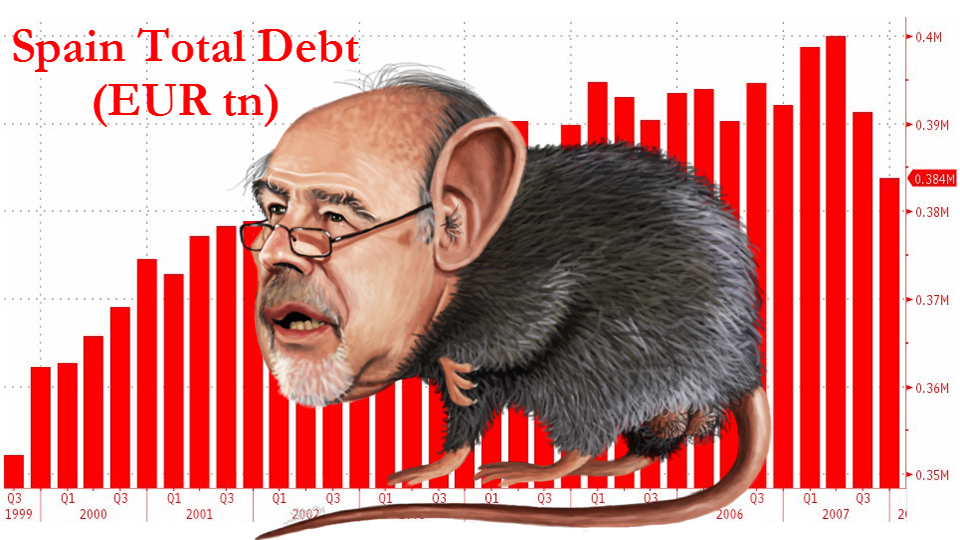
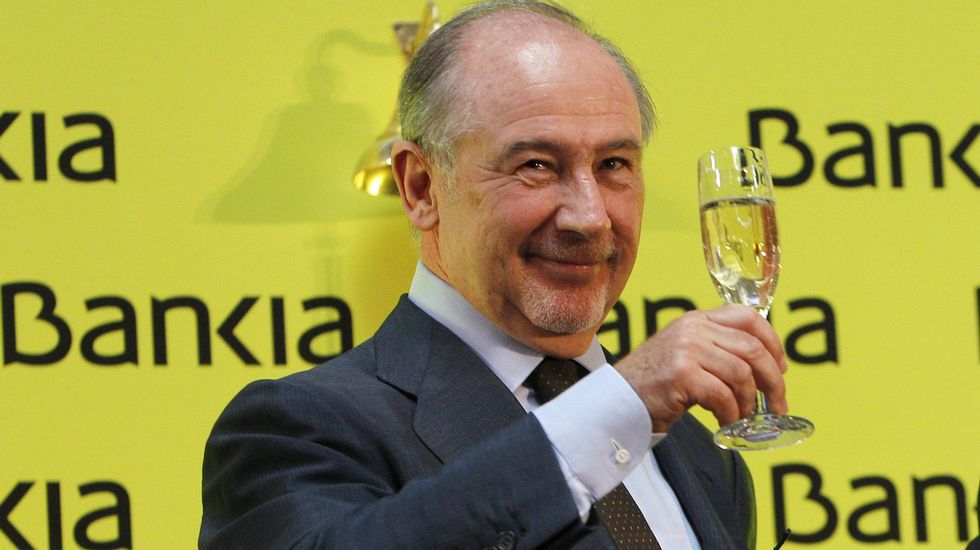
The case of Rodrigo Rato is perhaps the most interesting among some 150 high-level corruption cases scheduled to take place this year in Spain – involving over 2,000 elite figures in Spanish society. Rato was the country's Minister of Economics from 1996 to 2004, and a leading political force in the conservative Popular Party (PP) as well as managing director of the IMF (2004-2007) and chairman of Bankia, Spain’s largest bank (2010-12).
These institutions’ combined actions spurred Spain’s economic crash and intensifying poverty crisis, as Bankia’s massive debts were nationalized by the PP-controlled government and Rato's bank became the main recipient of the bailout deal with the EU and IMF. From these business-government arrangements, Rato and the rest of Spain's 1% profited while imposing austerity on the majority.

Last April, the Financial Times described Rato being shoved by a law officer during his arrest. “The touch lasted only a few seconds, but it will be seared into the mind of Rodrigo Rato — and of millions of Spaniards — for years to come,” wrote the paper. Millions saw the clip repeated on rolling TV coverage and the Internet. The Times article quotes an editorial by Spain’s El Mundo newspaper, illuminating its importance: “The precise moment in which the customs agent grabs his head... marks a point of no return, in which we leave behind an era.”

Translation: Rato and many others were no longer untouchable.
The case now underway against Rato and Bankia hinges around three aspects. First, the bank is charged with false advertising when it floated its stock for purchase. Second, it is accused of mis-selling toxic assets to unsuspecting members of the public. And third, it issued "black visa cards" to senior Bankia management, facilitating both tax evasion and bribery of politicians and government officials.
Spanish financial crisis, Rodrigo Rato, Bankia scandal, 15MpaRato, jailed bankers
15MpaRato: Citizens Call Rato In

In May of 2012, on the first anniversary of the 15M movement that took to the squares in a two-month occupation that helped spur Occupy Wall Street four months later, 15MpaRato launched its plan to jail Rodrigo Rato. According to law, Spanish citizens or organizations can file complaints that judges will consider and decide whether, and whom, to prosecute. This is exactly what happened with Rato.

“One of the first things we did was publicize an anonymous dropbox, and we received information from the citizens on Rato and Bankia. This grew and grew and included receiving 8,000 pages from the bank employees,” Simona Levi from 15MpaRato told Occupy.com.

15MpaRato used global leaks, an open-source program that creates a secure Internet space to receive sensitive information. By early June of 2012, enough evidence had been collected to initiate the case against Rato. Victims were also found to stand as claimants.

Next, activists launched Spain’s first-ever political crowdfunding campaign to pay the legal fees associated with the case. The campaign reached its funding target in less than 24 hours, and the anonymous drop-box provided essential information to citizens eager to get involved. For instance, they discovered that Bankia employees had leaked internal documents that read “DO NOT SHOW THIS TO THE CLIENTS,” and were instructed to target unsuspecting customers to buy the bank's toxic assets that should have only been sold to financial investors.

Another major leak involved the "Blesa emails," revealing Miguel Blesa, director of Bankia from 1997 to 2010, and other senior Bankia executives complicit in a wide-ranging credit card scam. The information was leaked to Xnet, an anti-corruption and tech-freedom group founded in 2008, akin to a Spanish Wikileaks, which helped initiate the 15M demonstrations. The network has been central within 15MpaRato, and in early 2016, Xnet will act as Barcelona’s official anti-corruption advisor, setting up an online portal where citizens can report corruption.

Out of the 100 individuals investigated thus far, 66 bankers and politicians will soon face trial for their crimes – Rodrigo Rato being one among them. Levi, who was also a founder of Xnet, said: "15MpaRato is a guerrilla [group] with the concrete objective of ending the establishment’s impunity, and Rato is the perfect target. He is so well known, every grandmother recognizes him. Plus, when we publicly stated we would go after him, we said it would also pull others politicians and bankers in, all connected to this one guy.”

She added that the campaign to jail Spain's criminal bankers "is far more than making a statement that politicians and bankers are corrupt – as everyone knew this. You cannot attack the enemy on all fronts. You have to choose one focal point.”

15MpaRato’s website states that Rato is just the beginning, and that others responsible for Spain's financial crisis are going down next. Boldly and simply, it states: "We are going after them."

The campaign has already been successful in part because of one crucial strategic move: it highlighted the way Bankia committed false advertising when it floated its stock on the market. Though the group's attack began as a hunch, based on the fact that Bankia had sold a product that failed within a year, leaks confirmed the suspicions.

Levi suggested that strong communication and social networking also enabled the group's success. “You need to make what you do visible,” she said. Part of that visibility involves an English section of the website detailing the case, the leaks and the broad national media coverage it has received.

15MpaRato also includes an open-source database enabling anyone to analyze the leaks – a vital and direct source of information, considering the otherwise superficial coverage they've gotten by the BBCThe New York Times and the El Pais English edition. Responding to the mainstream media's portrayal of the corruption in Spain, Levi added: “We have found it is much easier to put in prison a banker or politician – even a hundred of them – than to get the press, the government and the institutions to recognize that this is the work of ordinary citizens.”

Open letter to Iceland's Parliament on money reform

On the monetary reform resolution: the need for proper cash flow accounting

March 1, 2016


Dear Ladies/Sirs,

Bank money created as deposit is defined as 'cash' in current international accounting standards, so it must be accounted for as cash in the same bank cash flow statement - which currently is not.
(See here: Cash Flow Accounting in Banks— A study of practice, Ásgeir B. Torfason, University of Gothenburg, 2014 )
https://gupea.ub.gu.se/handle/2077/35272

By accounting for money created as an inflow in the cash flow accounting you solve most of the current issues:

1) the surfacing of 'electronic money seigniorage' that now is hidden;

2) banks will never again 'go under';

3) there will be no more unbalances in the inter-central bank clearing systems (in the TARGET2 currently there is an unbalance of 62 billion euro, this is in the Eurosystem);

4) real profits of bank activity - either central bank and commercial banks - are exposed and can be taxed relaxing the issue of government debt;

5) by making banks responsible for money creation - by making them 'accountable' in accounting terms - the moral hazard is decreased;

6) the central authority can know how much money is really circulating and best manage the monetary policies;

7) the macroeconomics models can take into account the money creation side of the economy (actually there is only one open source model that can make right predictions taking in account the money created as an asset for banks - called Minsky - and it is developed by professor Keen from Australia).

So now You have the tools to make some sense of the monetary reform.

Thanks You for Your kind consideration,

Marco Saba
President at IASSEM
Istituto di Alti Studi sulla Sovranità Economica e Monetaria

Post in evidenza

The Great Taking - The Movie

David Webb exposes the system Central Bankers have in place to take everything from everyone Webb takes us on a 50-year journey of how the C...