venerdì 18 dicembre 2015

Policy Makers Thinking About Different Types of QE


ECB Mario Draghi QE for people helicopter money

Who are the Prominent Policy Makers Thinking About Different Types of QE?

In a recent post Positive Money showed that there is a strong intellectual body of history behind the various alternative proposals for QE. Both John Maynard Keynes and Milton Friedman proposed a style of Quantitative Easing (QE) that was aimed at the real economy. Today, these types of proposals are commonly referred to as “QE for People”, “Sovereign Money Creation”, “Strategic QE” and “Helicopter Money” amongst others.
In effect, both Friedman and Keynes advocated a different form of QE than that which we are experiencing today: one that would be relayed away from the banking sector and speculators and towards consumers, non-financial businesses and low income earners – and one that could directly back investment projects, rather than create risky asset price bubbles.
At Positive Money we have been trying to keep track of Keynes’s and Friedman’s contemporaries and share them with the public. Accordingly, we will be releasing a series of posts that illustrate the various influential people who advocate a different type of QE. Each post will address a separate category of influencers. Today’s post will highlight quotes made by prominent Policy Makers and Public Advisors. Subsequent posts will highlight quotes made by: Academics, Politicians, City Workers, Journalists and Media Commentators, Activists and Special Advisors.

Policy Makers and Public Advisors
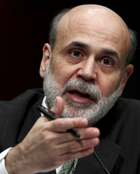
Senate Holds Hearing To Re-Nominate Ben Bernanke As Fed ChairmanBen Bernanke, former Chairman of US Federal Reserve Bank
“In practice, the effectiveness of anti-deflation policy could be significantly enhanced by cooperation between the monetary and fiscal authorities. A broad-based tax cut, for example, accommodated by a program of open-market purchases to alleviate any tendency for interest rates to increase, would almost certainly be an effective stimulant to consumption and hence to prices…A money-financed tax cut is essentially equivalent to Milton Friedman’s famous “helicopter drop” of money. Of course, in lieu of tax cuts or increases in transfers the government could increase spending on current goods and services or even acquire existing real or financial assets.”
http://www.federalreserve.gov/boarddocs/Speeches/2002/20021121/default.htm
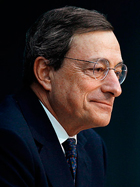
draghiMario Draghi, Chairman of the ECB
“For hundreds of years central banks have injected money in the economy through either banks and/or markets. That is what we know, and so we will certainly consider these ideas that are being discussed; they are being discussed everywhere and the ECB is part of these discussions in academic fora and in other circumstances.”
http://positivemoney.org/2015/10/mario-draghi-is-open-to-considering-helicopter-money/ 
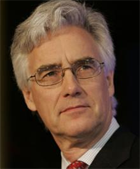
TurnerLord Adair Turner- Member of UK Financial Policy Committee, former Chairman of Financial Services Authority
“’Helicopter money’ – by which we mean overt money finance of increased fiscal deficits – may in some circumstances be the only certain way to stimulate nominal demand, and may carry with it less risk to future financial stability than the unconventional monetary policies currently being deployed.”
http://www.voxeu.org/article/helicopter-money-policy-option 
Willem BuiterWillem Buitler, Citigroup Chief Economist, and former member of Monetary Policy Committee of Bank of England
“So why it matters is that the competence of the Chinese authorities as managers of the macro economy is really in question – the messing around with monetary policy, the hinting on doing things on the fiscal side through the policy banks. But I think the only thing that is likely to stop China from going into, I think, recession – which is, you know, 4 percent growth on the official data, the mendacious official data, for a year or so – is a large consumption-oriented fiscal stimulus, funded through the central government and preferably monetized by the People’s Bank of China.”
http://www.zerohedge.com/news/2015-08-29/citigroup-chief-economist-thinks-only-helicopter-money-can-save-world-now 

sushil WadhwaniSushil Wadhwani, Former Member of Bank England Monetary Policy Committee
“We need to ensure the extra money leads to higher demand. One good place to start is with the textbook example of printing money to finance consumption – sending every adult in the country a voucher that can be spent in the next three months. Allocating £300 to each of Britain’s 50m adults to spend on goods and services would cost £15bn, or 20 per cent of the £75bn created by the new round of QE. (In 1999, the Japanese government distributed $175 vouchers to the public – 99.6 per cent of them were spent within the six-month limit.) Perhaps you can persuade the MPC that this is preferable to buying gilts?”
http://www.newstatesman.com/blogs/the-staggers/2011/10/chancellor-bank-osborne 

William White 140William White, former deputy governor of the Bank of Canada, former head of the Monetary and Economic at BIS, Chairman of the Economic and Development Review Committee at the OECD.
“Given the shortcomings of both monetary and fiscal policy on their own, is it possible that a combination of these measures, specifically OMF, might prove better able to generate “strong, balanced and sustainable growth? ”By way of analogy, it is like saying “Soup and sodium – not good. Soup and chlorine – also not good. But, soup and sodium chloride – very tasty”.”
http://www.project-syndicate.org/blog/overt-monetary-financing–omf–and-crisis-management#xfwRXTmSH3QKo2OA.99 

richard woodRichard Wood, Former Policy Advisor to Australian Treasury and Author of How to Solve the European Crisis: Challenging orthodoxy and creating new policy paradigms
“In respect of monetary policy, overt money financing (creating new money and channelling it through net government spending to low income people, infrastructure and the unemployed) could replace the ineffective and wasteful quantitative easing policy as a means to stimulate economic activity. Quantitative easing finances banks and speculators; creates asset price bubbles; distorts risk pricing and resource allocation; causes competitive devaluations and currency wars; and results in reversals and financial distress on exiting the policy. Quantitative easing has no direct positive impact on consumer prices as predicated by the central banks of Japan and the United States.”
http://www.voxeu.org/article/failed-policy-response-global-crisis

Olivier BlanchardOlivier Blanchard, Former Chief Economist IMF
“There is clearly something else you can do if you get to zero (inflation) and still want to increase spending. You can buy goods. Which one should you choose? We haven’t asked the question in the crisis but we should.”
http://uk.reuters.com/article/2015/10/07/uk-imf-blanchard-peoples-qe-idUKKCN0S12M120151007

Eurozone: Using Money Creation to Stimulate the Real Economy

mercoledì 16 dicembre 2015

Reinventing Banking: From Russia to Iceland to Ecuador

Reinventing Banking: From Russia to Iceland to Ecuador
Wednesday, 16 December 2015 00:00 By Ellen Brown, The Web of Debt Blog | News Analysis
http://www.truth-out.org/news/item/34056-reinventing-banking-from-russia-to-iceland-to-ecuador


Global developments in finance and geopolitics are prompting a rethinking of the structure of banking and of the nature of money itself. Among other interesting news items:
  • In Russia, vulnerability to Western sanctions has led to proposals for a banking system that is not only independent of the West but is based on different design principles.
  • In Iceland, the booms and busts culminating in the banking crisis of 2008-09 have prompted lawmakers to consider a plan to remove the power to create money from private banks.
  • In Ireland, Iceland and the UK, a recession-induced shortage of local credit has prompted proposals for a system of public interest banks on the model of the Sparkassen of Germany.
  • In Ecuador, the central bank is responding to a shortage of US dollars (the official Ecuadorian currency) by issuing digital dollars through accounts to which everyone has access, effectively making it a bank of the people.
Developments in Russia
In a November 2015 article titled "Russia Debates Unorthodox Orthodox Financial Alternative," William Engdahl writes:
A significant debate is underway in Russia since imposition of western financial sanctions on Russian banks and corporations in 2014. It's about a proposal presented by the Moscow Patriarchate of the Orthodox Church. The proposal, which resembles Islamic interest-free banking models in many respects, was first unveiled in December 2014 at the depth of the Ruble crisis and oil price free-fall. This August the idea received a huge boost from the endorsement of the Russian Chamber of Commerce and Industry. It could change history for the better depending on what is done and where it further leads.
Engdahl notes that the financial sanctions launched by the US Treasury in 2014 have forced a critical rethinking among Russian intellectuals and officials. Like China, Russia has developed an internal Russian version of SWIFT Interbank payments; and it is now considering a plan to restructure Russia's banking system. Engdahl writes:
Much as with Islamic banking models that ban usury, the Orthodox Financial System would not allow interest charges on loans. Participants of the system share risks, profits and losses. Speculative behavior is prohibited . . . . There would be a new low-risk bank or credit organization that controls all transactions, and investment funds or companies that source investors and mediate project financing. . . . Priority would be ensuring financing of the real sector of the economy . . . .
On September 15, 2013, Sergei Glazyev, one of Vladimir Putin's economic advisers, presented a a series of economic proposals to the Presidential Russian Security Council that also suggest radical change is on the horizon. The plan is aimed at reducing vulnerability to western sanctions and achieving long-term growth and economic sovereignty.
Particularly interesting is a proposal to provide targeted lending for businesses and industries by providing them with low-interest loans at 1-4 percent, financed through the central bank with quantitative easing (digital money creation). The proposal is to issue 20 trillion rubles for this purpose over a five year period. Using quantitative easing for economic development mirrors the proposal of UK Labour Leader Jeremy Corbyn for "quantitative easing for people."
William Engdahl concludes that Russia is in "a fascinating process of rethinking every aspect of her national economic survival because of the reality of the western attacks," one that "could produce a very healthy transformation away from the deadly defects" of the current banking model.
Iceland's Radical Money Plan
Iceland, too, is looking at a radical transformation of its money system, after suffering the crushing boom/bust cycle of the private banking model that bankrupted its largest banks in 2008. According to a March 2015 article in the UK Telegraph:
Iceland's government is considering a revolutionary monetary proposal - removing the power of commercial banks to create money and handing it to the central bank. The proposal, which would be a turnaround in the history of modern finance, was part of a report written by a lawmaker from the ruling centrist Progress Party, Frosti Sigurjonsson, entitled "A better monetary system for Iceland".
"The findings will be an important contribution to the upcoming discussion, here and elsewhere, on money creation and monetary policy," Prime Minister Sigmundur David Gunnlaugsson said. The report, commissioned by the premier, is aimed at putting an end to a monetary system in place through a slew of financial crises, including the latest one in 2008.
Under this "Sovereign Money" proposal, the country's central bank would become the only creator of money. Banks would continue to manage accounts and payments and would serve as intermediaries between savers and lenders. The proposal is a variant of the Chicago Plan promoted by Kumhof and Benes of the IMF.
Public Banking Initiatives in Iceland, Ireland and the UK
A major concern with stripping private banks of the power to create money as deposits when they make loans is that it will seriously reduce the availability of credit in an already sluggish economy. One solution is to make the banks, or some of them, public institutions. They would still be creating money when they made loans, but it would be as agents of the government; and the profits would be available for public use, on the model of the US Bank of North Dakota and the German Sparkassen (public savings banks).
In Ireland, three political parties - Sinn Fein, the Green Party and Renua Ireland (a new party) - are now supporting initiatives for a network of local publicly-owned banks on the Sparkassen model. In the UK, the New Economy Foundation (NEF) is proposing that the failed Royal Bank of Scotland be transformed into a network of public interest banks on that model. And in Iceland, public banking is part of the platform of a new political party called the Dawn Party.
Ecuador's Dinero Electronico: A National Digital Currency
So far, these banking overhauls are just proposals; but in Ecuador, radical transformation of the banking system is under way.
Ever since 2000, when Ecuador agreed to use the US dollar as its official legal tender, it has had to ship boatloads of paper dollars into the country just to conduct trade. In order to "seek efficiency in payment systems [and] to promote and contribute to the economic stability of the country," the government of President Rafael Correa has therefore established the world's first national digitally-issued currency.
Unlike Bitcoin and similar private crypto-currencies (which have been outlawed in the country), Ecuador's dinero electronico is operated and backed by the government. The Ecuadorian digital currency is less like Bitcoin than like M-Pesa, a private mobile phone-based money transfer service started by Vodafone, which has generated a "mobile money" revolution in Kenya.
Western central banks issue digital currency for the use of commercial banks in their reserve accounts, but it is not available to the public. In Ecuador, any qualifying person can have an account at the central bank; and opening one is as easy as walking into a participating financial institution and exchanging paper money for electronic money stored on their smartphones.
Ecuador's banks and other financial institutions were ordered in May 2015 to adopt the digital payment system within the next year, making them "macro-agents" of the Electric Currency System.
According to a National Assembly statement:
Electronic money will stimulate the economy; it will be possible to attract more Ecuadorian citizens, especially those who do not have checking or savings accounts and credit cards alone. The electronic currency will be backed by the assets of the Central Bank of Ecuador.
That means there is no fear of the bank going bankrupt or of bank runs or bail-ins. Nor can the digital currency be devalued by speculative short selling. The government has declared that these are digital US dollars trading at 1 to 1 - take it or leave it - and the people are taking it. According to an October 2015 article titled "Ecuador's Digital Currency Is Winning Hearts!", the currency is actually taking the country by storm; and other countries in Latin America and Africa are not far behind.
The president of the Ecuadorian Association of Private Banks observes that the digital currency could be used to finance the public debt. However, the government has insisted that this will not be done. According to an economist at Ecuador's central bank:
We did it from the government because we wanted it to be a democratic product. In any other countries, [digital currency] is provided by private companies, and it is expensive. There are barriers to entry, like [expensive fees] if you transfer money from one cellphone operator to another. What we have here is something everyone can use regardless of the operator they are using.
Banking Moves Into the 21st Century
The catastrophic failures of the Western banking system mandate a new vision. These transformations, current and proposed, are constructive steps toward streamlining the banking system, eliminating the risks that have devastated individuals and governments, democratizing money, and promoting sustainable and prosperous economies.
They also raise some provocative questions:
  • Would issuing "quantitative easing" to the tune of 20 trillion rubles for Russian development and trade trigger hyperinflation?
  • Could merging the Iceland version of the Chicago Plan with a public banking initiative return the power to create money to the public without collapsing credit?
  • How does the Ecuadorian national digital currency mesh with the "war on cash"underway in Europe?
These and related questions will be explored in later articles. Stay tuned.
This piece was reprinted by Truthout with permission or license. It may not be reproduced in any form without permission or license from the source.

Ellen Brown

Ellen Brown is an attorney, president of the Public Banking Institute, and author of twelve books including the best-selling Web of Debt. In The Public Bank Solution, her latest book, she explores successful public banking models historically and globally. Her websites are Web of Debt, Public Bank Solution, and Public Banking Institute.

Watch the presses roll as Europe scrambles to fix its banks

December 13, 2015 7:31 pm

Watch the presses roll as Europe scrambles to fix its banks

http://www.ft.com/intl/cms/s/0/374ba58a-a020-11e5-beba-5e33e2b79e46.html

This is how the crisis may be resolved — not with a bailout or debt resolution but by printing money
Library filer dated 12/12/2001 of someone counting Euro notes. Airline bosses urged holidaymakers to ditch their foreign currency Friday October 27, 2005, after a survey revealed the average aircraft carries the equivalent of almost £60,000 every trip. The research by easyJet found the majority of tourists converted large amounts of cash into foreign notes and coins before they reached their destinations. See PA Story TRANSPORT Currency. PRESS ASSOCIATION Photo. Photo credit should read: PA©PA
 
There is a story playing out in Italy that teaches us much about the practical and political limits of how you resolve a debt crisis. The European strategy of resolving bank crises through orderly legal resolution processes will ultimately have to be superseded by the crudest form of debt resolution in existence — old-fashioned money-printing by the central bank.
The story is about the suicide of an Italian pensioner last week after he realised that he had been “bailed-in” during a bank resolution procedure .
 
He had bought savings certificates from his bank, which, like so many financially inexperienced savers, he mistook for a deposit.
In Italy, in particular, many ordinary savers bought these certificates. Legally, however, these certificates constitute junior debt, one of the least secure asset classes of all. Under a new European law when a bank fails, first the shareholders pay, then the junior bondholders, and only then do national and European resolution funds pay up.
The pensioner’s bank was one of four small regional banks that recently went through resolution. Not only did the shareholders and junior bondholders lose out. The cost also swallowed about four years of future contributions into the Italian national bank resolution fund.
Since these are not the only imperilled Italian banks , this case raises some troubling issues about the whole process of dealing with ailing financial institutions. The EU now has the legislation to deal with bank rescues — the so-called bank recovery and resolution directive. But the system is totally underfunded. In particular, it lacks a fiscal backstop.
This raises important questions about macroeconomic policy in the eurozone, and for the European Central Bank in particular. In an ideal world — the world of finance professors — you would end any private-sector debt crisis through a resolution process. This would include bankruptcy, bank resolution procedures, or the creation of bad banks where the government takes on the bad assets of floundering institutions .
We Europeans are notoriously bad at resolution — special interests usually stand in the way. We are in the extend-and-pretend camp. We extend non-performing loans, and pretend they are still good. Italy’s statistics tell us that the volume of these loans is €200bn. Believe that if you will.
When pensioners start killing themselves, the political support for this process is hitting a limit. This is now happening in Italy. The country has no fiscal capacity for big bank bailouts.
The government has exhausted the room for fiscal manoeuvre allowed under European rules. So in terms of private sector debt resolution, Italy — and other highly indebted countries — have run out of all the legal options.
We are in the extend and pretend camp. We extend non-performing loans, and pretend they are still good

Resolving a public or private sector debt overhang through money printing is called debt monetisation — and it is strictly illegal under European law.
The central bank is allowed to buy debt instruments but only for the purpose of conducting its monetary policies — not to alleviate anyone of their burden. This opens a large grey area.
The official purpose of the ECB’s private and public sector asset purchase programmes — quantitative easing — is to achieve a higher level of inflation. If this goes on for a very long time — as I believe it will — it may end up as an ersatz debt resolution instrument.

The German policy establishment now openly accuses the ECB of debt monetisation. You will not get many members of the governing council to admit that debt monetisation is the reason for QE. But whatever the ulterior motive, the effect may be different from what they intended.
So, this is how the crisis may ultimately get resolved: not through debt resolution, not through a fiscal bailout, but through old-fashioned money-printing done under some legally sound disguise. The reason the eurozone will end up monetising debt is not because it is the intrinsically best way to do it, but because rules and political limits leave them with no choice. Expect this process to take a very long time.

The Swiss referendum on Sovereign Money

The Swiss referendum on Sovereign Money

Published: December 6, 2015
The writer is vice-chancellor of the Pakistan Institute of Development Economics. He holds a PhD in Economics from Stanford University


While money and banking plays an extremely important role in the economy, economics textbooks teach the opposite. According to the quantity theory of money (QTM), money plays no role in the economy at all; it is a veil which covers the workings of the real economy. An increase or decrease in the money supply will cause an increase or decrease in the prices, and will have no long run real effects on the economy. According to QTM, money is neutral: we must look beyond the veil of money to understand how the economy functions.
The truth is that the standard theories of money and banking are themselves a veil, which covers the reality of how the system works. This veil was penetrated briefly following the Great Depression of 1929, which was completely incomprehensible according to standard economic theories of the time. To explain the Great Depression, Keynes invented a new economics, in which money was not neutral. He argued that shortages of money would lead to unemployment and recessions, while excess would lead to inflation. At the same time, leading economists such as Irving Fisher, Frank Knight, Simon Schultz and many others realised the crucial role played by excessive credit creation by banks in precipitating the Great Depression. In 1933, they came up with the Chicago Plan, which takes away the power to create money from the banks and gives it back to the government. The Banking Act of 1935 created deposit insurance and many other regulatory measures to control banking, but did not implement the Chicago Plan. Keynesian insights about money and Chicago insights about banking were gradually forgotten. The eerie resemblance of the Global Financial Crisis of 2007 to the Great Depression led two IMF economists to dust off the bookshelves of history and revisit the Chicago Plan. Since then, it has been gathering momentum in terms of public awareness, but has been mostly invisible in the dominant media and politics, which are controlled by big finance. However, the Iceland government recently published a report that proposed a variant of the Chicago Plan. Most recently, on December 1, 2015, the Swiss public created a successful petition with 112,000 signatures to ensure parliamentary hearing on the proposal for Sovereign Money, which is a core element of the revised Chicago Plan. Since powerful interests have been blocking and opposing the Chicago Plan, it is up to the public to learn about the issues and create a movement for change. In this connection, interested readers may look up “Corrupt Banking System explained by twelve-year-old” on the internet for an entertaining and informative detailed video of explanation. We provide a very brief explanation of the central issues below.
In the fractional reserve banking system, banks are only required to keep a small fraction of cash against the demand deposits outstanding against them. For example, in order to create grant a loan of 10,000,000 to Mr X, Mozoon bank only needs five per cent of the amount, only 500,000 in the form of cash deposits. The bank grants the loan simply by creating an electronic entry in its accounts. In advanced economies, money travels electronically between financial institutions, and cash reserves are little needed. When necessary, they can be borrowed from many sources; the Central Bank in particular, is under obligation to cover cash shortfalls of banks. At 10 per cent interest on the loan, Mozoon Bank will make a cool profit of 1,000,000 based on its meagre cash reserves of only 500,000. Where did this profit come from? It came from the money created out of thin air by Mozoon Bank and then lent out to the borrower at 10 per cent interest. Because Pakistan is financially primitive, banks keep larger reserves (nearly 30 per cent) and cannot leverage their cash deposits to the extent possible in more advanced economies.
The conventional wisdom, taught in textbooks of monetary economics, is that the government creates money, not banks. Furthermore, banks are financial intermediaries: they lend money which they gather as deposits. The reality is that the banks invent the money that they lend. This means that the banks, and not the government, are in control of the money supply in the economy. Bank creation of money acts in ways that are opposite to Keynesian prescriptions, and destabilise the economy. According to Keynes, when the economy is in a recession, the government should expand the money supply. In a booming economy with full employment, the government should cut back on money supply to prevent inflation. However, banks lend less in recessions, reducing the money supply. They lend more in a booming economy, adding to inflationary forces. Following the Global Financial Crisis, theories of Hyman Minsky, called the Financial Fragility Hypothesis, have become very popular. Minsky adds details to this crude picture, and shows that banks systematically destabilise economies, leading to crises and crashes. The empirical record showing more than 200 banking crises over the past 30 years bears out the theories of Minsky. The Global Financial Crisis, like most others, was caused by excess money creation by banks, which fueled the fires of speculation, leading to a crash.
The solution to this problem is the proposal for Sovereign Money, which has been detailed in the Iceland Plan, and will now be up for discussion in Swiss parliament. Instead of fractional reserve, banks must keep 100 per cent reserves, preventing them from creating money. Instead, the central banks will create money in the right quantity, designed to stabilise the economy, according to the Keynesian prescriptions. IMF economists Benes and Kumhoff have shown that this radical reform of money and banking will bring multiple benefits. It will eliminate banking crises, increase growth, eliminate debt, and create more fiscal space for development projects. It will also decrease the massive inequality, which allows a tiny minority to control the political and economic system. The present system enslaves the majority in chains of debt only because a large number of deceptive claims about its benefits are widely believed. If we learn the truth, it can set us free.
Published in The Express Tribune, December 7th,  2015.
Like Opinion & Editorial on Facebook, follow @ETOpEd on Twitter to receive all updates on all our daily pieces.

martedì 15 dicembre 2015

Big Banks manipulate credit default swaps to perpetrate economic terrorism

Big Banks Caught Using Credit Default Swaps To Destroy Nations - Jeff Nielson

Big Banks Caught Using Credit Default Swaps To Destroy Nations - Jeff Nielson
By Jeff Nielson
Jeff Nielson is co-founder and managing partner of Bullion Bulls Canada; a website which provides precious metals commentary, economic analysis, and mining information to readers/investors. Jeff originally came to the precious metals sector as an investor around the middle of last decade, but soon decided this was where he wanted to make the focus of his career. His website is www.bullionbullscanada.com.


December 9, 2015

At the beginning of 2010, readers were presented with what was (at the time) merely a theory. The Big Bank crime syndicate was engaged in the serial manipulation of credit default swaps, in order to (among other things) destroy the economies of entire nations. It’s one of the reasons these “financial weapons of mass destruction” ( Warren Buffett ) were illegal in the U.S. for roughly 100 years, banned under anti-gambling statutes.
The theory was supported by a combination of compelling empirical evidence and logical deduction (i.e. “circumstantial evidence”) – roughly the same evidentiary basis by which we obtain most of our criminal convictions in our courts of law. The difference here is that with our governments having abandoned the Rule of Law, there was no one ready or willing to adjudicate over such evidence.
Before moving to the new evidence of an open conspiracy by the Big Banks to manipulate this market, it is necessary to review this older evidence. The chronology begins after the Crash of ’08, and takes the form of a comparison of two nations and their economies: Greece and the U.S.
Both nations were clearly hopelessly insolvent. Both nations’ insolvency came largely through absurd levels of military over-spending. The main difference is that one nation – the U.S. – was even more insolvent than the other. It simply pretended (and still pretends) to be “solvent” through enormous and absurdly transparent accounting fraud, which would be instantly prosecuted if attempted by any U.S. corporation (other than a Big Bank ).
Yet despite these two similar economies, there was nothing similar about their interest rates. The benchmark U.S. interest rate was permanently frozen at an ultra-fraudulent 0%. This meant paying no interest on loans to the U.S. government, despite the enormous risk of lending money to history’s most-indebted nation.
Similarly, the (supposed) “market rate” on various maturities of U.S. bonds remained at near-zero, despite the gargantuan risk. Such a disconnect between risk and interest rates has never before been seen in our debt markets. Then there was Greece’s interest rates , an even larger, logical disconnect.
Two nations with very similar economies, and very similar problems: bankruptcy. Yet the interest rates on their debt were not only different, but radically opposite. However, this impossible dichotomy is not the only unequivocal evidence of interest rate fraud. We also have the incredibly steep rise, in Greek interest rates, during a time when there was virtually no change in the government’s fiscal policy. All that changed was the size of the interest payments on Greece’s debts as a result of this interest rate manipulation.
Readers were presented with a detailed explanation of the tag-team of fraud which made possible such extreme manipulation of interest rates. It begins with manipulation of the credit default swap “market,” a crooked book-making operation where the “bookies” taking the bets not only place most of the bets themselves, they also adjudicate on any disputes on the settlement of bets. More pure fraud .
First the Big Banks manipulate credit default swap prices higher in the debt market of the intended victim. Then the tag-team operation moves to the corporate media, another tentacle of the crime syndicate which readers know as the One Bank . The media mouthpieces gasp-and-moan in mock anguish about the supposed “increased risk” in the debt market of the victim, while nothing has changed except the manipulative betting of the Big Bank crime syndicate.
The last tag-team partner in this chain of economic terrorism is the so-called “credit rating agencies.” These agencies claim to assess the manipulative betting in the CDS market, and the Chicken Little hysteria from the mainstream media, and then downgrade the debt of the victim’s market on the basis of a supposed “change in risk” – when, still, nothing has changed in the victim’s economy.
The downgrade on the victim’s debt results in automatic, upward revisions in the interest which the victim must pay on all of its debt. With essentially no regulation of the crime-saturated “derivatives market,” the crime syndicate could (and did) repeat this cycle of manipulation as often as was necessary to officially bankrupt Greece.
Via the economic terrorism of credit default swap manipulation alone, the Wall Street terrorists were able to drive interest payments on Greece’s debt higher by roughly a factor of 600%. Meanwhile, U.S. interest rates were manipulated in the opposite direction. What would have happened if those on Wall Street manipulated U.S. interest rates to 30% (the same level as Greece), resulting in U.S. interest payments rising by more than 1,000%?
Just to pay the interest on its debt (to the same, Big Bank crime syndicate), the U.S. government would have to begin by shutting down the entire government, and disbanding the U.S. military, in order to bring spending down to zero. Then it would have to double everyone’s taxes in order to come up with the full payments to the parasitic bankers. And then, in a few weeks, the U.S. economy would totally collapse – just as Greece’s economy did in 2011.
This is no longer a “conspiracy theory,” however, it is now a(nother) conspiracy fact, as shown by this headline .
Banks Said to Face SEC Probe Into Possible Credit Default Swap Collusion
First some translation. Whenever the (pretend) justice officials, (pretend) regulators, and media propaganda machine announce a “probe” into more, Big Bank serial crime, what it actually means is that another Big Bank mega-conspiracy can no longer be covered up.
First we see the (reluctant) “probe.” Then we see the even more-reluctant token prosecution. Then we see the Big Banks handed their token “punishment”: microscopic fines (in relation to the size of the crimes). And then the same Big Banks repeat the same crimes, and are caught again and again .
We saw it when the Big Banks were caught and convicted of conspiring to manipulate the $500 trillion, LIBOR debt market. We saw it when the Big Banks were caught and convicted of conspiring to launder trillions for the global drug cartels and “terrorist” entities, despite the supposed “wars” the U.S. claims to be fighting against drugs and terrorism. We saw it when the Big Banks were caught and convicted of conspiring to serially manipulate all of the world’s currencies.
Of course neither the corporate media, nor the pretend-regulators, nor the pretend-justice officials ever use the word “conspiracy.” They instead use the word “collusion,” even though the two terms are synonymous. Why? Because the corporate media preaches to us again and again that there are no conspiracies.
We have more unequivocal evidence showing that this “probe” is a cover-up, and not a bona fide investigation. It starts with another headline .
Big Banks must face U.S. [credit default] swaps price-fixing lawsuit
This headline is from a September 2014 report that not only were litigants pursuing a major lawsuit against the Big Banks for conspiring to manipulate the credit default swaps market, but that a U.S. judge had ruled that their evidence was credible enough to proceed to trial.
It should have taken the pretend-regulators and pretend-justice officials about 15 minutes after this ruling to announce their own investigation, announcing that they would begin to investigate a market which they claim to be continually policing. Instead, it took 15 months for this “probe” to begin. That spells cover-up, which is in itself another conspiracy.
We know this is another Big Bank criminal conspiracy to cover up the original conspiracy, based upon the obvious attempt to deceive by the corporate media, as it attempts to downplay the latest, now-exposed, Big Bank conspiracy [from the previous, original headline ]:
In the LIBOR scandal, regulators accused banks of making submissions on borrowing rates that benefited their trading positions. [emphasis mine]
Wrong! The Big Banks were convicted of conspiring to manipulate the LIBOR rate. Even more pathetically, for the first year of the LIBOR pretend-investigation, the pretend-justice officials tried to pass off the absurdity that only one Big Bank (Barclays) had conspired to rig the LIBOR rate.
This lie was pedaled, even though the LIBOR rate is set (in secret) collectively by roughly a dozen Big Banks. It would be akin to accusing a single voter of rigging an election. It was only when the pretend-justice officials finally accepted that they couldn’t sell a “one-bank conspiracy” that a few more Big Banks were added to this token prosecution.
In our system, the general principle is “guilty until proven innocent.” However, the logic behind this has ceased to apply to the Big Bank crime syndicate. Where there is smoke (i.e. some new “probe”), not only do we always see a subsequent fire, we get glimpses, even through the cover-up, of a massive wildfire.
Then we have the confessions of the criminals. A full one-quarter of Wall Street’s and London’s senior banking executives freely admit that crime is a way of life in their industry -- organized crime. Even in our justice system (or what remains of it), once armed with confessions, the principle of “innocent until proven guilty” no longer applies – the guilt is conceded.
The Big Banks manipulate credit default swaps to perpetrate economic terrorism against other nations in the world, where they literally destroy the economies of those victim-nations. It used to be a theory, but now the proof is finally emerging. You heard it here first.

Open letter to: EC Commissioner Lord Jonathan Hill, Baron of Oareford

Post in evidenza

The Great Taking - The Movie

David Webb exposes the system Central Bankers have in place to take everything from everyone Webb takes us on a 50-year journey of how the C...