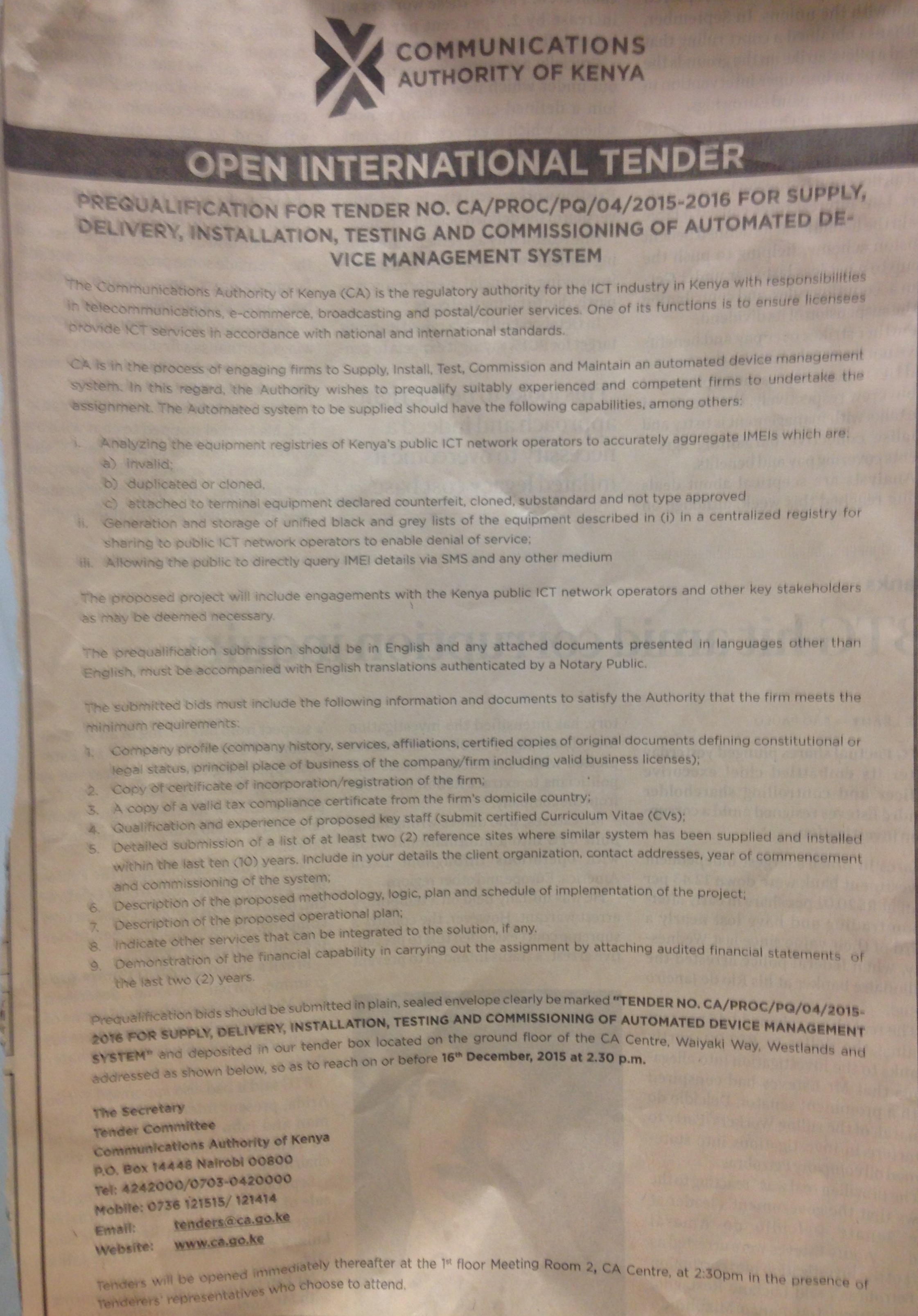
Eagle-eyed readers may have spotted this notice in the Financial Times last week (click to enlarge):

It’s an open international tender by the communications authority of
Kenya inviting bids for the supply, delivery and installation, testing
and commissioning of an automated device management system.
Amongst other things, the system is supposed to accurately register
and aggregate IMEIs (international mobile station equipment identities)
which are invalid, duplicated or cloned or attached to mobile phones
declared counterfeit, cloned, substandard and not type-approved.
The system is also supposed to generate and manage a centralised
register of unified black and grey lists of illegal mobile phones to be
shared with public ICT network operators to help enable denial of
service. Finally, the public is supposed to be able to directly query
the IMEI database via SMS or any other medium.
Why did it catch our eye?
Well, a few weeks ago, we drew attention to research from
October’s FinAccess Geospatial Mapping Survey, which noted amongst other things that:
Mobile money service providers reported the highest instances of fraud at 37 percent as compared to 10 percent of bank agents.
The research also noted that the greatest type of fraud reported
amongst service providers in forex bureaus and mobile money providers
was ‘counterfeit money’.
Keeping all this in mind, back in September 2012 the
BBC reported that
as of the end of that month Kenya was planning to switch-off all
counterfeit mobile phones and ban new “fake” devices from being
activated on networks.
As the communications secretary Dr. Bitange Ndemo stated (our emphasis):
“In this era of mobile banking, use of counterfeit
devices, which are manufactured without due consideration to the
recognised security standards, may expose our mobile money systems as well as the wider banking and financial system to unnecessary risks,” said the communications secretary Dr Bitange Ndemo.
“The government cannot allow this to happen and thus our decision to have all unregistered SIM cards and counterfeit handset mobile phones phased out by 30 September 2012.”
The Kenyan government went ahead with the black-list as threatened.
And yet, by 2013, there was an increase in mobile money fraud as
fraudsters became more sophisticated and innovative at exploiting
loopholes in controls implemented by merchants, banks and consumers.
According to the
2014 Kenyan Cyber Security Report the
most common schemes were fake SMS promotions wherein mobile-money users
are promised a reward after they send money to certain numbers. Other
times, agents were called using fake numbers so that fraudsters could
get access to funds and PIN numbers. There were also insider incidents.
By the 2015
Kenyan Cyber Security report, however, things had got even worse:
Locally, saw a sharp rise in financial fraud within banks
through mobile money, system tampering and mobile network exploitation.
Tyrus Kamau, information security consultant and chair of
AfricaHackOn, added there was now a real concern about the very fast
proliferation of technologies such as NFC, which he said have inherent
vulnerabilities which banks and merchants need to address sooner rather
than later.
Furthermore, as the report also noted, Kenya’s growing adoption of
mobile money had generally opened up new targets for cyber criminals.
Instead of targeting banks, cyber criminals were now routinely targeting
payment systems and mobile money service providers with which to access
bank systems.
Telecommunication service providers in Kenya have, as a result, become key cyber criminal targets.
It’s clear the government is trying to get abreast of the problem.
Needless to say, whether cybercrime, counterfeit mobiles and more pertinently still
fake mobile money supply
is successfully nipped in the bud with the simple roll-out of an
integrated and publicly accessible IMEI blacklisting system (a.k.a. a
type of mobile credit checking system) is another story.
The costs of maintaining an up-to-date system are not small.
Meanwhile, Barclays reports on Tuesday that Kenya’s headline
inflation rose to 7.3 per cent year on year in November from 6.7 per
cent in October as food inflation rose from 11.3 per cent to 12.7 per
cent. Nonfood inflation remained unchanged at 3.6 per cent y/y in
November. They add:
With food prices and FX remaining key threats to the inflation outlook, we expect further policy tightening in early 2016.
Add that to fake money supply, cybercrime on the up
plus a mini banking crisis on the back of
two collapsed Kenyan banks in the last quarter and questions over the
role of auditors in the collapses…
…and well, it’s a tough time for what is considered to be the most sophisticated banking sector in east Africa.
To wit, it’s probably no coincidence that Patrick Njoroge, the new
governor of Kenya’s central bank imposed an indefinite moratorium on new
banking licences last month in order to buy the central bank time to
remove what he called “blind spots” in its supervisory capacity.
As the FT
reports on Tuesday:
“We’re doing a deep cleaning of ourselves,” he said. “I
need to have new people. I need to train them. I don’t want to be
sending them around to various banks with a new portfolio and the guy
has insufficient training.”
The question is, will mobile payments purveyors remain profitable under that new supervisory regime?
Related links:
Kenya central bank head seeks to weed out ‘bad apples’ – FT
What mobile money giveth, it also taketh away – FT Alphaville
Mpesa: the costs of evolving an independent central bank – FT Alphaville
When financial inclusion stands for financial intrusion – FT Alphaville
Mobile Money Fraud Rampant in Kenya - PaymentsAfrika